What Is VAT? UK Rates, Threshold and Rules Explained
Value Added Tax, usually shortened to VAT, is a tax you pay on most goods and services in the United Kingdom. It is added to the price of things you buy, from a sandwich to a sofa, and it is collected by the business that sells them and passed on to HM Revenue and Customs, known as HMRC. The standard rate of VAT is 20 per cent, and it has been 20 per cent since 4 January 2011. Two lower rates also apply: a reduced rate of 5 per cent and a zero rate of 0 per cent, for particular goods and services. This guide explains what VAT is, who pays it, how the three rates work, when a business must register for VAT, and how to read the VAT on a receipt.
What is VAT and who pays it?
VAT is a consumption tax. That means it is a tax on spending, not on earning. Income tax is taken from what you earn; VAT is charged when you spend. When you buy something in a shop, the price you see on the shelf normally already includes VAT. You pay the full price, the shop keeps the price before VAT, and it passes the VAT part to HMRC. The business is the collector, but the customer is the person who bears the cost. That is why VAT is sometimes called an indirect tax: the person who pays it to the government is not the person who ultimately bears it.
VAT applies to most goods and services sold in the UK, but not to everything. Some things are charged at a lower rate, some at 0 per cent, and some are exempt from VAT altogether. The rules are set out in the Value Added Tax Act 1994 and in detailed guidance published by HMRC, and the official lists on GOV.UK set out which rate applies to which goods and services. Because the boundary between the rates can be surprisingly technical, a business that gets the rate wrong can underpay or overpay tax, and a shopper can be surprised to find VAT on something they expected to be VAT-free.
VAT is not unique to the UK. It is used in more than 170 countries around the world, including every member of the European Union. The UK kept VAT after leaving the EU, but it now sets its own rates and rules. The tax raises a very large share of government revenue, second only to income tax, which is one reason the rates and the registration threshold are watched closely every year in the Budget.
The three VAT rates: 20 per cent, 5 per cent and 0 per cent
The standard rate of VAT is 20 per cent, and it applies to most goods and services. If a product or service is not specifically listed as reduced-rated, zero-rated or exempt, the standard rate applies by default. That covers a very wide range of everyday spending: adult clothing, electronics, furniture, restaurant meals, hotel rooms, professional services such as a solicitor or an accountant, and most goods bought online. A £120 item at the standard rate, for example, is made up of £100 for the goods and £20 of VAT. The VAT is one sixth of the price you pay, because the price includes the tax.
The reduced rate is 5 per cent, and it applies to a much shorter list of goods and services where the government has decided to keep the cost down. The most common examples are domestic fuel and power, including gas and electricity supplied to your home, children's car seats, and some energy-saving materials installed in a home, such as insulation. Mobility aids for older people and nicotine replacement products such as patches and gum are also reduced-rated. The reduced rate is set by law, so a business cannot simply choose to charge 5 per cent because it thinks its product is essential; the item must be on the list and must meet the conditions set out in the relevant VAT notice.
The zero rate is 0 per cent. Zero-rated goods and services carry no VAT at all for the customer, but they are still within the VAT system, which matters for businesses, as explained below. The main zero-rated categories are most food and drink for human consumption, children's clothing and footwear, books and newspapers, including their digital equivalents, and public transport. Most food bought in a supermarket is zero-rated, which is why a weekly shop usually carries little or no VAT. There are important exceptions. Hot takeaway food, restaurant meals, confectionery, crisps, ice cream, soft drinks and alcoholic drinks are standard-rated, even though they are food and drink. A cold sandwich bought to take away is generally zero-rated, while the same sandwich eaten in the restaurant is standard-rated, because catering is a standard-rated service.
Zero-rated is not the same as exempt
One of the most confusing parts of VAT is the difference between zero-rated and exempt. Both mean the customer pays no VAT, but they have very different consequences for the business. A zero-rated sale is still a taxable supply, just taxed at 0 per cent. That means it counts towards the business's taxable turnover for registration purposes, and the business can reclaim the VAT it paid on its own costs, such as raw materials, rent and equipment. A shop that sells mostly zero-rated food, for example, can still reclaim the VAT on its shop fittings and its delivery vans.
An exempt supply, by contrast, sits outside the VAT system entirely. No VAT is charged, the sale does not count towards the registration threshold, and the business cannot reclaim the VAT it paid on related costs. Common exempt supplies include most financial services, insurance, some education and training, some health services, and postage stamps. Property transactions are also largely exempt, with some exceptions. A business that makes only exempt supplies does not need to register for VAT at all, and it cannot reclaim VAT on its purchases, which becomes a cost it has to absorb or pass on in its prices.
That distinction is why accountants take care over the classification. A business that wrongly treats an exempt sale as zero-rated could claim back VAT it is not entitled to, while a business that wrongly treats a zero-rated sale as exempt could lose the right to reclaim VAT and could fall below the registration threshold when it should be registered. When in doubt, the official position is set out in HMRC's VAT notices, and GOV.UK's guide to VAT rates on different goods and services lists the rate for hundreds of categories.
When must a business register for VAT?
A business must register for VAT once its taxable turnover goes over £90,000 in any rolling 12-month period. That threshold has been £90,000 since 1 April 2024, when it rose from £85,000, and it was confirmed unchanged in the Budget in October 2026. Taxable turnover means the total value of everything the business sells that is not exempt and not outside the scope of VAT, including zero-rated sales. It is turnover, not profit. A business with £95,000 of sales and £90,000 of costs has still gone over the threshold, even though its profit is only £5,000.
There are two tests. The first looks backwards: if taxable turnover in the last 12 months has gone over £90,000, the business must register. The second looks forwards: if the business expects its taxable turnover to go over £90,000 in the next 30 days alone, for example because it has just won a large contract, it must register as well. Registration must be completed within 30 days of the end of the month in which the threshold was crossed. A business that crosses the threshold at the end of March, for example, has until 30 April to register. Late registration can lead to a penalty, based on the VAT owed.
A business can also register voluntarily below the threshold, and many do. A small business that sells mainly to other VAT-registered businesses may want to register so that it can reclaim the VAT on its own purchases, even though it does not have to charge VAT yet. Registration also makes a business look more established to some customers, although it also means charging VAT on sales and filing VAT returns, which adds administration. A business can deregister if its taxable turnover falls below the deregistration threshold of £88,000, although it must apply to HMRC to do so. Once registered, a business must charge VAT on its taxable sales, keep VAT records, and submit VAT returns to HMRC, usually every three months, under the Making Tax Digital rules, which require digital records and filing through compatible software.
How VAT works in practice for a business
For a registered business, VAT works as a chain. The business charges VAT on what it sells, which is called output tax, and it pays VAT on what it buys, which is called input tax. Every three months, or in some cases every month or every year under a special scheme, it submits a VAT return to HMRC and pays over the difference. If it charged more VAT than it paid, it pays the difference to HMRC. If it paid more VAT than it charged, for example because it bought a large piece of equipment, it can reclaim the difference from HMRC.
That is why a VAT-registered business does not really bear the cost of the VAT on its purchases, as long as its own sales are taxable. The tax is passed along the chain until it reaches the final consumer, who cannot reclaim it. An exempt business breaks the chain, because it cannot reclaim the VAT on its purchases, and that VAT becomes a real cost. That is one reason financial services and insurance are often described as bearing a hidden VAT cost, even though the customer sees no VAT on the bill.
Small businesses can also use special VAT schemes to simplify the administration. The Flat Rate Scheme, for example, lets a small business pay VAT as a fixed percentage of its turnover, rather than working out the VAT on every sale and purchase, although it can no longer reclaim VAT on most purchases. The Cash Accounting Scheme lets a business account for VAT when it is paid rather than when it invoices, which helps cash flow. The Annual Accounting Scheme lets a business file one return a year instead of four. Which scheme suits a business depends on its turnover, its customers and its costs, and HMRC publishes guidance on each of them.
VAT on your shopping and your receipt
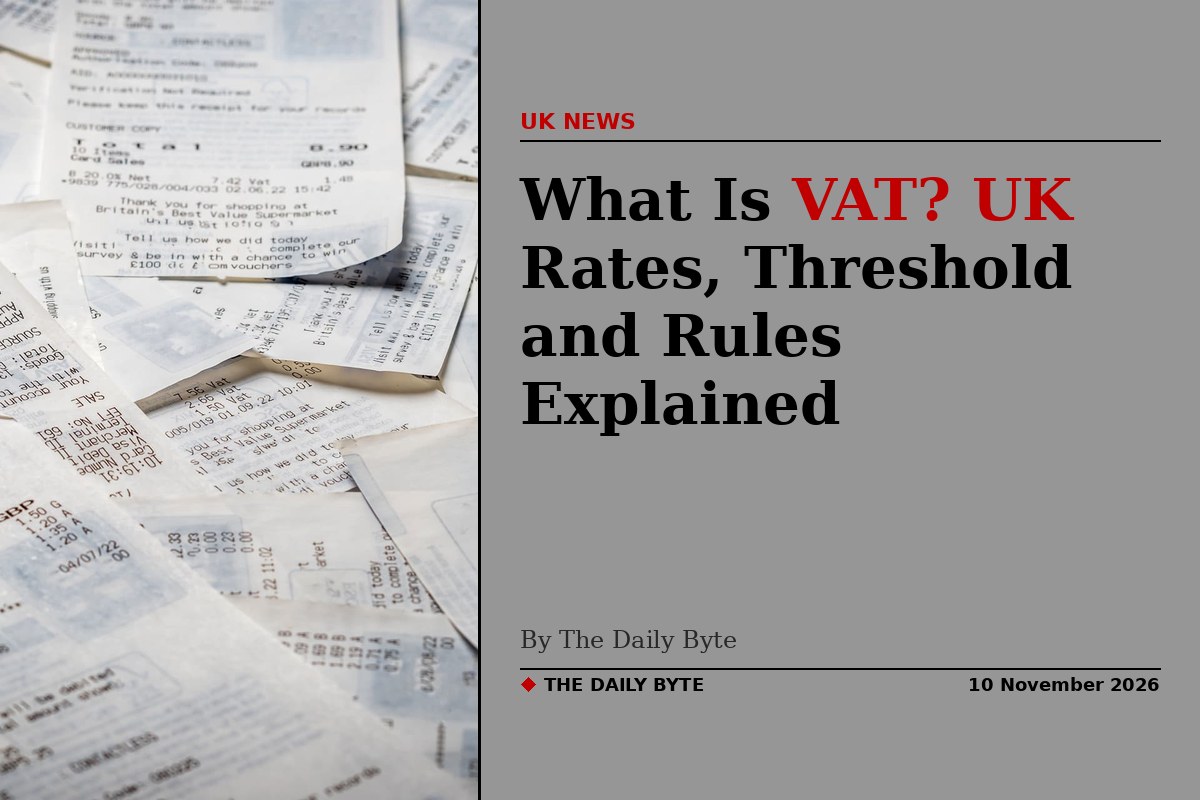
For shoppers, the most visible sign of VAT is the receipt. Most UK prices are shown inclusive of VAT, so the price on the shelf is the price you pay at the till, and the VAT is already inside it. That is different from some other countries, where sales tax is added at the till. A shop receipt often breaks the total down by VAT rate, showing how much of the bill was standard-rated, how much was zero-rated, and how much VAT was charged in total. A supermarket receipt, for example, may show that the food was zero-rated and only the wine, the cleaning products and the hot food carried VAT.
There are a few places where VAT is more visible. If you buy goods from a business that is not VAT-registered, it will not charge you VAT, and its prices may be lower as a result, although it also cannot reclaim the VAT on its own costs. If you are a business customer buying from a VAT-registered supplier, you will usually be given a VAT invoice showing the VAT separately, so that you can reclaim it if you are registered yourself. If you buy goods to take abroad, some shops offer a VAT refund scheme for overseas visitors, although the rules for that changed after the UK left the EU, and the details should be checked with the retailer or on GOV.UK before you travel.
It is also worth knowing that not every charge that looks like a tax is VAT. Some bills include other taxes and levies, such as Insurance Premium Tax on an insurance policy, or Air Passenger Duty on a flight. Those are separate taxes with their own rules, and they are not VAT, even though they appear on the same bill. If a charge is described as VAT, it should be at 20 per cent, 5 per cent or 0 per cent, and the business should be able to explain which rate applies and why.
Common questions about VAT
One question people often ask is whether they have to pay VAT on second-hand goods. The answer is usually yes, if the seller is VAT-registered and the goods are standard-rated, although there are special schemes for second-hand goods, works of art and antiques that let dealers charge VAT only on their profit margin rather than on the full price. Another common question is whether VAT applies to services bought online from abroad. In many cases it does, and the supplier or the online marketplace is responsible for collecting it, which is why the price you pay on a large overseas platform often already includes UK VAT.
People also ask whether VAT rates ever change. They do, although the standard rate has been stable at 20 per cent since 2011. Governments use VAT rates as a policy tool: they have temporarily cut VAT on hospitality and tourism in the past, and they have changed the rate on energy-saving materials and on domestic energy from time to time. That is why any guide to VAT, including this one, is a snapshot. The rates and thresholds in this article reflect the position in November 2026, and anyone making a business decision should check the current guidance on GOV.UK, where HMRC publishes the up-to-date rates and notices.
Finally, it is worth remembering what VAT is not. It is not a tax on profit, it is not the same as income tax or corporation tax, and it is not charged on everything. It is a tax on spending, collected by businesses and paid by consumers, with three rates and a registration threshold that decides which businesses must join the system. Once you know the three rates, the £90,000 threshold and the difference between zero-rated and exempt, most of the confusion around VAT falls away, and the line on a receipt that once looked like a mystery starts to make sense.
Frequently asked questions
What is VAT? VAT is Value Added Tax, a tax charged on most goods and services sold in the UK. The customer pays it as part of the price, the business collects it, and the business passes it to HMRC.
What are the UK VAT rates? The standard rate is 20 per cent on most goods and services, the reduced rate is 5 per cent on items such as domestic fuel and children's car seats, and the zero rate is 0 per cent on items such as most food, children's clothing and books.
When must a business register for VAT? A business must register when its taxable turnover goes over £90,000 in any rolling 12 months, or when it expects to go over £90,000 in the next 30 days. The threshold has been £90,000 since 1 April 2024.
What is the difference between zero-rated and exempt? Zero-rated sales are taxed at 0 per cent but still count towards the £90,000 threshold, and the business can reclaim VAT on its costs. Exempt sales sit outside the VAT system, do not count towards the threshold, and the business cannot reclaim VAT on related costs.
Is VAT included in the price I see in a shop? Usually, yes. UK prices are normally shown inclusive of VAT, so the price on the shelf is the price you pay at the till. The receipt often shows how much of the total was VAT.
Sources: GOV.UK, VAT rates on different goods and services and VAT Calculator, Current UK VAT Rate. Rates and thresholds reflect the position in November 2026; check GOV.UK for the latest guidance.