What Was Huawei Convicted Of in the US Trial?
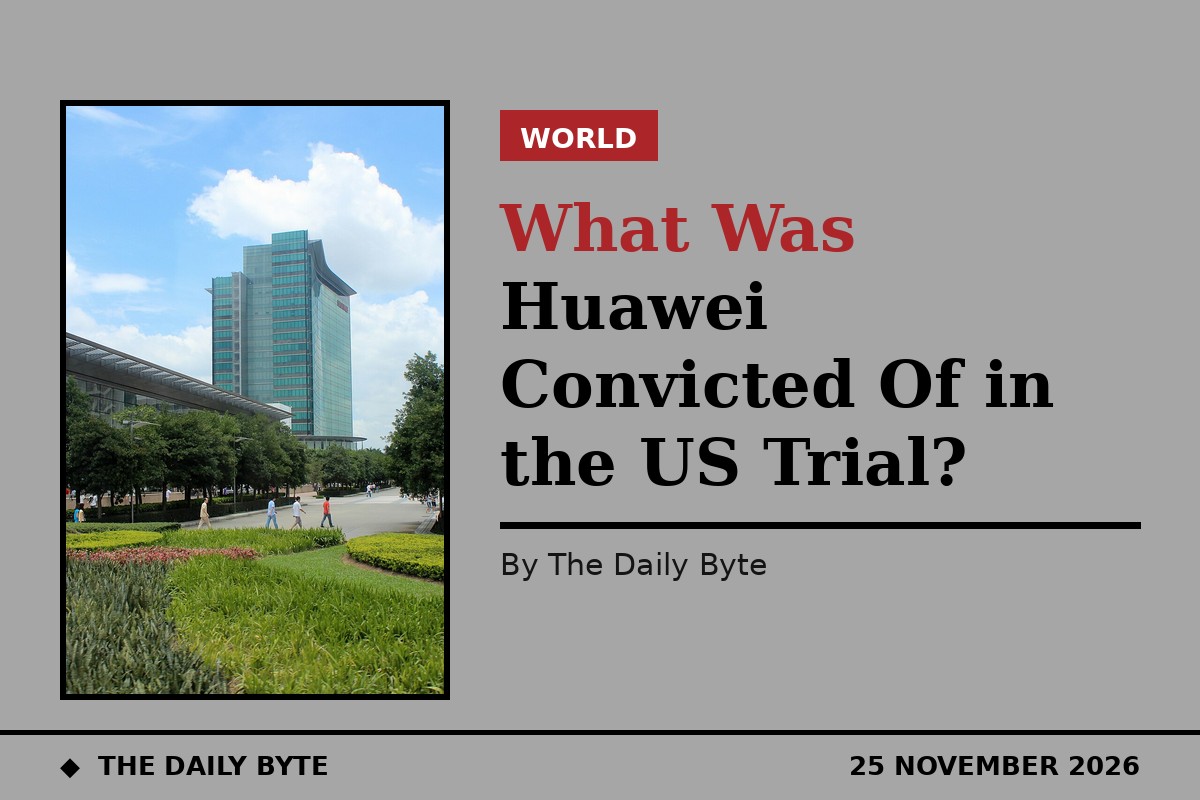
A federal jury in Brooklyn, New York, found the Chinese technology company Huawei guilty on 10 of the 12 criminal counts it faced, in a verdict delivered on Tuesday 24 November 2026. The jury convicted Huawei of bank fraud, wire fraud, conspiring to steal trade secrets from American companies and violating United States sanctions on Iran, but acquitted the company of the two most sweeping charges against it: racketeering conspiracy and conspiracy to obstruct justice. Sentencing has been set for 14 September 2027, when the company faces financial penalties rather than prison, because a company cannot be jailed.
The verdict ended a criminal case that began in 2018 and a trial that lasted more than two months, with prosecutors calling more than 60 witnesses and the defence calling 15. It is the most serious criminal judgment ever delivered against Huawei in the United States, and it closes the central chapter of a prosecution that has shaped the technology rivalry between Washington and Beijing for eight years. Huawei has said it plans to appeal, so the verdict is not yet the final word.
What exactly was Huawei found guilty of?
Huawei Technologies and three affiliated companies faced 12 counts. The jury found Huawei Technologies guilty on counts 2 to 11 and not guilty on counts 1 and 12. The three affiliates — Huawei Device Co. Ltd., Futurewei Technologies Inc. and Huawei Device USA Inc. — were each found guilty on two conspiracy counts. The counts of conviction, as listed by the United States Department of Justice, were conspiracy to steal trade secrets; conspiracy to commit wire fraud and bank fraud; wire fraud; bank fraud; conspiracy to defraud the United States; conspiracy to violate the International Emergency Economic Powers Act, the law under which the Iran sanctions were imposed; substantive violations of that Act; and conspiracy to commit money laundering.
Guilty: conspiracy to steal trade secrets; conspiracy to commit wire and bank fraud; wire fraud; bank fraud; conspiracy to defraud the United States; conspiracy to violate the International Emergency Economic Powers Act; substantive sanctions violations; and money-laundering conspiracy.
Not guilty: racketeering conspiracy, the charge that Huawei operated as a criminal enterprise; and conspiracy to obstruct justice.
The split matters. Prosecutors presented the case as a single twenty-year criminal conspiracy in which Huawei stole technology, lied to banks and evaded sanctions as a matter of company policy. The jury accepted most of the individual allegations but rejected the claim that the conduct added up to a racketeering enterprise, and rejected the claim that Huawei conspired to obstruct justice. Huawei called the remaining charges without merit and said it would challenge the convictions.
What did prosecutors say Huawei did in Iran?
The Iran part of the case was the oldest. The 2018 indictment alleged that Huawei misled the banks HSBC, Standard Chartered and BNP Paribas about its business in Iran, so that money could be moved in and out of the country in violation of United States sanctions. Prosecutors said Huawei concealed its control over a company called Skycom Tech Co., which operated in Iran, and presented Skycom to the banks as an independent business partner rather than a Huawei-controlled operation.
The case first became public in December 2018, when Meng Wanzhou, Huawei's chief financial officer and the daughter of the company's founder, was detained in Canada on a United States warrant. She had been secretly indicted for allegedly misleading an HSBC banker about Huawei's business in Iran. She fought extradition for nearly three years before entering a deferred prosecution agreement and flying home to China. The charges against her were later dropped, and she did not testify at the Huawei trial, although the HSBC banker she met in 2013 did.
Prosecutors gave jurors a statement attached to Meng's deferred prosecution agreement in which she acknowledged that the company had illegally conducted business in Iran. The defence argued that the banks knew about Huawei's Iranian operations and were competing for its business, and that the transactions were ordinary banking rather than fraud.
What trade secrets was Huawei accused of stealing?
Prosecutors added the trade-secret charges in 2020, extending the case to alleged conduct over two decades. They told jurors that Huawei stole source code from the American networking company Cisco Systems for use in its own routers, and that Huawei engineers copied the code so closely that they reproduced Cisco's name spelled backwards, as “ocsic”, inside it. They also accused Huawei of stealing antenna technology from the wireless company Quintel, and of hiring a professor to gain access to a circuit board developed by the semiconductor company CNEX.
Other episodes presented at trial included the T-Mobile testing robot known as Tappy. Prosecutors showed jurors video that they said showed a Huawei employee slipping a piece of the smartphone-testing robot into his backpack after gaining access to a T-Mobile laboratory, and told them about a Huawei engineer who entered a Fujitsu booth at a trade show to photograph a device. Huawei's lawyers argued that prosecutors had cherry-picked a handful of unrelated incidents to support a claim of a twenty-year conspiracy, and that some of the material in question was publicly available and did not qualify as a trade secret. They said Huawei had succeeded through hard work, innovation and investment in research and development.
How did the case reach a Brooklyn courtroom?
The criminal case began with the indictment unsealed in January 2019, a month after Meng's detention in Canada. In 2019 the United States government also placed Huawei on a trade blacklist that restricted its access to American technology, a separate administrative step from the criminal prosecution. The case then moved slowly through the courts for years, with the trial finally opening in the Eastern District of New York in the autumn of 2026 before United States District Judge Ann Donnelly.
The trial lasted more than two months. Prosecutors called more than 60 witnesses; the defence called 15. The jury began deliberating on Wednesday 18 November 2026 and returned its verdict on Tuesday 24 November. Reporting of the trial drew on Reuters investigations from 2012 and 2013 that first exposed Huawei's activities in Iran, which prosecutors discussed during the proceedings.
What happens next?
Sentencing is scheduled for 14 September 2027. Because the defendants are companies, the penalties available to the court are financial: criminal fines, forfeiture and restitution. No individual was on trial, and no one will go to prison as a result of this verdict. Huawei has said it plans to appeal, and its lawyers are expected to challenge the convictions before sentencing and after it.
An appeal would revisit the convictions themselves, including whether the evidence supported the fraud and trade-secret counts and whether the trial was conducted fairly. Until any appeal is decided, the verdict stands as the jury delivered it, but it is not yet final in the legal sense. The acquittals on racketeering and obstruction, by contrast, are final: prosecutors cannot retry Huawei on those two counts.
Why does the verdict matter beyond Huawei?
Huawei is one of China's most important international companies, with more than 200,000 employees and operations in about 170 countries, according to Reuters. United States authorities have warned for years, starting under the Obama administration, that the company's expansion posed national security risks, and the company sits at the centre of the wider competition between Washington and Beijing over telecommunications, semiconductors and artificial intelligence.
Experts quoted by Reuters noted that the case has not undermined Huawei's business in practice: the company diversified after the 2019 blacklisting and has emerged as a central player in China's push for artificial intelligence. The verdict therefore changes Huawei's legal position in the United States without obviously changing its commercial position in China or in the many countries where it continues to operate. What it does settle, for now, is the factual question at the heart of the prosecution: a jury found that Huawei deceived banks about Iran and conspired to steal American trade secrets, while rejecting the prosecution's broadest claim that the company was run as a criminal enterprise.
Sources: Reuters, “China's Huawei convicted in US in sprawling criminal trial over Iran business”, 24 November 2026; CNN, “US court convicts China's Huawei for fraud, conspiring to steal trade secrets”, 24 November 2026.


