White House seeks $30.1bn to rebuild US aviation
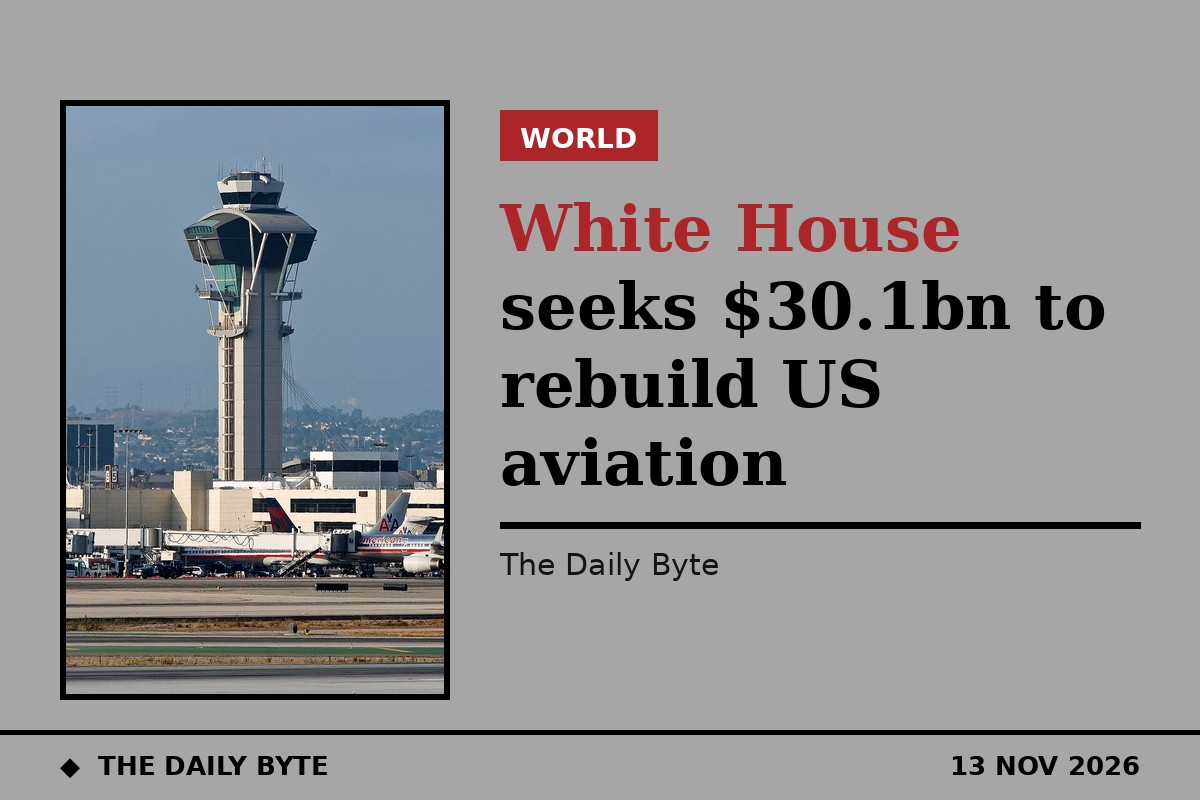
The White House and the US Department of Transportation have asked Congress to approve a further $30.1 billion to upgrade the country's ageing airports and air traffic control system, in a request sent to lawmakers on Friday.
The appeal comes after a series of incidents that have exposed the age of the equipment guiding American airspace. In January 2025, a midair collision at Ronald Reagan Washington National Airport killed 67 people, and in September this year failures at air traffic facilities in the north-east delayed or cancelled thousands of flights.
Congress has already approved $12.5 billion over five years, agreed in July 2025, to upgrade air traffic control and recruit more controllers. The new request would go further, covering control towers, computer systems and airport terminals.
What the $30.1 billion would pay for
The request was made by White House budget director Russell Vought and Transportation Secretary Sean Duffy. Of the total, $10.1 billion is earmarked for air traffic control modernisation, including $7.2 billion for a common automation platform and new controller workstations, and $2 billion for cloud computing.
A further $2 billion would replace and improve Federal Aviation Administration control towers, while $18 billion would go to airport projects, including $10 billion to modernise or replace ageing terminals.
In their letter to lawmakers, Vought and Duffy said the investment was critical to completing the modernisation of the national airspace, delivering a resilient telecommunications backbone for controllers, modern hardware and software, new control towers and improved airport infrastructure.
Major airlines including American Airlines, Delta Air Lines, United Airlines and Southwest Airlines have expressed support for the request.
Decades-old systems still in use
The Federal Aviation Administration still relies on computers that are decades old, and in some cases on replacement parts bought through auction websites. Last week the agency said it would replace, by the end of 2028, the floppy disks still used for weather and other information at more than 400 air traffic control facilities.
Progress has been made on the communications network: Vought and Duffy said in their letter that the FAA has replaced 68 percent of its legacy copper telecommunications network with high-speed fibre infrastructure.
In September, two separate failures showed how fragile the system remains. A circuit failed at a Philadelphia air traffic facility, and a construction crew in New Jersey accidentally severed a fibre-optic cable. Together, the incidents delayed or cancelled thousands of flights across the densely populated north-east of the country.
The Government Accountability Office warned in September that the FAA needed better cost and schedule planning for its modernisation programme. Senator Eric Schmitt, a Missouri Republican, introduced the Modern Skies Act in September to push the overhaul forward.
Congress asked to act before January
The administration has called on the Republican-led Congress to approve the funding in the final weeks of the year. Democrats are set to take control of Congress in January, so the White House is pressing for a decision before the changeover.
Approval is not guaranteed. Lawmakers would still have to agree the funding, including how much should go to the Federal Aviation Administration and how much should support airport projects. But with airlines backing the plan and recent failures fresh in the public mind, the request puts the state of American aviation firmly on the agenda for the final weeks of the current Congress.


