WHO Keeps Congo Ebola Emergency as Cases Hit 11,613
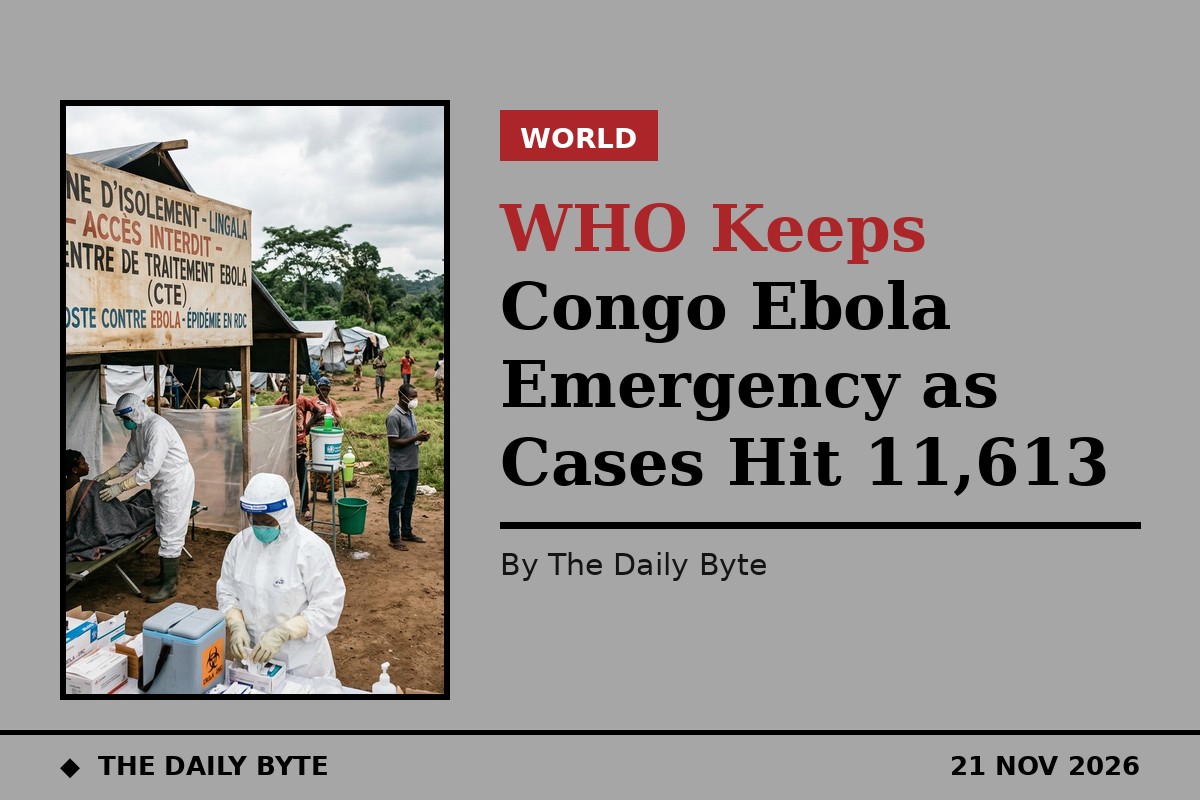
The World Health Organization has kept the Ebola outbreak in the Democratic Republic of the Congo at the highest level of global alert, as confirmed cases climbed to 11,613 with 5,678 deaths.
WHO Director-General Tedros Adhanom Ghebreyesus decided on 18 November that the outbreak continues to constitute a public health emergency of international concern, following the advice of the International Health Regulations Emergency Committee at its third meeting on the epidemic the day before. The decision came in a Disease Outbreak News update published on 20 November, which put the toll as of 17 November at 11,613 confirmed cases and 5,678 deaths across 68 health zones in eight provinces, a crude case fatality ratio of 48.9 per cent.
The figures mark a further rise since the previous update on 6 November, with 945 more cases and 480 more deaths in the intervening period. In the last 21 days covered by the update, 1,417 new confirmed cases were recorded. Ituri accounted for 668 of them, down 13 per cent on the previous 21-day period, while Nord Kivu recorded 635, up 8 per cent, and Haut-Uélé 90, up 13 per cent. Tshopo reported 20 cases and Nord-Ubangi four. Active transmission continues in 48 of the 68 affected zones, and 3,148 people have recovered.
Ituri remains the hardest-hit province since the outbreak was declared on 15 May, with 7,946 cases and 3,751 deaths. Nord Kivu follows with 2,996 cases and 1,654 deaths, and continues to record the highest provincial fatality ratio, at 55 per cent. Haut-Uélé has reported 534 cases and 231 deaths, while Tshopo has recorded 109 cases and 35 deaths.
Children are dying at the highest rate
Children are paying the heaviest price. There have been 1,207 confirmed cases among children under five, and 844 of them have died, roughly seven in ten, according to Congolese health ministry and WHO data reported by Reuters. That is higher than the adult fatality rate of around 50 per cent.
The high share of deaths happening outside treatment centres underlines the difficulty of finding cases early. Of the 720 deaths reported since 28 October, 452 occurred in communities and 268 in treatment centres. WHO said the pattern, especially among young children, continues to highlight challenges in early case detection and timely access to care.
Contact tracing is also falling short. As of 17 November, an average of 81 per cent of identified contacts were seen daily over the previous 14 days, below the required threshold of 95 per cent. Only two provinces, Bas-Uélé and Nord-Ubangi, were at or above the target.
No approved vaccine for this strain
The outbreak is caused by Bundibugyo virus, a distinct Ebola virus species for which there is no approved vaccine or specific treatment. Early symptoms such as fever, fatigue, muscle pain, headache and a sore throat are non-specific, which complicates diagnosis, and bleeding occurs in only around 5 to 10 per cent of confirmed cases, according to WHO and Africa CDC officials quoted by Reuters.
WHO has approved trials of two new vaccines, with results due in early 2027. Scientists told Reuters that the Bundibugyo virus is spreading at double the pace of the 2014 to 2016 West Africa epidemic, the largest Ebola outbreak on record, and that more than 11,000 cases and over 5,500 deaths have now been recorded. Six months after it was declared, the outbreak in the Democratic Republic of the Congo is already the largest Ebola outbreak ever recorded in the country, whatever the virus species, and the second-largest on record anywhere.
Response under strain as funding lags
Africa CDC said the outbreak is still not under control. Its director-general, Jean Kaseya, told Reuters that if it is not stopped now, it could become the worst Ebola outbreak the world has seen. The agency counts 400 to 500 new cases a week, and says most new cases are coming from outside known contact lists.
Money is also short. Only $1.3 billion of $2.9 billion pledged for the response has been released, which Kaseya described as a collective failure. WHO said rising insecurity remains the greatest obstacle to expanding operations, alongside displacement and a fragile health system, and that the next phase must prioritise quality, reach and community trust alongside sustained funding, coordination and security.
There was better news elsewhere in the region. Kenya has reported nine cumulative cases, including two deaths, with no new case since 19 October, and its last patient was discharged on 11 November. Nigeria reported a single imported case, which was medically evacuated to Switzerland and discharged on 11 November after two negative tests. Both countries have begun a 42-day countdown to declaring the end of their outbreaks, while maintaining heightened surveillance at points of entry. Updated WHO recommendations will follow in the coming days.


