WHO Pledges $1m for Haiti's Last Major Hospital
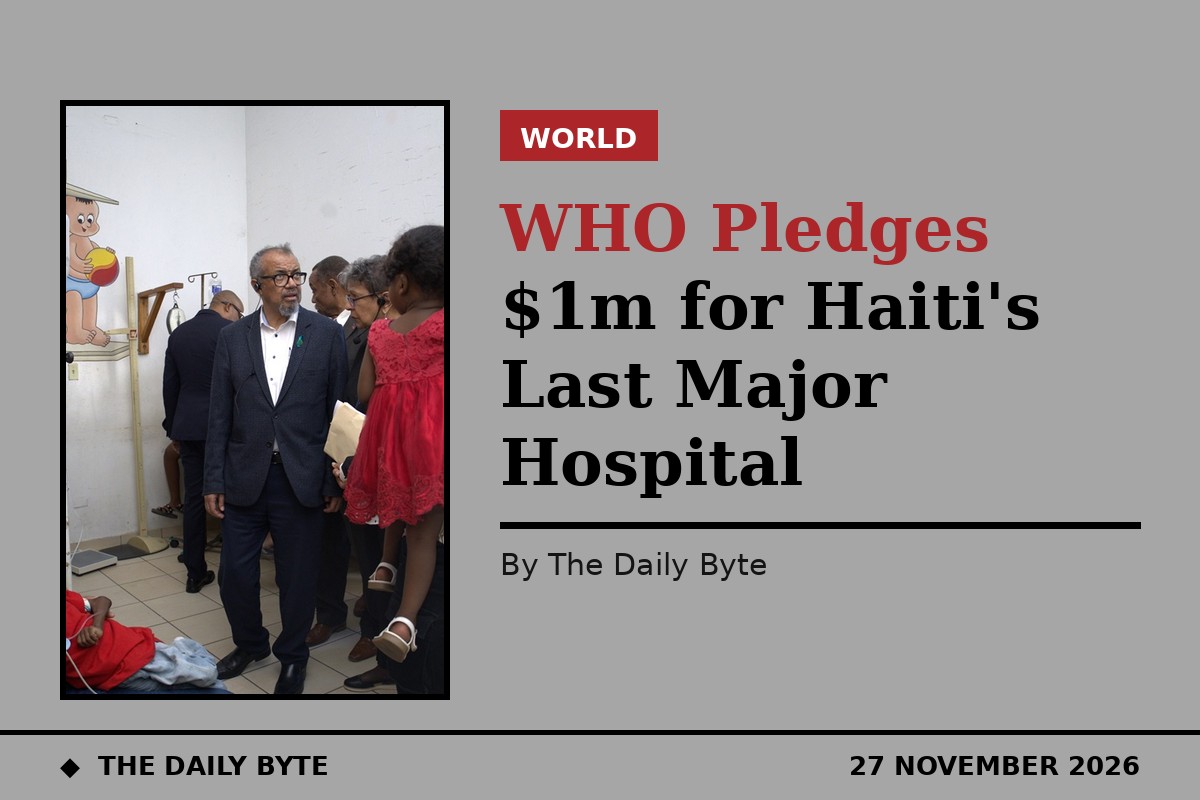
The World Health Organization has pledged US$1 million for critical medical equipment at Haiti's last major public hospital still operating in Port-au-Prince, as armed violence and mass displacement push the country's health system to breaking point.
WHO Director-General Dr Tedros Adhanom Ghebreyesus announced the funding on Thursday 26 November during a visit to Haiti. The money will pay for a computed tomography (CT) scanner and equipment for four operating rooms at Hopital Universitaire La Paix, known as HUP, in the capital.
HUP is the last major public referral hospital still functioning in Port-au-Prince, a city where almost half of health facilities, 49.5 per cent, are no longer working and only 12 per cent are partially operational. Across Haiti, a country of more than 11 million people, almost a quarter of health facilities are not functioning and close to half are operating only partially.
A health system under severe strain
Armed violence continues to disrupt access to health care across Haiti, forcing facilities to close, displacing communities and interrupting medical supply chains. About 1.5 million people have been displaced, and an estimated 4.9 million people need health assistance in 2026, according to the WHO.
"Haiti's health system is under immense strain due to the overwhelming volume of patients and influx of trauma cases," Dr Tedros said. "I visited Hopital Universitaire La Paix and saw firsthand the demands facing the facility and its staff. I also witnessed the resilience, courage and dedication of Haiti's health workers amid the very challenging circumstances in which they are working."
During the visit, Dr Tedros met Prime Minister Alix Didier Fils-Aime and Minister of Public Health and Population Dr Bertrand Sinal to discuss priorities for strengthening the health system. He also met United Nations partners working in the country.
The hospital's workload
Since January 2026, with support from WHO and its regional office, the Pan American Health Organization, HUP has treated more than 19,575 emergency patients, including 291 victims of gunshot wounds. It has performed 3,086 surgeries and handled 1,442 high-risk deliveries in that time.
The WHO described the hospital as a lifeline for people in Port-au-Prince with nowhere else to go for urgent medical care. The new scanner and operating theatre equipment are intended to strengthen emergency diagnostics, surgery and critical care at the facility.
Haiti's health minister said the visit was the first by a WHO director-general to Haiti in 24 years. The minister also announced that part of the General Hospital complex in Port-au-Prince, closed for almost three years after a gang attack, would partly resume activities on 2 December.
More than $30m mobilised
In the last two years, WHO and PAHO have mobilised more than US$30 million to support Haiti's health response, the WHO said. The funding has helped sustain lifesaving care at key facilities, substantially reduce cholera transmission and maintain essential health services for vulnerable communities, with efforts continuing to raise more.
Dr Tedros said WHO and PAHO would continue to support the government and people of Haiti to sustain and expand access to essential health services, strengthen the health system and improve disease surveillance and outbreak response. "But Haiti's people and health workers need sustained international solidarity and support," he said.


