Why Are the Kennedys Trying to Block Trump's Arch?
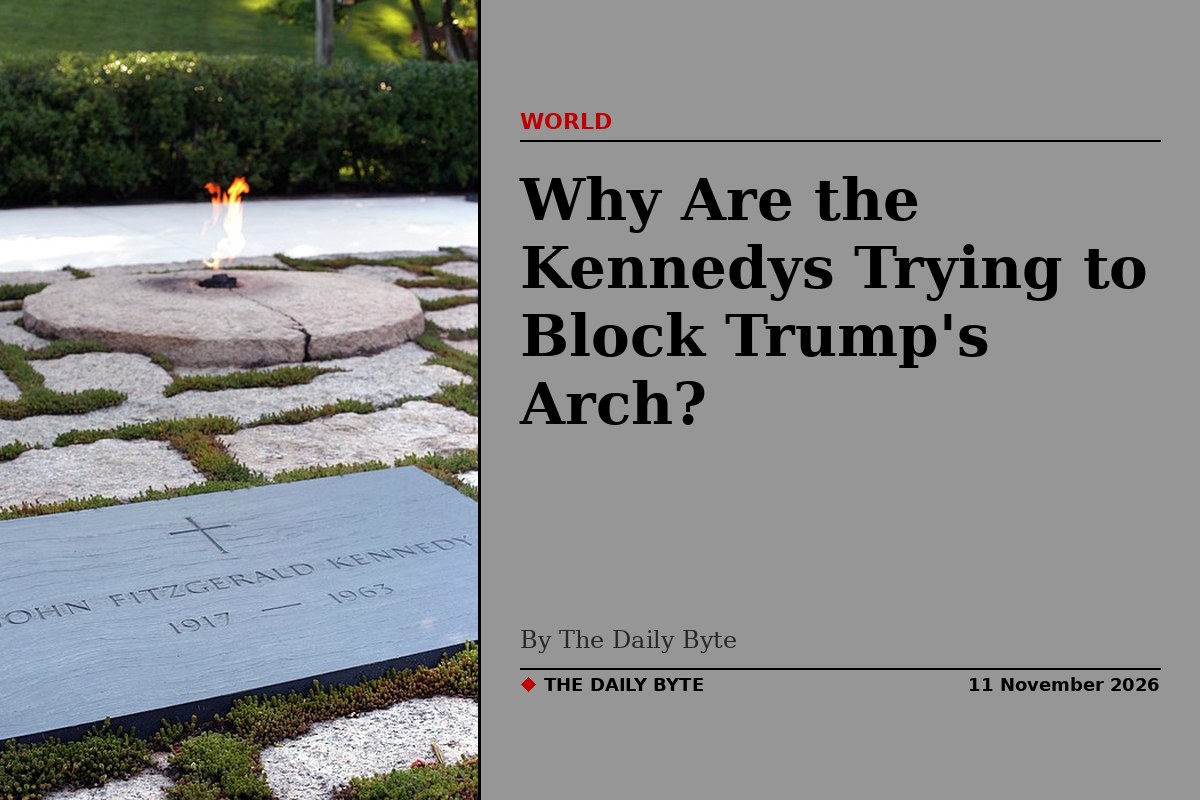
Nine members of the Kennedy family have gone to court to stop President Donald Trump building a 250-foot triumphal arch near Arlington National Cemetery, arguing it would cast a shadow over the graves of their relatives and damage one of America's most revered memorial sites. The family filed a motion on Tuesday 10 November 2026 to join two existing federal lawsuits against the project, in the latest legal challenge to a monument that has already been paused by a judge.
The arch, which Trump calls the Independence Arch, is planned for Memorial Circle, a traffic circle across the Potomac River from the Lincoln Memorial. Here is what the arch is, who is suing, what each side argues and what happens next.
What is Trump's arch?
The arch is a proposed 250-foot (76-metre) triumphal arch, modelled on the Arc de Triomphe in Paris, that would stand in Memorial Circle, next to the entrance to Arlington National Cemetery and across the river from the Lincoln Memorial in Washington, DC. Renderings show it topped by a 60-foot gold winged female figure holding a flame, flanked by gold flying eagles, in a mass of gold ornamentation and grey granite.
The White House says the arch is being built to mark the 250th anniversary of the United States in 2026, and it unveiled a website last week to showcase the design. The family says the structure would be more than double the size of the Lincoln Memorial and the equivalent of a 25-storey office building.
The project has moved quickly. The National Capital Planning Commission approved it by eight votes to four last Thursday, and the administration authorised construction at the Memorial Circle site on 5 November. But a federal judge then blocked any construction work for 14 days, and the project now faces four separate legal challenges.
Who are the Kennedys suing?
The nine plaintiffs are children and grandchildren of former Senators Robert F. Kennedy and Edward M. Kennedy, the brothers of President John F. Kennedy. They include Rory Kennedy and Maxwell Kennedy, the children of Robert F. Kennedy and Ethel Kennedy, as well as Christopher Kennedy, Kerry Kennedy, Courtney Kennedy, Kathleen Kennedy Townsend, Joseph Kennedy II, Joseph Kennedy III and Edward Kennedy Jr.
Six members of the Kennedy family are buried at Arlington National Cemetery: President John F. Kennedy, First Lady Jacqueline Kennedy Onassis, Senator Robert F. Kennedy and his wife Ethel Kennedy, Senator Edward M. Kennedy, and Lieutenant Joseph P. Kennedy Jr. The family says it has a particular right to challenge the arch because courts have in the past recognised families' interests in protecting their relatives' gravesites.
The family is represented by veteran Washington lawyer Norm Eisen and Steve Jonas, of the Democracy Defenders Fund, a legal advocacy group. One prominent Kennedy did not join the case: Robert F. Kennedy Jr., the health and human services secretary in the Trump administration, who has a fractured relationship with many of his relatives.
Why do the Kennedys want the arch blocked?
The family's central argument is about the setting of the graves. In their filing, they say the arch 'will permanently cast shadows over and damage historically significant sight lines to the existing grave sites and memorials established in the Kennedy family's honor at Arlington National Cemetery, as well as to the memorials of hundreds of thousands of fallen American heroes'.
Specifically, they say the arch would obstruct the clear sightline to the Kennedy gravesites, including the Eternal Flame at President John F. Kennedy's grave, as seen from the Arlington Memorial Bridge, 'destroying an essential element' of the gravesite's design. They also say it would block the view between the Lincoln Memorial and Arlington House, two landmarks that were designed to face one another as a symbol of national reunification after the Civil War, a line of sight that has existed for nearly a century.
The family also makes a legal argument: that the National Park Service and the Department of the Interior authorised construction without the congressional approval the law requires. 'We believe Donald Trump has violated the laws and procedures established by Congress to protect this most sacred national memorial,' Rory Kennedy and Maxwell Kennedy said in a joint statement. Their lawyers called the arch 'an illegal interference with Arlington National Cemetery and the heroes remembered there'.
What does the Trump administration say?
The administration contends that Congress approved the arch more than 100 years ago, when it authorised construction of a bridge across the Potomac River. That is the argument it has used to say no fresh approval is needed.
The White House has not responded in detail to the Kennedy filing, and did not immediately respond to a request for comment from Reuters. The Justice Department has said construction of the arch would not be completed until after the end of Trump's second term, a timetable that places its finish beyond his presidency.
Supporters of the project present it as a monument to the 250th anniversary of American independence. Opponents, including veterans and preservationists, say its scale and gilded design are out of keeping with the solemn character of the cemetery and the memorial landscape around it.
What has the court done so far?
US District Judge Tanya Chutkan, who is overseeing one of the lawsuits, last week prohibited the Trump administration from carrying out construction-related activity near the proposed site for 14 days. The order, made on 6 November, runs through 19 November while she considers whether to issue a preliminary injunction, a longer court order that would keep building paused while the cases are decided.
The Kennedys filed a motion to intervene in two existing lawsuits, meaning they asked the judge to let them join cases that were already under way, rather than starting a new one. They also filed a complaint of their own, asking the court to block the project and to set aside the authorisation that allowed it to go ahead.
Who else has sued over the arch?
The Kennedy case is the fourth legal challenge to the arch. Three veterans and an architectural historian were the first to sue the Trump administration over the project, in February. The District of Columbia and Virginia then filed a separate lawsuit late in October, and Arlington County has also sued.
The governments' cases raise similar arguments about congressional approval and the effect of the arch on the protected memorial landscape. The Kennedy filing adds a personal dimension, focusing on the family's gravesites and the experience of visiting them.
What happens next?
The immediate question is whether Judge Chutkan grants a preliminary injunction, which would keep construction paused for months while the lawsuits are heard. If she refuses, the administration could begin work at Memorial Circle, although further appeals would be likely.
The politics may matter as much as the courts. Numerous Democrats in Congress have vowed to block construction once they take control in January, after winning November's midterm elections. For now, the arch remains a rendering and a website, not a building site — and the Kennedy family's intervention has made it one of the most closely watched legal fights in Washington.
| Feature | Detail |
|---|---|
| Height | 250 feet (76 metres) |
| Design | Triumphal arch modelled on the Arc de Triomphe, topped by a 60-foot gold winged figure holding a flame, flanked by gold eagles |
| Location | Memorial Circle, across the Potomac River from the Lincoln Memorial, next to Arlington National Cemetery |
| Purpose | Marking the 250th anniversary of the United States |
| Status | Construction paused by court order until 19 November 2026; four lawsuits pending |
| Kennedy plaintiffs | Nine children and grandchildren of Robert F. Kennedy and Edward M. Kennedy |
Frequently asked questions
What is Trump's arch? It is a proposed 250-foot triumphal arch, called the Independence Arch, planned for Memorial Circle in Washington, DC, across the Potomac River from the Lincoln Memorial, to mark the 250th anniversary of the United States.
Why are the Kennedys suing to block it? Nine members of the Kennedy family say the arch would cast a permanent shadow over their relatives' graves at Arlington National Cemetery and obstruct the sightline to John F. Kennedy's Eternal Flame from the Arlington Memorial Bridge. They also argue it was authorised without the congressional approval required by law.
Where would the arch be built? At Memorial Circle, a traffic circle next to the entrance to Arlington National Cemetery in Virginia, across the river from the Lincoln Memorial.
Has construction of the arch started? No. US District Judge Tanya Chutkan blocked construction-related activity for 14 days on 6 November 2026 while she considers whether to issue a longer preliminary injunction.
Did Robert F. Kennedy Jr join the lawsuit? No. The health and human services secretary, who is the nephew of President John F. Kennedy, did not join the case brought by his relatives.
How tall is Trump's arch? The arch would be 250 feet (76 metres) tall, topped by a 60-foot gold winged figure holding a flame. The Kennedy family says it would be more than double the size of the Lincoln Memorial.


