Why Did COP31 Collapse? Fossil Fuels Explained
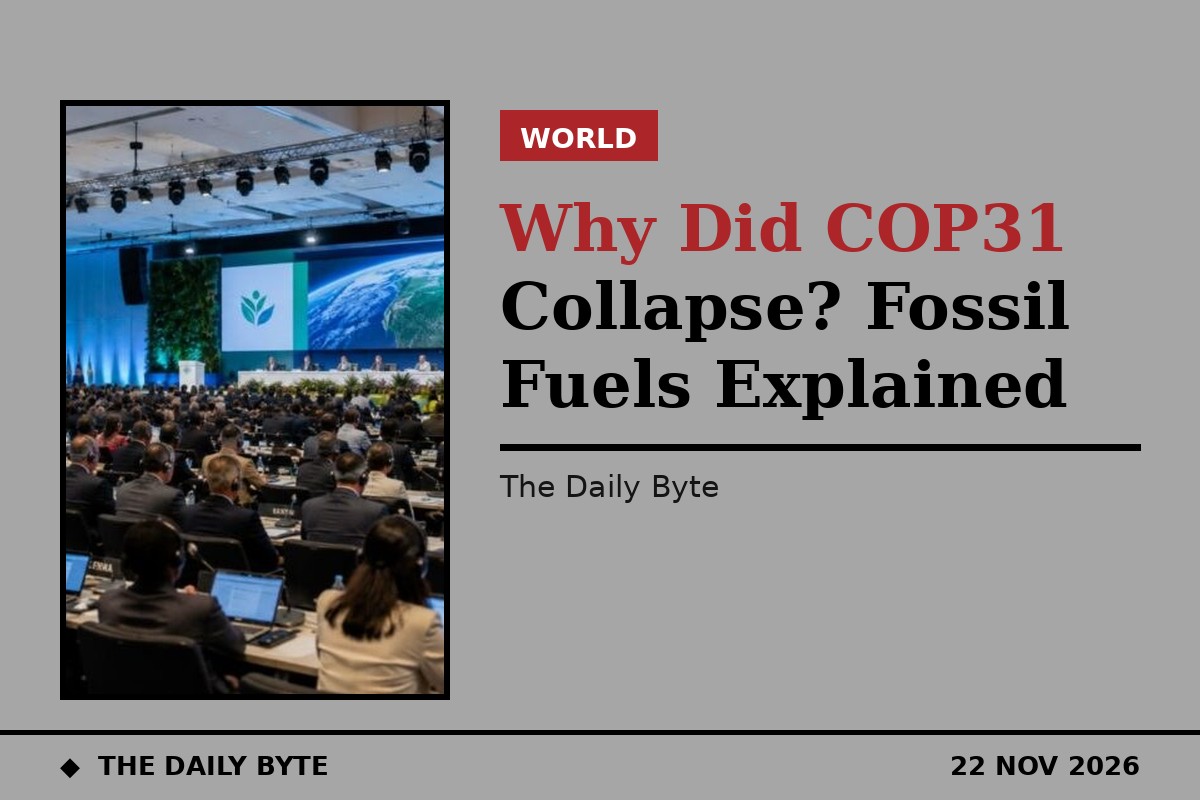
COP31 collapsed on Sunday 22 November 2026, ending without the overarching climate agreement it was meant to produce. After two weeks of talks in Antalya, Turkey, the European Union, the United Kingdom and a host of other countries refused to endorse a final draft deal that made no mention of fossil fuels at all, and the summit’s president, Murat Kurum, conceded that there was no consensus. The talks had already run a record 44 hours past their official close, making COP31 the longest-ever United Nations climate conference. So why did COP31 collapse, what was in the draft that countries rejected, and what happens now that the world’s biggest climate summit has ended in failure?
The short answer is that the final text dropped the one issue that matters most to the science: fossil fuels. Coal, oil and gas are the main drivers of climate change, yet the draft cover decision — the Antalya Pact — did not name them once. Instead it only recalled a deal agreed three years earlier in Dubai, in which governments pledged to transition away from fossil fuels. For the EU and many other countries, that was not a step forward but a step backwards, and they chose no deal over a bad deal.
What is COP31?
COP31 is the 31st session of the Conference of the Parties to the United Nations Framework Convention on Climate Change, the annual summit where nearly 200 countries negotiate the global response to climate change. COP stands for Conference of the Parties, and the parties are the countries that signed the UN climate convention. Each year the summit is hosted by a different country, and decisions are taken by consensus, which means that just one of the nearly 200 nations involved can block agreement.
This year’s summit was held in Antalya, on Turkey’s Mediterranean coast, with Turkey hosting and Australia leading the negotiations. The two countries were described as co-hosts, and they spent the final days conducting emergency diplomacy to try to prevent the talks from collapsing. The summit was due to close on Friday, but it ran into the weekend as negotiators struggled to agree on a final text.
Every COP produces a stack of technical decisions, but the most politically important is usually the cover decision: a single overarching text that captures what countries agreed and sends a signal about the future direction of climate action. At COP31 that cover decision was called the Antalya Pact. It was the Antalya Pact that failed, and its failure is what people mean when they say COP31 collapsed.
Why did the COP31 deal fail?
The collapse came down to a single word that was missing: fossil fuels. Language on fossil fuels is fiercely opposed by oil-producing states such as Saudi Arabia, and the final draft reflected that opposition. An opening draft from Australia had called for a faster phase-out of fossil fuels, but a slimmer version released later removed every mention of them after Saudi Arabia and other major oil and gas producers reportedly objected. The final text, released in the early hours of Sunday, omitted any reference to phasing out oil, coal and gas.
That omission was the breaking point. Ireland’s climate minister, Darragh O’Brien, speaking for the EU — Ireland holds the rotating EU presidency — told the closing session: “We will not endorse a cover decision ... that does not even mention fossil fuels, which is the key driver of climate change.” Outside the hall, he told reporters the summit had been “hijacked by some oil states.” The UK’s energy secretary, Miatta Fahnbulleh, called the failure “immensely disappointing”, and the UK government said the draft “moves us backwards on the science”. The UK’s climate negotiator, Kate Hughes, said the text was “a lowest common denominator where it should have been, instead, presenting bold collective ambition on climate action.”
It was not only the EU and the UK. Panama, a vocal critic of the COP process that had threatened to walk away from the talks, formally objected, as did Vanuatu and Belize. The Marshall Islands’ climate envoy, Kathy Jetnil-Kijiner, told delegates: “We will not compromise our future to benefit fossil fuel interests. We will not accept an outcome that undermines our security and threatens our future.” A coalition of more than 130 countries had pushed to reaffirm the COP28 agreement to transition away from oil, gas and coal, and that coalition was not willing to accept a text that went backwards.
Threats of a walkout on Saturday had prompted Turkey and Australia to convene a hurried meeting between the European Union and Saudi Arabia, but a compromise remained elusive. The COP31 president, Murat Kurum, had said earlier on Sunday that there would be no new draft of the deal. At the closing plenary he told delegates: “I understand that there is no agreement on this text. For that reason, these decisions have not been adopted.”
What was in the final COP31 draft?
The final draft was not empty, but its contents explain why so many countries found it unacceptable. It introduced an oblique reference to the 2023 Dubai deal to shift the world away from fossil fuels, but stopped short of naming fossil fuels explicitly. It proposed retaining a push to expand carbon capture, a technology championed by the fossil fuel industry but criticised as costly and ineffective in cutting emissions. Saudi Arabia’s climate negotiator, Mohammad Ayoub, speaking on behalf of the wider Arab Group of nations, said: “We believe that climate change requires all solutions on the table and that countries select from these solutions depending on their national circumstances.”
Faced with blowback over fossil fuels, Turkey and Australia pointed to electrification as a way to cut emissions and bolster energy security. The draft called for global efforts to boost the share of electricity in total final energy consumption to 35% by 2035 and to expand “clean energy”. But it did not explicitly require that electrification be powered by renewable energy, and around one-third of global electricity is produced using coal and another fifth using fossil gas. The draft also included a proposal to speed up the adoption of electric cars and heat pumps.
Climate campaigners had urged countries to reject the deal. Sara Shaw of the environmental group 350.org said: “This text isn’t a climate plan. It’s a license to keep polluting.” The EU’s joint statement from Darragh O’Brien and EU climate commissioner Wopke Hoekstra was blunt: “The cover decision was not supported because the interests of a few were allowed to obstruct the ambition needed by many. Consensus cannot mean the lowest common denominator. We cannot endorse a decision that greenwashes fossil fuels.”
What else divided countries at COP31?
Fossil fuels were the headline dispute, but they were not the only one. Countries also disagreed over how to respond to the looming breach of the 1.5°C warming target set under the Paris climate accord. The latest draft expressed “deep concern” that global warming would cross 1.5°C, but some countries lamented that the text did not go further. The proposed agreement acknowledged that warming is projected to exceed the Paris Agreement’s 1.5°C threshold, yet offered limited new measures to address the threat.
Climate finance was another major fault line. The talks jammed over long-running complaints that rich nations are shirking their obligations to help developing nations confront climate change, and the removal of a $120 billion target for climate adaptation angered developing nations. African countries had demanded delivery of $120 billion in adaptation finance, and its absence from the final text was a serious grievance. “We need finance, yet our partners showed up to this COP with empty hands,” said Jetnil-Kijiner of the Marshall Islands. “We cannot do this on our own. We cannot survive on empty promises.”
Attempts by Saudi Arabia, India and Kenya to delay the next major reports by the Intergovernmental Panel on Climate Change (IPCC) were another source of friction. Dozens of countries across Europe, Africa and the Pacific want these assessments by the IPCC, the global authority on climate science, published in time for a crucial stocktake of global carbon-cutting efforts in 2028. The draft text only “highlighted the importance” of these reports for that stocktake.
The backdrop to all of this was difficult. The talks came against soaring energy prices and geopolitical tensions stemming from the war between the United States and Iran, which has roiled the Middle East, and in a year of climate-linked disasters from Europe to Nepal and Indonesia. The summit had been under pressure to show progress on tackling soaring greenhouse gas emissions, and it did not deliver it.
Has a COP ever collapsed like this before?
Yes, but not for a long time. The failure to agree on the main cover decision left the summit effectively ending in “no deal”, and that has not happened since COP6 at The Hague in 2000. Some smaller issues were approved at COP31, so the summit did not end with literally nothing, but the central agreement — the document that was supposed to define the outcome — was not adopted.
The scale of the overtime also made history. COP31 became the longest climate change summit in more than three decades, running two days past its scheduled finish and 44 hours beyond its official close. That record is itself a measure of how hard negotiators tried, and how far apart they remained.
| Fact | Detail |
|---|---|
| Summit | COP31, Antalya, Turkey |
| Co-hosts | Turkey (host) and Australia (negotiations lead) |
| President | Murat Kurum, Turkish environment minister |
| Scheduled close | Friday 20 November 2026 |
| Actual end | Sunday 22 November 2026, 44 hours into overtime |
| Failed text | The Antalya Pact cover decision |
| Key omission | No mention of fossil fuels, coal, oil or gas |
| Countries objecting | EU, UK, Panama, Vanuatu, Belize and others |
| Adaptation finance | $120 billion target removed from the draft |
| Electrification goal | Electricity to 35% of final energy use by 2035 |
| Last COP ending in no deal | COP6, The Hague, 2000 |
What happens next after COP31?
The Paris Agreement still stands, and the Dubai pledge to transition away from fossil fuels still stands, because COP31 did not replace them. What failed was the attempt to add a new, stronger signal on top of them. The immediate question is whether the process can recover before the next summit. Ethiopia was named as the host of COP32 during the Antalya talks, so the next round of negotiations has a home, but the same divisions will be waiting there.
For the countries that rejected the draft, the calculation was that a weak deal would be worse than no deal, because it would have locked in lower ambition and allowed the world to claim progress that had not happened. For the oil-producing states, the calculation was that they would not accept language that threatened their economies. Neither side moved, and the consensus rule meant that neither side could win. That is the structural problem COP31 exposed: when nearly 200 countries must all agree, a small number of determined opponents can block the rest.
The longer-term consequence is about credibility. The summit was meant to show that the world could still act together on climate change in a fractured geopolitical moment. Instead it showed the opposite, and the gap between what the science demands and what the negotiations deliver has grown wider. The 1.5°C target is now projected to be crossed, the $120 billion adaptation target was dropped, and the next IPCC reports face delay. Those are the facts that will frame the run-up to COP32, and they are why the collapse of COP31 matters far beyond the conference hall in Antalya.
Frequently asked questions
Why did COP31 collapse? COP31 collapsed because the final draft of the Antalya Pact made no mention of fossil fuels, and the EU, the UK and other countries refused to endorse it. The COP31 president, Murat Kurum, confirmed there was no consensus, so the deal was not adopted.
What is the Antalya Pact? The Antalya Pact was the proposed cover decision at COP31, the overarching text meant to capture what countries agreed at the summit. It recalled the 2023 Dubai deal on transitioning away from fossil fuels but did not name fossil fuels itself.
Where was COP31 held? COP31 was held in Antalya, Turkey, with Turkey hosting and Australia leading the negotiations. It ran from mid-November 2026 and ended on Sunday 22 November, 44 hours past its scheduled close.
Has a COP failed before? Yes. The last time a COP ended without agreement on its main deal was COP6 at The Hague in 2000. COP31 is also the longest-ever UN climate conference.
What happens after COP31 fails? The Paris Agreement and the COP28 pledge to transition away from fossil fuels remain in force. Ethiopia was named as host of COP32, where the same disputes over fossil fuels, finance and the 1.5°C target will return.
Sources: Phys.org / AFP, “COP31 fails to agree on climate deal in chaotic finale”, 22 November 2026; The Times, “Cop31 talks collapse after UK and EU reject proposal”, 22 November 2026; Inter Press Service / Global Issues, “COP31 Cover Deal Collapses as EU and Others Reject Draft Over Fossil Fuel Omission”, 22 November 2026. Published 22 November 2026.


