Why did Italy fine Meta €805 million?
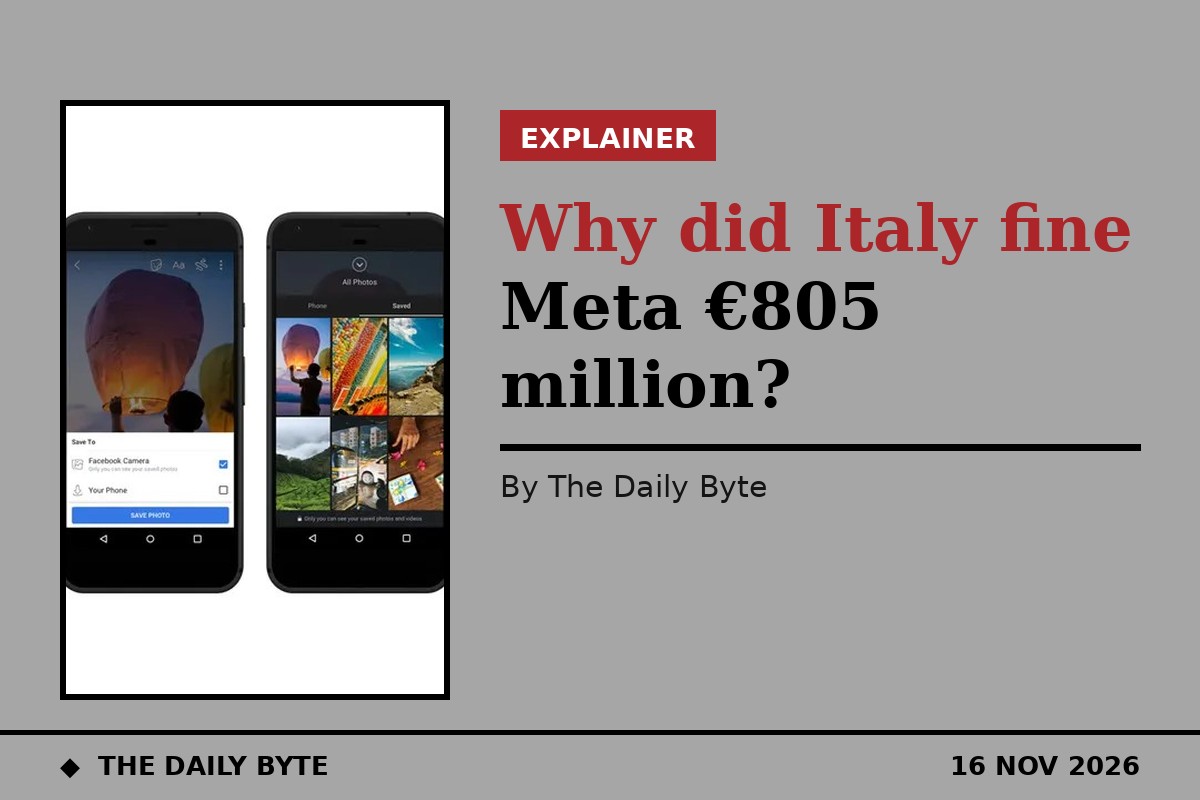
Italy fined Meta €805 million because the Facebook app on Android phones was reading photos, videos and their metadata from Italian users' phones without their specific consent. The fine, announced by Italy's data protection authority, the Garante, on 14 November 2026, covers a Facebook feature that has been switched on by default since 2023 and reached about 20 million Android users in Italy.
The Garante, formally the Garante per la protezione dei dati personali, fined Meta Platforms Ireland Limited €805 million — about £670 million or $887 million — and ordered Meta to switch the feature off by default and ask users for a separate, specific consent within 60 days. It is among the largest fines the Italian authority has ever imposed on a technology company.
What did Meta actually do?
The case turns on a Facebook feature called, in Italian, "Ottieni suggerimenti dalla galleria quando navighi su Facebook" — in English, "Get suggestions from your gallery while browsing Facebook". While a user scrolls through Facebook, the feature suggests photos and videos from the phone's gallery as ideas for posts. It has been available since 2023.
The Garante found three problems with how the feature worked. First, access to the phone's gallery was requested through a single permission covering the whole app and several functions with different purposes, rather than a separate permission for gallery suggestions. Second, that permission was preceded by a generic notice — telling users to "enable other features" — which did not explain that they were also authorising gallery-based suggestions. Third, the feature was switched on by default.
Once granted in full, the Garante said, such a permission lets the app read the entire photo archive on the device, on an ongoing basis, without the user or the authority being able to verify what is actually being used. The authority stressed that the smartphone is part of a person's private sphere, so any access to the information on it requires free and informed consent.
Which rule did Meta break?
The decision rests on Article 122 of Italy's Privacy Code, which implements the European Union's ePrivacy Directive into Italian law. That rule governs access to information stored on a person's device, and it is separate from the EU's General Data Protection Regulation (GDPR).
That distinction mattered for jurisdiction. Meta argued that Ireland's regulator should have handled the case, because Meta Platforms Ireland Limited is based in Dublin and the GDPR's "one-stop-shop" mechanism normally gives the lead regulator in the company's home country the case. The Garante rejected that argument, because the ePrivacy rules at issue do not come with a one-stop-shop mechanism — so the Italian authority could act directly.
It is also important to be clear about what the decision does not say. The Garante found improper access to data; it did not find that Facebook copied every photo from users' phones or made private material public. The investigation did not examine whether gallery content was used to train artificial intelligence models — Meta denies that it was — and the Garante said it reserves the right to assess separately a newer feature, launched in 2026, that allows gallery content to be processed in the cloud.
How did the investigation start?
The investigation began in July 2025, after a report from the Centro Tutela Consumatori Utenti di Bolzano, the consumer protection centre in Bolzano in northern Italy. The Garante then carried out its own technical analysis of the Facebook app for Android.
The case was decided on 14 November 2026 and published in Rome the same day as decision document 10321080. The timing matters for Meta's deadlines: within 60 days — by mid-January 2027 — Meta must request a separate, specific consent for the gallery-suggestions feature from users in Italy, explain clearly what the feature is for, that it involves access to the gallery, and how to switch it off, and keep the feature off by default, even for people who already gave the bundled permission. If the deadline passes without compliance, the feature cannot be switched on for users who have not given valid consent.
Meta must also report to the Garante within 30 days on the steps started, and within 90 days on the measures adopted.
Why is the fine €805 million?
The Garante said the amount is about 0.47 per cent of the Meta group's worldwide turnover. In setting the figure, it weighed the high number of people involved, about 20 million Android users in Italy; the duration of the infringement, still ongoing for people who have not updated the app and for those who already granted the permission; a previous decision against the company in 2019; and what it described as limited cooperation during the investigation.
As a mitigating factor, the Garante noted changes Meta made after the complaint, but judged them late and limited to users who update the app. The fine is a one-off penalty, not a recurring charge, and Meta can be expected to challenge it — although no appeal had been announced at the time of writing.
The penalty also reflects a wider pattern: European regulators have fined Meta repeatedly over data handling, including multi-billion-euro GDPR penalties in Ireland. This Italian decision is different because it was brought under ePrivacy rules rather than the GDPR, showing national regulators can act on their own where the ePrivacy Directive applies.
What does it mean for Facebook users?
For users in Italy, the practical effect is that the gallery-suggestions feature must be off unless they give a clear, separate yes to it. Users elsewhere are not covered by this decision, although the same feature exists in other countries and other regulators may take note of Italy's reasoning.
For users anywhere, the case is a reminder to check what an app can see. On Android, a single "allow" can open up a phone's whole photo library, so checking app permissions in the phone's settings — and switching off gallery access for apps that do not need it — is the simplest protection.
Frequently asked questions
Why did Italy fine Meta €805 million? Because the Facebook app for Android accessed photos, videos and metadata on Italian users' phones without specific consent, through a gallery-suggestions feature that was on by default since 2023.
Did Facebook steal or publish people's private photos? No. The finding is about access without proper consent, not copying or publishing photos.
Does the fine affect Facebook users outside Italy? No. The decision covers users in Italy only, although it may influence how other regulators look at the same feature.
Was the fine about AI training? No. The investigation did not examine whether gallery content was used to train AI models, and Meta denies that it was.
What must Meta do now? Within 60 days it must switch the feature off by default in Italy, ask for separate consent, explain the feature clearly, and report to the Garante within 30 and 90 days.
Sources: Garante per la protezione dei dati personali (official press release, 14 November 2026); PPC Land; CX Today.


