Why Do Dogs Wag Their Tails? Science Explained
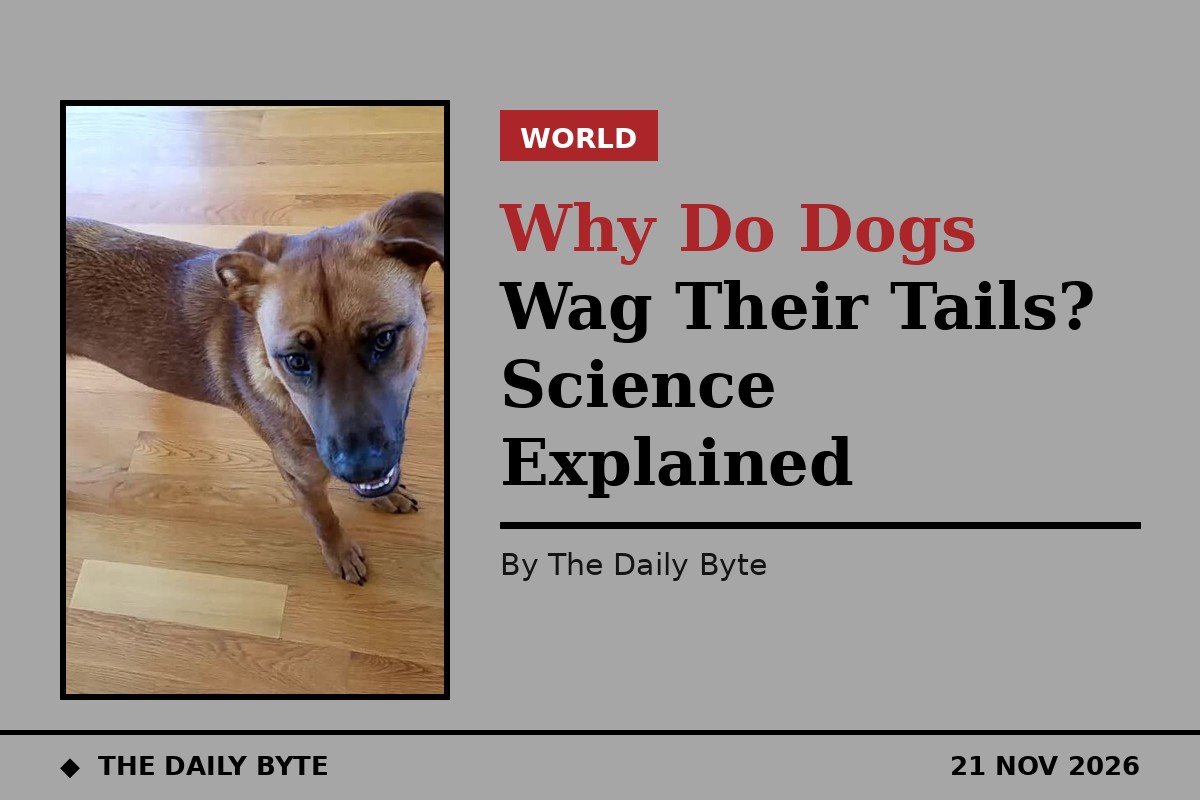
Dogs wag their tails to communicate, not simply because they are happy. A wagging tail is a social signal: it tells other dogs and people how aroused the dog is and, by the direction and height of the wag, whether it wants to approach or back away. The familiar idea that a wagging tail always means a friendly dog is wrong, and it is a misunderstanding that can lead people to approach a dog that is actually frightened, tense or warning them off.
This explainer sets out what tail wagging is for, how the speed, height and direction of a wag change its meaning, why dogs wag so much more than their wild relatives, and how to read a wag together with the rest of the dog's body.
What tail wagging is for
A dog's tail is an extension of its spine, and it has more than one job. It helps with balance when a dog turns at speed, and it carries scent, but its most visible job is communication. Dogs use the position and movement of the tail to signal their emotional state to other dogs and to people, much as humans use facial expressions. Researchers at the Royal Society, writing in Biology Letters in January 2024, describe tail wagging as one of the most conspicuous of all animal behaviours for humans to observe, and note that people are so sensitive to it that engineers have even used tail-wagging patterns when designing robots that need to seem friendly.
One telling detail is when wagging happens. Dogs tend not to wag their tails when they are alone. The behaviour appears when there is another animal or a person nearby to interact with, which is strong evidence that it is a signal aimed at someone else rather than a private reflex. A dog greeting its owner at the door, a dog meeting a stranger on a walk, and a dog facing down a rival are all wagging for an audience, but they are saying different things.
Wagging also develops early. Puppies begin to wag their tails at about three to four weeks of age, around the time they start to interact properly with their littermates and with people. That timing fits with the idea that wagging is part of learning to live in a social group, and it is one of the first signals a puppy learns to send and to read.
Speed, height and direction change the meaning
A wag is not a single message. Three things about it matter: how fast the tail moves, how high it is held, and which side it favours. The speed of the wag is a measure of arousal, or excitement, and it works in both directions: a dog can wag furiously because it is delighted, and it can wag furiously because it is agitated. Speed alone never tells you whether the feeling is good or bad.
The height of the tail gives more of the answer. A tail held at its natural resting height, which for most dogs hangs down near the hocks, or heels, means the dog is relaxed. A tail held lower than usual, and tucked under the body when the dog is frightened, signals nervousness or submission. A tail held slightly higher than normal suggests arousal and curiosity, and a tail held vertical and stiff can signal dominance or aggression. The American Society for the Prevention of Cruelty to Animals gives the same guidance to owners: a high, stiff tail is a reason to give the dog space, not to reach out a hand.
The direction of the wag carries the most surprising information. In a 2007 study published in Current Biology, researchers at the University of Trento in Italy, led by Giorgio Vallortigara, found that dogs wag their tails more to the right when they see something they want to approach, such as their owner, and more to the left when they see something they want to avoid, such as an unfamiliar dog showing an aggressive posture. The reason lies in the brain: the left hemisphere, which is associated with positive approach feelings, controls the right side of the body, and the right hemisphere, associated with negative avoidance feelings, controls the left.
A follow-up study by the same team in 2013 showed that other dogs read this signal too. Dogs shown videos of tails wagging mainly to the right were more relaxed, with lower heart rates, while dogs shown tails wagging mainly to the left showed more signs of stress and anxiety. In other words, the direction of a wag is not just a side effect of how the dog feels: it is information that other dogs use to decide how to behave.
| What you see | What it usually means |
|---|---|
| Tail at natural height, loose wag | Relaxed and friendly |
| Tail low or tucked under the body | Nervous, fearful or submissive |
| Tail high and stiff, fast wag | Aroused, dominant or aggressive |
| Wag biased to the dog's right | Positive feelings, wants to approach |
| Wag biased to the dog's left | Negative feelings, wants to withdraw |
| Whole body wiggling with the wag | Very happy and keen to interact |
Why dogs wag so much more than wolves
Wolves, the dog's closest wild relatives, wag their tails too, but they do it far less often and in fewer situations than domestic dogs. The Royal Society paper from 2024 asks why, and offers two explanations. The first is that frequent wagging arose as a by-product of domestication: in selecting dogs for tameness and docility over thousands of years, humans also selected, by accident, for animals that wag more. The second is that humans selected for it directly, because people are drawn to rhythmic movement and may have favoured dogs whose tails wagged in an obvious, regular way. The authors stress that both ideas are hypotheses waiting to be tested, not settled facts, but either way the result is the same: the modern dog is a far more enthusiastic wagger than its wild ancestor.
That history also explains why the signal works so well on people. Humans are unusually good at reading dog tails, far better than we are at reading the signals of most other animals, because dogs and people have spent thousands of years learning each other's cues. The downside is that we over-read the simplest version of the signal. A wagging tail has become shorthand for a happy dog in cartoons, films and advertising, and many people never learn that the same movement can mean the opposite.
How to read a wag in real life
The practical rule is to read the whole dog, not just the tail. A loose, sweeping wag with a relaxed body, soft ears and a wiggly rear end is the friendly greeting most people imagine. A fast, stiff wag with a high tail, a hard stare, raised hackles or a still, forward-leaning body is a warning, and the right response is to stop, avoid eye contact and give the dog room. A low wag with a crouched body and ears pinned back means the dog is scared, and crowding it will make things worse.
Breed matters too, because the natural tail position differs. A pug's tail curls up, a greyhound's rests slightly between its legs, and some breeds have docked or naturally short tails that make the signal harder to read. With those dogs, the rest of the body has to do more of the talking. And with any dog, a wag that stops suddenly is worth noticing: a dog that goes still is often about to act, whether that means jumping up in greeting or snapping in warning.
Frequently asked questions
Does a wagging tail always mean a dog is happy? No. It means the dog is aroused and communicating. A loose wag with a relaxed body usually means happiness, but a fast, stiff wag with a high tail can mean agitation or aggression, and a low wag can mean fear.
What does it mean when a dog wags to the right? Research from the University of Trento found that dogs wag more to their right when they feel positive and want to approach, and more to their left when they feel negative and want to withdraw. Other dogs can read the difference and react to it.
Do wolves wag their tails? Yes, but much less often and in fewer situations than domestic dogs. Dogs appear to have become far more frequent waggers during domestication, possibly because humans selected for tameness or for rhythmic displays.
When do puppies start wagging their tails? At about three to four weeks of age, depending on the breed, around the time they begin interacting properly with littermates and people.
Can a dog wag its tail when it is alone? Rarely. Dogs tend to wag only when there is another animal or person nearby, which is evidence that wagging is a social signal aimed at someone else.


