Why Do Fireflies Glow? Light Explained
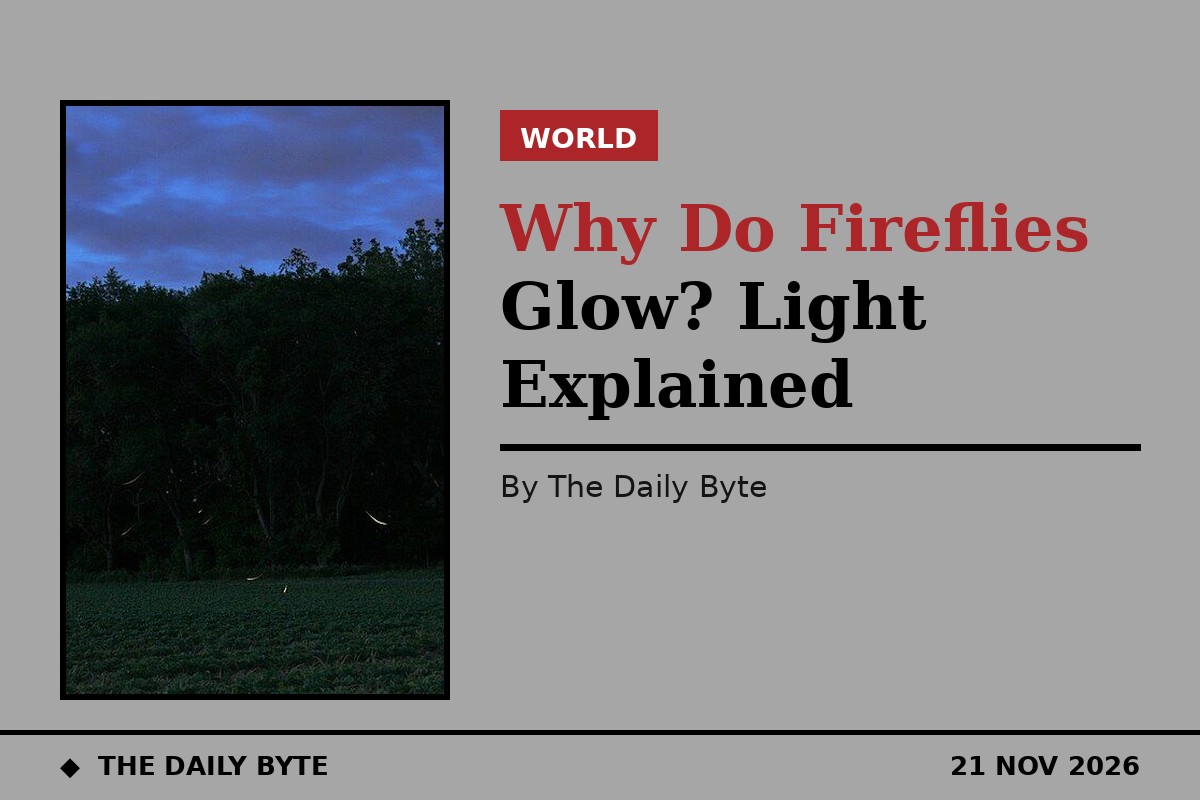
Fireflies glow because of a chemical reaction inside their bodies called bioluminescence. In a light organ at the end of the abdomen, an enzyme called luciferase brings together a light-making chemical called luciferin, oxygen and the cell's energy molecule, ATP. The reaction produces light and almost no heat, which is why firefly light is called cold light. The firefly controls the flashing by controlling how much oxygen reaches the reaction, and it uses the flashes to find a mate, to warn predators away, and to tell its own species apart from all the others.
This explainer sets out the chemistry of the glow, how the firefly switches it on and off, why the light is so efficient, and what the flashes are for, from the glowing larvae on the forest floor to the synchronised displays of whole hillsides.
The chemistry of the glow
The light is made in special cells called photocytes, packed into a light organ at the tip of the abdomen and richly supplied with tiny air tubes. The reaction has three main ingredients: luciferin, the chemical that will give off the light; luciferase, the enzyme that drives the reaction; and ATP, the molecule cells use to store and spend energy. Luciferase first joins luciferin to ATP, and the resulting compound then reacts with oxygen. That produces an excited form of a molecule called oxyluciferin, and when it relaxes back to its normal state it releases the extra energy as a photon of light, usually green or yellow-green.
Luciferin was first isolated in the laboratory in 1949, and firefly luciferin has the chemical formula C11H8N2O3S2. Different firefly species tune the reaction to different colours, from green through yellow to orange, by small changes in the luciferase enzyme that alter the shape of the pocket where the reaction happens. The colour is part of the species' identity, and it is one of the ways a firefly recognises its own kind in the dark.
The most striking thing about the reaction is its efficiency. A normal light bulb turns most of its energy into heat and only a small fraction into light. A firefly turns almost all of the reaction's energy into light and gives off only a minute amount of heat. Britannica puts the figure at approximately 100 percent of the energy given off as light. That matters, because if the light organ got as hot as a light bulb, as Scientific American points out, the insect would not survive the experience. The firefly's cold light is one of the most efficient light-producing systems in nature, and scientists have borrowed the luciferin-luciferase reaction for laboratory tests, including rapid checks for bacterial contamination in food, where the ATP in bacteria kick-starts the same glow.
| Ingredient | What it does |
|---|---|
| Luciferin | The light-making chemical, oxidised to produce light |
| Luciferase | The enzyme that drives the reaction |
| ATP | The cell's energy molecule, which starts the reaction |
| Oxygen | Reacts with the activated luciferin to make the glow |
| Photocytes | The light-producing cells in the abdomen |
How the firefly switches its light on and off
A firefly does not glow continuously. It flashes, sometimes in patterns lasting less than a second, and it controls the flashing by controlling oxygen. Insects do not have lungs. They move oxygen from outside the body to their cells through a branching network of ever-smaller tubes called tracheoles. The light organ's oxygen supply is normally held back, because the cell's energy factories, the mitochondria, grab the available oxygen for themselves. When the firefly's brain sends the signal to flash, it triggers the production of nitric oxide, a gas that temporarily stops the mitochondria from holding on to oxygen. The freed oxygen flows into the light organ, the reaction runs, and the firefly glows. Nitric oxide breaks down very quickly, so the oxygen is soon trapped again and the light goes out. That is how a firefly can flash on and off many times a second.
The speed of the flash matters. Each species has its own flash pattern: a single long glow, two short pulses, a rising sweep, or a rapid series of blinks. Males fly and flash while females answer from the ground, and the pair exchange signals until they meet. Studies in two firefly species have shown that females prefer males with faster flash rates and brighter flashes, so the pattern is not just an identity badge but a measure of quality. In the Great Smoky Mountains of the eastern United States, the species Photinus carolinus takes this further: thousands of males synchronise their flashes, lighting up a whole hillside in waves, which helps males and females find each other in the crowd.
Why glow at all? Mates, warnings and defence
Finding a mate is the main job of the adult glow, but it is not the only one. Fireflies are not good to eat. They produce defensive steroids called lucibufagins, which make them taste bitter and are poisonous to many predators. The glow is also a warning: the larvae, which live on the ground and feed on snails, slugs and worms, produce short glows even though they cannot fly, and the light tells predators that this small soft animal is not worth eating. Some females of the genus Photuris take the deception further: they mimic the flash pattern of another species to lure its males in, and then eat them, gaining both a meal and the other species' defensive chemicals.
Not every firefly glows as an adult. There are more than 2,000 firefly species worldwide, in the beetle family Lampyridae, and in some of them the adults are active by day and find mates by scent rather than by light. The glowing species are the ones people notice, but they are only part of the family. Even in glowing species, the females of some kinds cannot fly and signal from the grass, while the males fly above them. The whole system depends on darkness: artificial light at night can drown out the flashes, which is one reason firefly numbers are falling in many places, along with the loss of the damp meadows and woodland edges where they breed.
Are fireflies really flies?
No. Fireflies are beetles, not flies, and they are also known as lightning bugs. Like other beetles they have hard wing cases, and their larvae look like small armoured grubs, sometimes called glow-worms. The name firefly is a piece of folk naming, like calling a ladybird a bug when it is also a beetle. The confusion is understandable: the adults fly, they glow like embers, and they appear on warm summer evenings exactly when people are outdoors to see them.
The larvae are worth a closer look. They live for one or two years, far longer than the adults, which live only a few weeks, and they are hunters. A firefly larva tracks a snail or slug, bites it and injects digestive fluids, then feeds on the softened tissue. Some larvae can glow from the day they hatch, and the glow is thought to warn predators away while they are still small and defenceless. The adult's famous flashing is therefore the second act of a life that starts on the ground, glowing quietly in the dark.
Frequently asked questions
Do fireflies produce heat when they glow? Almost none. Firefly light is cold light: approximately 100 percent of the energy is given off as light and only a minute amount as heat, which is why the insect can carry its own lamp without cooking itself.
Why do fireflies flash in patterns? Each species has its own flash pattern, which lets males and females recognise their own kind and find each other. Females in some species prefer faster and brighter flashes.
Do all fireflies glow? No. There are more than 2,000 firefly species, and in some the adults are active by day and find mates by scent instead of light. The larvae of glowing species usually glow too.
Are fireflies beetles or flies? They are beetles, in the family Lampyridae, despite the name. They are also called lightning bugs.
Why are fireflies disappearing? The main pressures are artificial light at night, which drowns out their flashes, and the loss of the damp meadows and woodland edges where they breed.


