Why Do Onions Make You Cry? Chemistry Explained
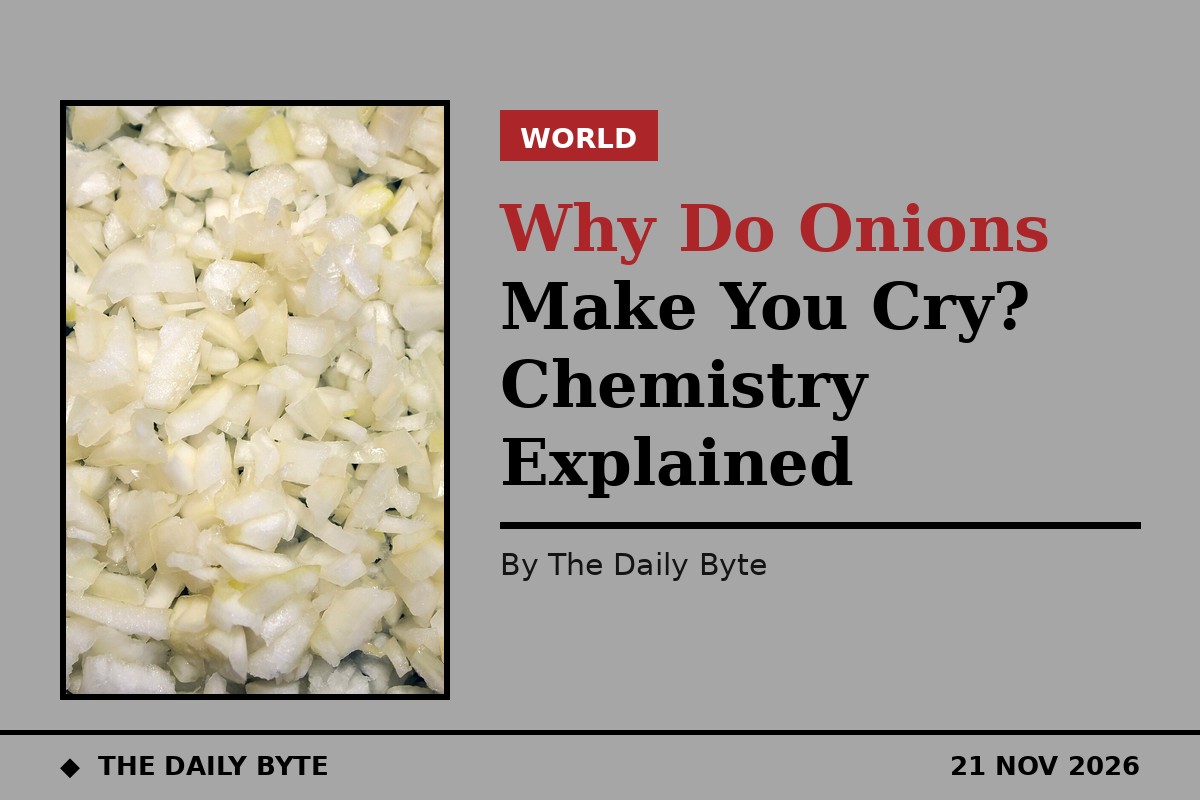
Onions make you cry because cutting them releases a gas called syn-propanethial S-oxide, which drifts up into your eyes, stings the nerves on the surface of the eye, and triggers a reflex that floods the eye with tears to wash the irritant away. The onion contains none of this gas while it is whole: the gas is only made in the seconds after the knife breaks the onion's cells, when chemicals that are normally kept apart are mixed together.
This explainer follows the chain reaction step by step, explains how the gas makes your eyes water, why the onion produces it at all, and what actually helps if you want to chop an onion without crying.
The chain reaction inside a cut onion
An onion is a member of the allium family, which also includes garlic, leeks and chives, and it grows by absorbing sulfur from the soil. That sulfur ends up stored in compounds called amino acid sulfoxides. While the onion is intact, these compounds sit in separate compartments from the enzymes that can act on them, and nothing happens. The moment a knife cuts through the onion, the cell walls break open and the compartments mix.
The first enzyme released is called alliinase. It converts the amino acid sulfoxides into sulfenic acids, including one called 1-propenesulfenic acid. A second enzyme then takes over: lachrymatory-factor synthase, which rearranges the sulfenic acid into syn-propanethial S-oxide, the compound that makes you cry. The existence of this second enzyme was only established in 2002, when Japanese scientists led by Shinsuke Imai published their findings in the journal Nature. Before that, researchers had wrongly blamed alliinase alone for the tears.
Syn-propanethial S-oxide is a small, volatile molecule with the chemical formula C3H6SO. Its structure was worked out in stages: its molecular formula was determined in 1956, and its exact shape was pinned down in 1979 by Eric Block and his colleagues. Because it is volatile, it evaporates from the cut surface almost immediately. According to Scientific American, formation of the compound peaks at about 30 seconds after the onion is damaged and the cycle completes over about five minutes, which matches everyday experience: the tears are worst just after you start chopping.
| Step | What happens |
|---|---|
| 1. The knife cuts the onion | Cell walls break and stored chemicals mix |
| 2. Alliinase is released | Amino acid sulfoxides become sulfenic acids |
| 3. Lachrymatory-factor synthase acts | Sulfenic acid becomes syn-propanethial S-oxide |
| 4. The gas reaches your eyes | Nerves detect it and the tear glands respond |
How the gas makes your eyes water
The gas rises from the chopping board and reaches the front surface of the eye, the cornea. The cornea is densely packed with sensory nerve endings from the ciliary nerve, a branch of the large trigeminal nerve that carries touch, temperature and pain signals from the face. Those nerve endings detect the gas, and the brain interprets the signal as a burning sensation. The response is automatic: the nerve activity triggers the lachrymal glands, and tears are released to dilute the irritant and wash it away.
The Royal Society of Chemistry notes that when the gas contacts the surface of the eye it reacts with water to create an acid, which adds to the sting. It also describes the compound as similar to tear gas, which is a fair comparison: both are lachrymators, from the Latin lacrima, meaning tears, and both work by irritating the eye until tears flush them out. The important difference is one of strength. The onion gas is mild and the tears deal with it quickly, which is why the pain fades within moments of stepping away from the board.
Why does the onion do this at all?
The onion does not make this gas for our benefit. The leading explanation is that it is a defence against being eaten: an animal that bites into an onion gets a mouthful of stinging gas and learns to leave the plant alone. The Royal Society of Chemistry also notes that the compound can kill bacteria and fungi, giving the onion a mild antibiotic defence as well. The chemistry is therefore doing two jobs at once, protecting the plant from animals and from microbes.
Garlic, the onion's close relative, shows how specific this defence is. Garlic contains similar sulfur compounds, but its sulfenic acid takes a different chemical route that does not produce syn-propanethial S-oxide, so chopping garlic does not make your eyes water. The difference comes down to a single fork in the chemistry: onions have the lachrymatory-factor synthase enzyme, and garlic effectively does not use that route.
Not all onions are equal either. Spring onions and other mild varieties contain much lower levels of the enzymes involved, which is why they rarely bring on tears. Sweet onions tend to be milder for the same reason. The strongest tears come from ordinary brown and yellow onions, which carry the highest levels of the precursor compounds.
How to cry less when you chop onions
The chemistry points to the remedies, and the useful ones all work by slowing the gas down or keeping it away from your eyes. A sharp knife helps, because it slices cleanly through fewer cells than a blunt one, which crushes a wider path and releases more of the chemicals. Chilling the onion in the fridge before cutting also helps: the cold reduces how readily the volatile compounds turn into gas, and cold slows the enzymes down. Cooking has the same effect in a stronger form, because heat deactivates the enzymes entirely, which is why a frying onion stops making you cry once it starts sizzling.
Distance and airflow help too. Cutting near an open window, under a cooker hood, or beside a small fan carries the gas away from your face. Cutting the onion under running water works, but it is awkward and washes away flavour along with the gas. Swim goggles or onion goggles work by sealing the eyes off from the gas altogether, and they are the most reliable option for people who chop onions often. What does not help is holding a piece of bread in your mouth or chewing gum, neither of which has any effect on the chemistry.
Plant breeders have also tackled the problem at its source. A food technology company in New Zealand has developed an onion with the lachrymatory-factor synthase enzyme switched off, so it produces other sulfur compounds instead of the tear gas. Those onions are tear-free by design, although they are not yet a common sight in shops.
Frequently asked questions
Is it the smell of the onion that makes you cry? No. The smell comes from different sulfur compounds, called thiosulfinates, which form at the same time but do not cause tears. The tears are caused by syn-propanethial S-oxide, a separate gas that reaches the eye and irritates its nerves.
Why do spring onions not make me cry? They contain much lower levels of the enzymes and precursor compounds that produce the tear gas, so far less of it is released when they are cut.
Are onion tears harmful to my eyes? No. The gas is a mild irritant and the tears are doing their job by washing it away. It is still sensible not to rub your eyes while chopping, because that spreads the gas across the eye and can make the sting worse.
Why does garlic not make me cry? Garlic's sulfenic acid takes a different chemical route that does not produce syn-propanethial S-oxide, so no tear gas is released when garlic is chopped.
Does cooking an onion stop the tears? Yes. Heat deactivates the enzymes that make the gas, so an onion that is already cooking will not make you cry. Chilling an onion before cutting has a similar but weaker effect.


