Why Do Stars Twinkle? The Science Explained
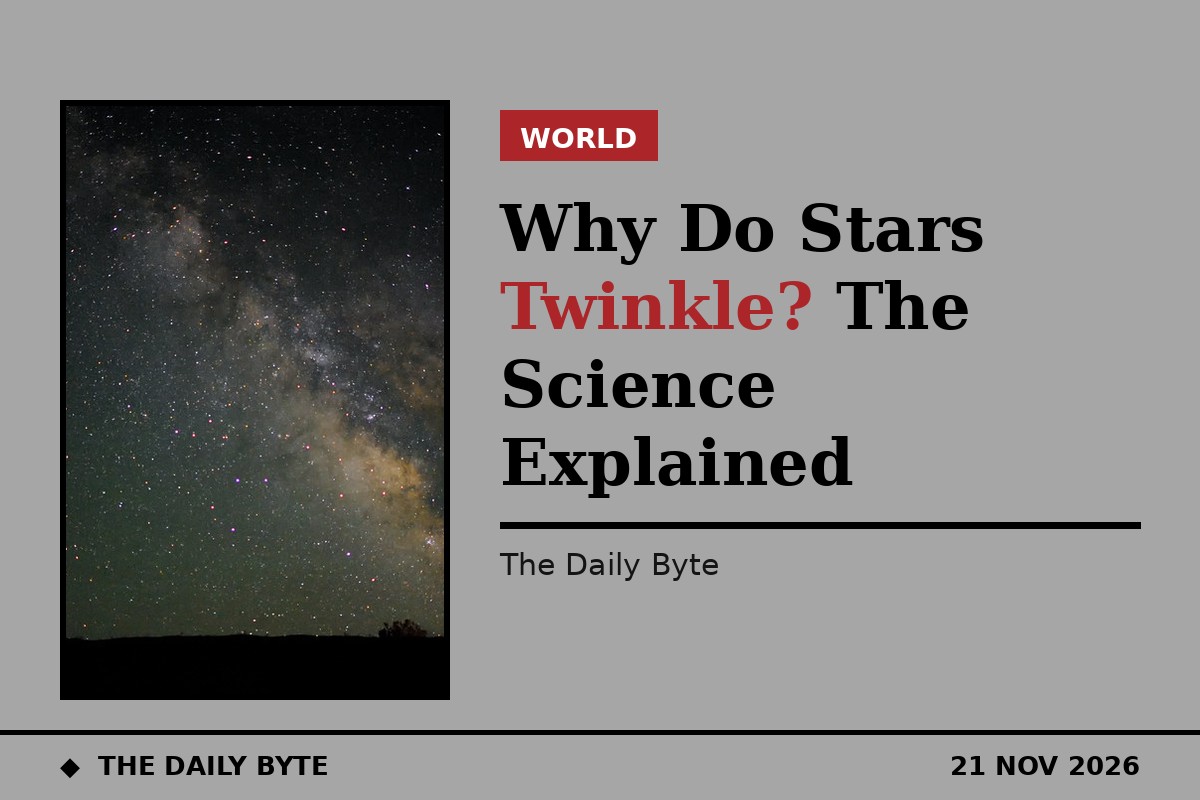
Stars twinkle because their light has to pass through Earth's restless atmosphere before it reaches our eyes. The air above us is never still: pockets of warm and cool air, stirred by wind, bend the starlight slightly from side to side several times a second. A star is so far away that it appears as a single point of light, so every tiny bend makes it flicker, shift and sometimes change colour. The star itself is shining steadily. The twinkling happens on the way down, not up in space.
Astronomers call this effect scintillation, from the Latin word for sparkle. It is the same physics that makes a coin at the bottom of a swimming pool look as if it is wobbling, or a spoon in a glass of water look bent at the surface. Light changes direction when it moves through air of different densities, and our atmosphere is full of moving parcels of air with different temperatures and densities. Each parcel acts like a tiny, shifting lens. As starlight passes through one parcel after another, its path is nudged in a different direction each time, and the star appears to dance.
Why do stars twinkle but planets do not?
The difference is size, or rather apparent size. Stars are so distant that even the largest of them look like points of light to the naked eye. All of a star's light arrives along what is effectively a single narrow beam, so a small bend in that beam changes how bright the star looks from moment to moment. Planets are far closer. Venus, Mars and Jupiter may look like bright stars to the eye, but through a telescope they are visible as small discs, not points. Light from different parts of a planet's disc is bent in slightly different ways, and the variations average out, so the planet's overall brightness stays steady. That is why the old stargazer's trick works: if it twinkles, it is a star; if it shines steadily, it is probably a planet.
The Moon and the Sun behave the same way. They are large discs in the sky, so the twinkling from one part of the disc cancels out the twinkling from another. Look at the Moon through a telescope on a turbulent night, though, and you will see its edge shimmering and rippling. The effect is still there; it is only the averaging that hides it from the naked eye.
Why do stars near the horizon twinkle more?
Stars low in the sky twinkle far more violently than stars overhead, and the reason is the amount of air their light must cross. Light from a star directly above you passes through the thinnest possible slice of atmosphere. Light from a star near the horizon travels through a much longer, slanting path, crossing far more moving air on the way. The more air parcels the light passes through, the more it is bent, and the stronger the twinkling.
The effect is easy to see on a clear evening. Sirius, the brightest star in the night sky, sits low in the south in winter, and it often flashes red, white and blue as it twinkles. Those colour changes are real: the atmosphere bends different colours of light by slightly different amounts, so as the star's image shifts, different colours reach your eye in turn. A few hours later, when Sirius has climbed higher, the same star twinkles far less, because its light is taking a shorter route through the air.
What is "seeing" in astronomy?
Astronomers have a name for how much the atmosphere blurs and shakes a star's image: they call it "seeing". On a night of good seeing, a star's image wobbles only slightly; on a night of poor seeing, it jumps around far more. The size of the wobble is usually only a few arcseconds, a tiny angle on the sky. The full Moon is about 1,800 arcseconds wide, so a shift of a few arcseconds sounds negligible, but a star itself appears far smaller than an arcsecond across. A wobble of that size is huge compared with the star's own apparent size, which is why the twinkling is so obvious to the eye.
Seeing is the reason astronomers build their telescopes on high, dry mountains, above as much of the turbulent air as possible, and the reason they care so much about calm, stable air. It is also why long-exposure photographs of stars taken from the ground show them as bloated discs rather than sharp points: each momentary image is displaced slightly, and the photograph adds all those displaced images together into a blur.
Do stars twinkle in space?
No. Above the atmosphere, stars do not twinkle at all. That is one of the main reasons the Hubble Space Telescope was placed in orbit: with no air in the way, it can take the sharp pictures of the distant universe that ground-based telescopes struggle to match, even though its mirror is far smaller than the largest mirrors on Earth. A time-lapse taken from the ground shows a star as a cluster of shifting speckles, each one a separate bent image of the same point of light. From space, the same star is a single steady point.
Ground-based astronomers have learned to fight back. Modern large telescopes use adaptive optics, sometimes called rubber mirrors: a flexible mirror that changes shape hundreds of times a second to cancel out the bending caused by the atmosphere in real time. Some systems shine a powerful laser into the sky to create an artificial star, a reference point whose true appearance is known, so the telescope can measure the distortion and correct for it. The technique has transformed what ground telescopes can see, but it is a repair job for a problem that only exists because we look at the sky through moving air.
Can twinkling tell astronomers anything useful?
Yes, and in more ways than one. The amount of twinkling on a given night tells an observer how steady the air is, which is why astronomers check the seeing before deciding what to observe. Twinkling also gives away impostors: a steady bright "star" low in the evening sky is usually a planet, and a twinkling one is a star. And the study of scintillation has a practical cousin in radio astronomy, where the twinkling of distant radio sources as their signals pass through the solar wind reveals the speed and structure of that wind.
There is also a historical footnote. For centuries, twinkling was misunderstood. The ancient Greek philosopher Aristotle thought the twinkling came from the eye itself, because he believed vision worked by beams sent out from the eye, and those beams grew weaker and more distorted over long distances. It was Isaac Newton, through his studies of optics, who established that light bends as it passes from one medium to another, and that the atmosphere was doing the bending. The nursery rhyme had it right about the sight, and wrong about the cause: the little star does twinkle, but only because we are watching it from the bottom of an ocean of air.
Frequently asked questions
Why do stars twinkle? Because Earth's turbulent atmosphere bends their light slightly from side to side several times a second. Stars look like single points of light, so every small bend makes them flicker. The stars themselves shine steadily.
Why do planets not twinkle? Planets are close enough to appear as tiny discs rather than points. Light from different parts of the disc is bent in different ways, and the variations average out, so a planet's brightness stays steady.
Why do stars near the horizon twinkle more? Their light travels a longer, slanting path through the atmosphere, crossing more moving air, so it is bent more often and more strongly than light from a star overhead.
Do stars twinkle in space? No. There is no atmosphere in space to bend the light, which is why the Hubble Space Telescope, in orbit above the air, sees stars as sharp, steady points.
Why do twinkling stars sometimes change colour? The atmosphere bends different colours of light by slightly different amounts. As the star's image shifts, red, white and blue light reach your eye in turn, so a low star such as Sirius can appear to flash different colours.
Sources: NASA StarChild, "Why do stars twinkle?"; NASA Science, "APOD: 2000 July 25 — Why Stars Twinkle"; Encyclopaedia Britannica, "Why Do Stars Twinkle?"; Scientific American, "Why Do Stars Twinkle?" and "What Makes Stars Twinkle?"