Why Do Tides Happen? The Moon, Sun and Sea
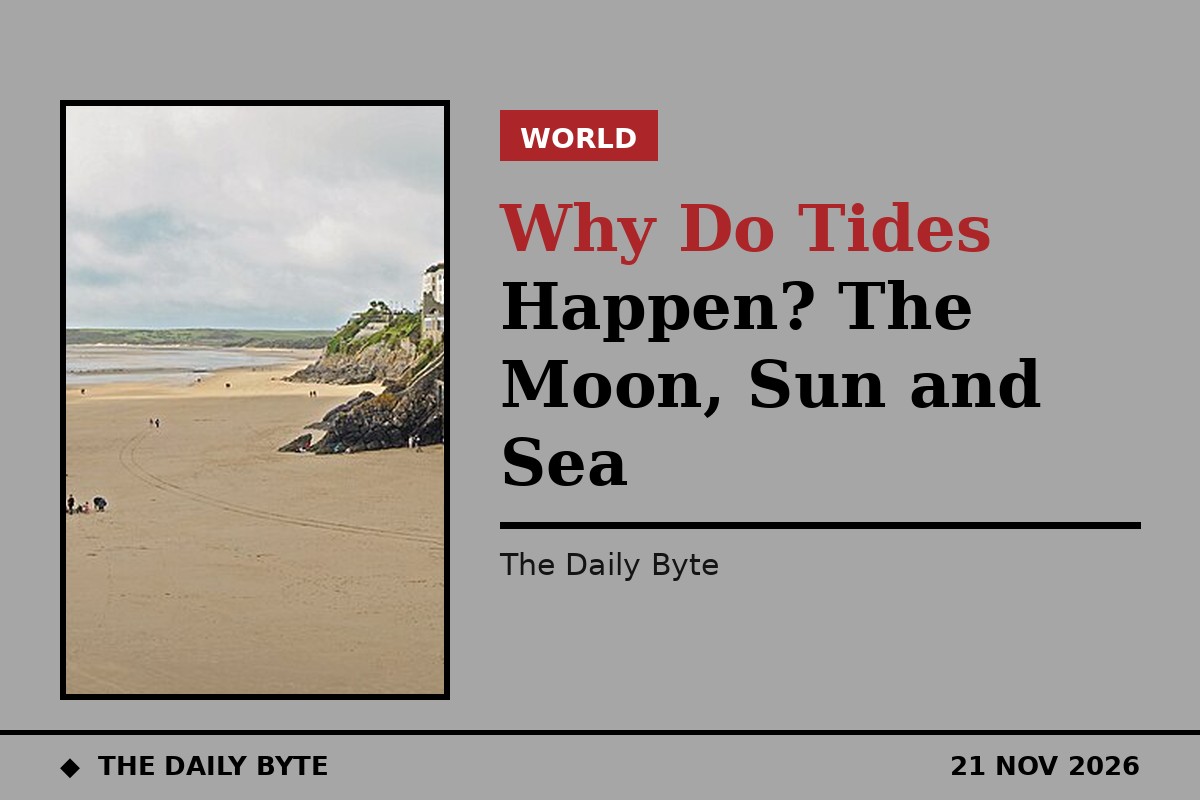
Tides happen because the Moon’s gravity pulls on the Earth’s oceans unevenly. The water on the side of the Earth facing the Moon is pulled towards the Moon more strongly than the solid Earth itself, so it piles up into a bulge. On the opposite side of the planet, the water is pulled less strongly than the Earth, so a second bulge forms there too. As the Earth rotates beneath these two bulges, most coastlines pass through a bulge twice a day, and the sea rises and falls twice: two high tides and two low tides, roughly every 12 hours and 25 minutes.
It is one of the oldest puzzles in science, and the answer had to wait for Isaac Newton’s theory of gravity in the 17th century. People had long noticed that the tides follow the Moon — high tide arrives later each day, by about the same amount as moonrise is delayed — but only gravity explained why there are two high tides a day rather than one.
Gravity pulls unevenly, and water can move
The key is that gravity weakens with distance, and the Earth is large. The Moon’s pull on the ocean facing it is stronger than its pull on the centre of the Earth, and its pull on the centre is stronger than its pull on the far-side ocean. These differences, called differential or tidal forces, stretch the Earth very slightly along the line to the Moon, into something like the shape of a rugby ball, with its long axis pointing at the Moon.
Solid rock barely responds to such a tiny stretch — the ground itself rises and falls by only about 20 centimetres. Water, though, is free to flow, so it gathers where the pull is strongest and where it is weakest, forming the two bulges. The Sun also pulls on the oceans, but because it is so much further away, its tide-raising force is only about 46 per cent of the Moon’s, even though the Sun’s overall gravity is far stronger.
Two bulges, two high tides a day
Think of the bulges as staying roughly fixed in line with the Moon while the Earth spins inside them. A beach on the coast rotates into a bulge and the sea level rises: high tide. About six hours later the beach has rotated out of the bulge and into the dip between the bulges, and the water falls away: low tide. Six hours after that it reaches the second bulge, and there is a second high tide, followed by a second low tide. The full cycle takes about 24 hours and 50 minutes, which is one lunar day — the time it takes for the Moon to return to the same position in the sky.
That extra 50 minutes is why the tides shift later every day. The Moon orbits the Earth in the same direction that the Earth rotates, so the Earth has to turn a little further each day to bring the Moon back overhead. High tide therefore arrives roughly 50 minutes later tomorrow than it did today, and the pattern repeats through the month.
The Sun’s part: spring tides and neap tides
The Moon sets the rhythm, but the Sun sets the range — the difference in height between high and low water. Twice a month, at the new Moon and the full Moon, the Sun, Moon and Earth line up. Their tidal forces then pull in the same direction, or from exactly opposite sides, and reinforce each other. The result is the biggest tides of the month, with the highest high waters and the lowest low waters. These are called spring tides, and the name has nothing to do with the season: it comes from an old word meaning to rise or leap up.
A week later, at the first and last quarter Moons, the Sun and Moon sit at right angles to each other as seen from Earth, and their pulls partly cancel out. The tides then have their smallest range of the month. These are neap tides, and the sea rises and falls much less dramatically. Spring tides and neap tides differ by roughly 20 per cent above and below the average, and there are about seven days between a spring tide and the next neap tide.
Why tides are not the same everywhere
The two-bulge picture explains the timing, but real tides are shaped by the shape of the land. Continents get in the way, ocean basins have their own natural rhythms, the sea floor slows the tidal wave down, and the Earth’s rotation deflects the moving water. In the open ocean, the difference between high and low water is usually less than half a metre. Near the coast, where the tidal wave runs into shallow water and is funnelled into bays and estuaries, it can grow enormously.
The most extreme example is the Bay of Fundy in Canada, where the tidal range reaches 44.6 feet, about 13.6 metres, because the bay’s shape and depth make the water slosh back and forth in step with the tide, amplifying it like water rocking in a bath. In Britain, the Severn Estuary in the south-west has one of the largest tidal ranges in the world, up to about 15 metres, and its famous tidal bore — a wave that runs up the river against the current — can be surfed for miles.
Some places break the twice-a-day rule altogether. In parts of the Gulf of Mexico and South-East Asia there is only one high tide and one low tide a day, and in a few places, such as Southampton on the south coast of England, the shape of the coast and the channels produces a double high tide, with the water pausing and rising again. Tide tables, published for every port, exist precisely because local geography matters so much.
Tides, power and safety
People have used the tides for centuries: to drive mills, to carry ships in and out of harbour on the rising water, and in modern times to generate electricity. The world’s first large tidal power station, at La Rance in Brittany, France, has been running since 1966, using the rise and fall of the water to spin turbines. Newer projects use the tidal current itself, like an underwater wind farm.
Tides also demand respect. A rising tide can cut off a beach, a causeway or a stretch of sand in minutes, and every year people are caught out walking on tidal flats. The sands of Morecambe Bay in north-west England are famous for it: the channels shift, the tide comes in faster than a person can run, and crossings are only safe with a local guide. Checking the tide times before setting out is one of the simplest safety habits on any coast.
Frequently asked questions
Why are there two high tides a day instead of one? Because the Moon’s gravity creates two bulges of water, one on the side facing the Moon and one on the opposite side, and the Earth’s rotation carries each coastline through both bulges in about 24 hours and 50 minutes.
Why does high tide come later each day? The Moon moves along its orbit while the Earth turns, so the Earth must rotate for about 24 hours and 50 minutes, not 24 hours, to bring the Moon back overhead. Tides follow the Moon, so they slip about 50 minutes later each day.
What is the difference between a spring tide and a king tide? A spring tide is the biggest tide of the fortnightly cycle, at new and full Moon. A king tide is the very highest spring tide of the year, when the Moon is also at its closest to Earth, so it is the extreme end of the same effect.
Do lakes have tides? In theory yes, because the Moon pulls on them too, but the effect is tiny — a few centimetres at most on a large lake — and wind and weather swamp it completely. Tides are an ocean-scale phenomenon.
Does the Moon’s gravity affect people? No, not in any measurable way. The tidal force depends on the difference in gravity across an object, and across a human body that difference is vanishingly small. Only oceans, which span thousands of kilometres, show the effect.


