Why Do We Blush? The Science Explained
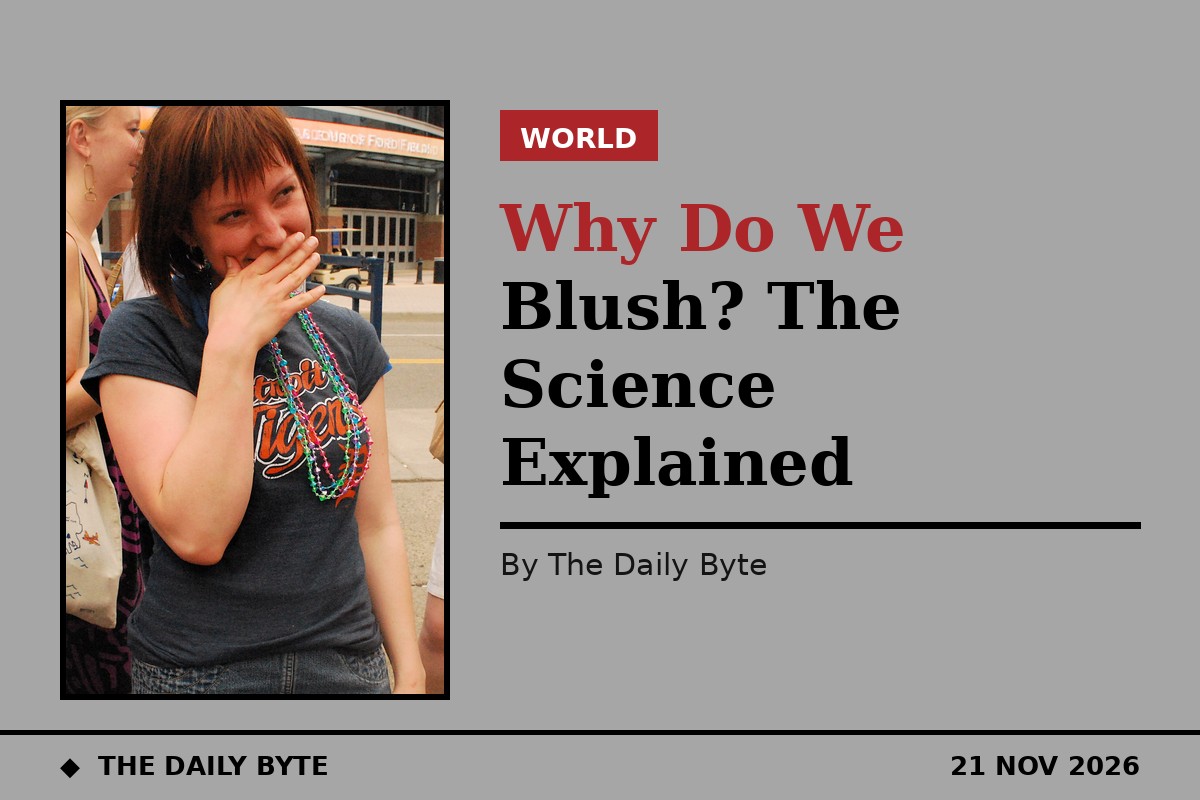
We blush because embarrassment, shame or sudden attention switches on the sympathetic nervous system, the branch of the nervous system that runs the fight-or-flight response, and that signal widens the blood vessels in the face so that more blood flows close to the skin. The face turns red within seconds, and because the response is involuntary, you cannot switch it off by an act of will. It is a social reflex as much as a physical one: the trigger is almost always other people, or the thought of what other people are thinking.
This explainer sets out the chain of events from a social trigger to a red face, why the face reddens when the rest of the body does not, what blushing is for, how it differs from flushing, and what, if anything, you can do about it.
What happens in the body when you blush?
It starts in the brain. A social threat, such as being praised in front of a group, realising you have made a mistake in public, or being caught doing something private, is picked up by brain regions that monitor social standing, including the amygdala, which processes emotion, and the prefrontal cortex, which handles self-monitoring. Those regions activate the sympathetic nervous system, which is the same system that speeds up the heart, quickens breathing and slows digestion when you are frightened. The adrenal glands release adrenaline, also called epinephrine, into the bloodstream.
Adrenaline then acts on the blood vessels of the face, and here the face behaves differently from the rest of the body. In most of the body, sympathetic activation narrows blood vessels, pushing blood towards the large muscles and the heart. In the face, neck and upper chest, the dominant receptors are beta-adrenergic receptors, and when adrenaline binds to them the smooth muscle in the vessel walls relaxes and the vessels widen instead. This widening is called vasodilation. Blood floods the small vessels near the surface of the skin, and the red colour of the blood shows through the thin facial skin as a blush.
The anatomy of the face makes the effect visible. The cheeks contain a dense network of capillary loops close to the surface, and beneath them sits a web of veins capable of holding a large volume of blood for its size. A landmark study published in 1982 by the physiologist Sten Mellander showed directly that the veins of the human cheek dilate in response to this kind of signal, a finding that matters because veins elsewhere in the body rarely behave this way. A review of the physiology by Peter Drummond and James Lance, published in the journal Neuroscience and Biobehavioral Reviews, describes blushing as the unusual combination of this facial vasodilation with sympathetic activation, and notes that the central mechanisms also involve higher brain areas concerned with self-reflective thought.
The blush usually spreads across the cheeks and can extend to the ears, neck and upper chest. It arrives within seconds of the trigger and fades over seconds to minutes as the parasympathetic nervous system, the calming counterpart of the sympathetic system, slows the heart and returns the body to its resting state. That is why a blush feels like a wave: it rises fast, and it ebbs on its own.
Why does only the face turn red?
Three features of the face work together. First, the blood vessels of the cheeks, forehead and neck carry an unusually dense distribution of beta-adrenoceptors, the docking sites where adrenaline triggers widening rather than narrowing. Second, the vessels themselves are wider and sit closer to the skin surface than vessels elsewhere, so extra blood is immediately visible. Third, facial skin is thin and richly supplied with blood, which is also why a cut on the face bleeds more than a cut of the same size on the arm.
The contrast with the hands is instructive. In the same embarrassing moment that widens the vessels of the face, the vessels of the fingertips tend to narrow, which is why your hands can feel cold while your cheeks burn. One chemical signal, adrenaline, produces opposite effects in different parts of the body because the receptors differ. That is the whole trick of blushing: it is not a general rush of blood to the head, but a local, specific response of facial blood vessels.
People with darker skin blush in exactly the same way, although the redness is less easy to see. The blood vessels widen and the skin warms in the same pattern, and the person feels the same heat and tingling in the cheeks. Visibility depends on how much the colour of the blood shows through the skin, not on whether the response happened.
Why do humans blush at all?
Nobody knows for certain, and that is part of what makes blushing interesting. Charles Darwin, writing in 1872 in The Expression of the Emotions in Man and Animals, treated blushing as peculiar to humans, and modern research still finds no clear equivalent in other animals. The leading explanation is social. A blush is a signal that cannot be faked or suppressed at will, and it communicates something useful: that you know you have broken a social rule, that you are sorry, or that you care what the group thinks of you.
In that reading, blushing is a kind of appeasement display, comparable to the submissive gestures other animals use to defuse aggression. It tells the people watching that you have registered the mistake and are not challenging them. Experiments on social judgement support this: when a person makes a social error and then blushes, observers tend to rate them as more trustworthy and more sincere than a person who makes the same error without blushing, and they judge the error less harshly. The blush, in other words, can soften the social punishment for a mistake.
There is a second, related idea: blushing helps the group, not just the individual. Feeling your face burn is unpleasant, and that unpleasantness teaches you to avoid repeating the behaviour that caused it. In this view the blush is a small, built-in social correction, keeping people inside the bounds of what their group accepts. Both explanations may be true at once, and neither requires blushing to be useful in any physical sense. It is a social organ, not a survival organ.
Blushing and flushing are not the same thing
A blush is triggered by emotion, usually embarrassment, shame, pride or sudden attention. Flushing is the same visible reddening produced by a physical cause: heat, exercise, alcohol, spicy food, fever, the menopause, or a skin condition such as rosacea. The end result looks similar, but the trigger and the mechanism are different, and confusing the two is why people sometimes look for a medical cause for ordinary embarrassment.
Some medical conditions do cause frequent facial reddening, and they are worth knowing about. Rosacea produces persistent redness and visible blood vessels, often with spots. Carcinoid syndrome, a rare condition linked to certain tumours, can cause flushing. Some medicines, including niacin in high doses, can flush the face. But in most people who blush often, there is no underlying disease: the cause is a sensitive sympathetic response to social situations, and the problem is the embarrassment about blushing itself rather than anything wrong with the blood vessels.
That feedback loop has a name: erythrophobia, the fear of blushing. A person who dreads blushing becomes more self-conscious in social situations, which makes blushing more likely, which confirms the fear. It is one of the reasons blushing can become a bigger problem than the social errors that trigger it, and it is also why treatments for severe blushing focus on the anxiety as much as on the blood vessels.
Can you stop blushing?
You cannot stop a blush by deciding to, because the sympathetic nervous system does not take orders from the conscious mind. What you can do is change the conditions around it. Cooling the face, breathing slowly and steadily, and shifting attention away from yourself and onto the other person or the task in hand can all reduce the intensity, because they lower the general level of arousal that feeds the response. Accepting the blush rather than fighting it also helps: the struggle against it is itself a source of self-consciousness, and it is the self-consciousness that keeps the signal going.
For people whose blushing is severe enough to interfere with work or social life, there are medical options. Cognitive behavioural therapy can break the cycle of fear and self-monitoring. Beta-blocker medicines, which block the beta-adrenergic receptors involved, are sometimes used, and a 2020 research review noted them as a possible treatment for excessive facial blushing, particularly where rosacea is also present. As a last resort, an operation called endoscopic thoracic sympathectomy cuts the sympathetic nerves that supply the face, but it is irreversible and can cause compensatory sweating elsewhere, so it is reserved for the most severe cases. Anyone considering any of these should discuss it with a doctor first.
Most blushing needs no treatment at all. It is common, it is involuntary, it fades within minutes, and it is, if the research is right, doing quiet social work on your behalf: telling the people around you that you care about what they think, and that you know when you have got something wrong.
Frequently asked questions
Does blushing always mean you are embarrassed? No. Embarrassment is the most common trigger, but blushing also follows praise, romantic attraction, sudden attention and strong self-consciousness of any kind. The common thread is social evaluation, not one single emotion.
Why can you not blush on purpose? Because blushing runs through the autonomic nervous system, which governs involuntary functions such as heart rate and digestion. You cannot deliberately activate it, and you cannot deliberately switch it off, which is precisely what makes it a trustworthy social signal.
Do animals blush? No clear equivalent has been found in other animals. Darwin treated blushing as peculiar to humans, and the current understanding is that it depends on self-conscious emotions tied to social rules, which appear to be a human speciality.
Is blushing bad for your health? Ordinary blushing is not harmful. It is a normal physiological response. Frequent or severe blushing that causes distress, or facial redness that persists rather than coming and going, is worth discussing with a doctor, because it can have other causes.
Why do some people blush more than others? People differ in how reactive their sympathetic nervous system is and in how sensitive they are to social evaluation. Fair skin makes a blush more visible, but the response itself varies from person to person, and anxiety about blushing makes it more likely.