Why Do We Cry? The Science of Tears Explained
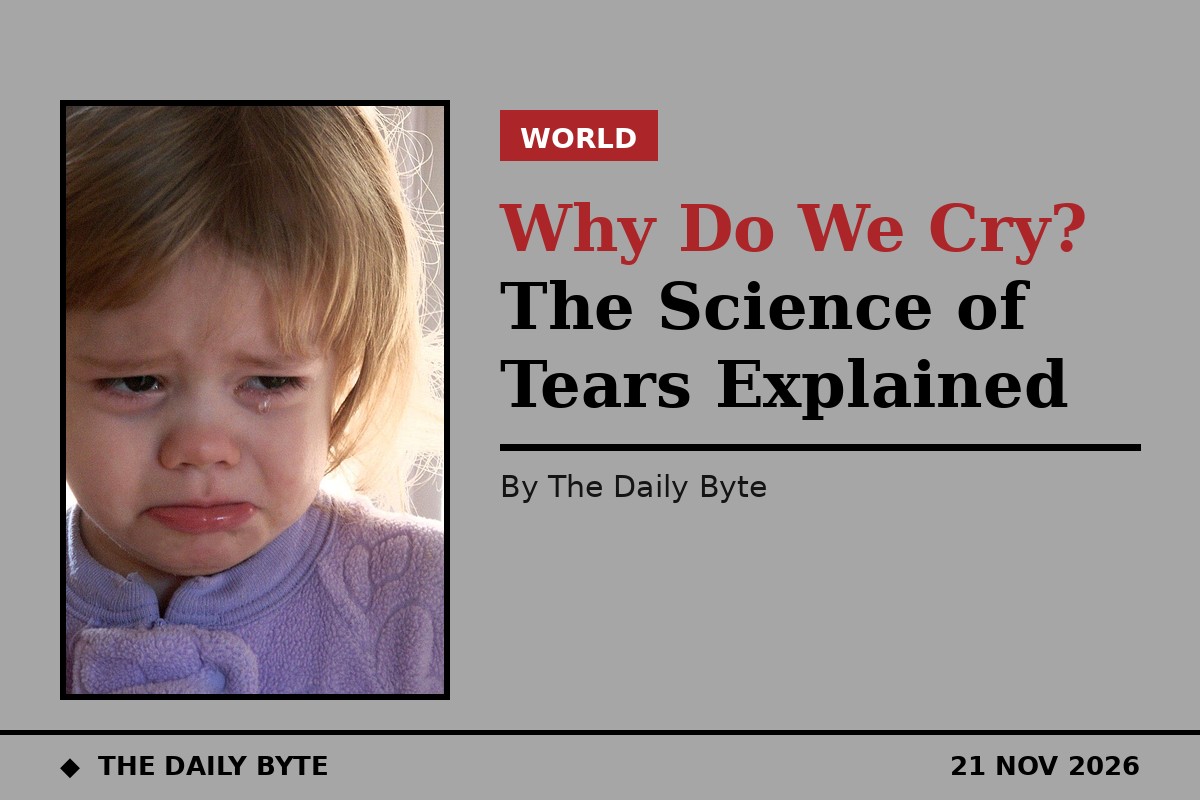
We cry because tears do two different jobs, and only one of them is about feelings. Basal tears coat and protect the eye all day, and reflex tears flush away irritants such as dust or onion fumes, while emotional tears are triggered by strong feelings and appear to be unique to humans. When you cry, your lacrimal glands, the tear glands above each eye, make fluid faster than your tear ducts can drain it, so the extra fluid spills over your eyelids and down your face. The trigger for the emotional kind runs through the brain's emotion centres, which is why grief, joy, anger, relief and even awe can all produce the same tears.
This explainer sets out the three kinds of tears and what each one does, how a feeling in the brain becomes fluid in the eye, what tears are actually made of, why emotional crying may have evolved, and when crying is a sign to see a doctor.
The three kinds of tears
Your eyes make tears all the time, and scientists divide them into three types by what triggers them. Basal tears flow continuously, day and night, at a rate of roughly half a microlitre to about two microlitres a minute. They coat the cornea, the clear window at the front of the eye, keeping it smooth so that light focuses properly, nourishing it, since the cornea has no blood vessels of its own, and protecting it from infection. Every blink spreads a fresh layer across the surface, and without basal tears every blink would feel like sandpaper and vision would blur.
Reflex tears are the emergency response. When something irritates the surface of the eye, a speck of dust, a stray eyelash, smoke, wind, or the gas released by a cut onion, nerves on the cornea send an alarm to the brain, and the lacrimal glands flood the eye with a much larger volume of watery tears to wash the irritant away. Irritation can increase tear production up to about a hundredfold, to roughly 300 microlitres a minute, which is why your eyes can stream within seconds of chopping an onion. The onion's gas, syn-propanethial-S-oxide, reacts with the tear fluid and irritates the nerve endings, and the reflex tears are simply the eye's way of flushing it out.
Emotional tears, also called psychic tears, are the third type, and they are the ones this question is really about. They flow in response to strong feelings: sadness and grief, but also happiness, anger, frustration, fear, relief, empathy and awe. Unlike the other two types, they are not triggered by anything touching the eye, and they are controlled by a different circuit, one that starts in the brain's emotion centres rather than on the surface of the cornea. Emotional crying of this kind appears to be unique to humans: other animals produce tears to protect their eyes, but none is known to shed tears from emotion.
How a feeling becomes a tear
The bridge between a feeling and a tear is the autonomic nervous system, the background network that runs the heartbeat, digestion and other functions without conscious control. When an emotional event is processed by brain regions including the amygdala, which handles emotion, the hypothalamus and the anterior cingulate cortex, the signal reaches the lacrimal glands through parasympathetic nerve fibres, and the glands step up production. The connection between the lacrimal gland and the brain areas involved in emotion has been demonstrated directly, which is why a feeling can make your eyes water within seconds.
The plumbing then decides whether you actually cry. Tears normally drain away through tiny openings called puncta at the inner corners of the eyelids, down the tear ducts and into the nose, which is why your nose runs when you cry. When the glands produce fluid faster than the ducts can drain it, the excess builds up until there is too much for the eyelids to hold, and it spills over the rim of the eyelid and down the cheek, exactly as water overflows a riverbank. That overflow is what we call crying, and it is a matter of volume as much as of emotion: the same glands, the same ducts, and a rate of production that has overtaken the drainage.
Babies show the other end of the same system. A newborn's cry is a distress call, and it works: it summons a caregiver, and it does so before the baby can speak or even understand what it is doing. As children grow, the same apparatus is put to new uses, expressing sadness, frustration, joy and empathy, and adults go on using it all their lives.
What is actually in a tear?
A tear looks like a drop of salt water, but it is a layered fluid made by several different glands. The tear film that coats the eye has three layers: a thin oily outer layer made by the meibomian glands along the eyelid margins, which slows evaporation; a watery middle layer, the bulk of the tear, made by the lacrimal glands, carrying salts, glucose, oxygen for the cornea, antibodies and germ-fighting proteins; and a mucous inner layer made by goblet cells in the conjunctiva, which helps the watery layer spread evenly instead of beading up. One of the proteins in tears, lysozyme, breaks apart bacterial cell walls, and it was discovered in 1922 by Alexander Fleming, years before penicillin, partly by studying his own tears.
Emotional tears differ chemically from the other kinds, and that difference has driven a lot of speculation. Research led by the biochemist William Frey at the University of Minnesota found that emotional tears contain higher levels of the stress hormone adrenocorticotropic hormone, known as ACTH, and of leucine enkephalin, a natural painkiller, as well as more protein in general than reflex tears. That finding gave rise to the popular idea that crying flushes stress hormones out of the body, but the amounts are small and no study has shown that the hormones in tears are the reason people feel better after crying. The honest position is that emotional tears are chemically different, and that the difference may matter, but that nobody has proved how.
What is better established is what happens around the crying. Strong emotion activates the sympathetic nervous system, the fight-or-flight branch, and crying is often followed by a parasympathetic rebound, the calming branch taking over, which slows the heart and steadies breathing. That sequence matches what people report: crying rarely feels good while it is happening, but many people feel calmer and clearer afterwards, as if something has been released. Whether the relief comes from the tears, the breathing, or the social response is hard to separate.
Why did emotional crying evolve?
Nobody knows for certain why humans alone shed emotional tears, but the leading explanation is social. Tears are a signal that cannot easily be faked: they are visible, involuntary and hard to produce on demand, which makes them a trustworthy sign of genuine feeling. A person in tears is visibly in need, and the usual response from those around them is sympathy, comfort and help. In that reading, crying is a form of nonverbal communication that evolved to elicit care from the group, and it works from the first days of life, when a baby's cry is the only way to summon help.
There is a related idea, that crying signals helplessness. Psychological research on crying emphasises that an underlying experience of perceived helplessness can usually explain why people cry, whether the trigger is grief, frustration, being overwhelmed, or even joy so strong it feels unmanageable. Tears blur vision and handicap aggressive or defensive action, which may function as a signal of appeasement: I am not a threat, I need help. That fits with the observation that people cry more readily in front of people they trust than in front of strangers, and that crying in a safe setting feels different from crying where it might be judged.
Both explanations may be true at once, and they are not the only ones. Crying may also help the person crying, by forcing a pause, by changing breathing, and by marking the moment as one that matters, which helps the brain process it. What the theories share is that they treat emotional tears as a human speciality tied to our social lives, not as a plumbing accident. Other animals have tear glands and use them to protect their eyes, but they do not appear to have connected those glands to their emotional lives, and that connection is what makes a human tear different from a dog's wet eye.
When crying is a sign to see a doctor
Ordinary crying needs no treatment, but there are situations worth a medical opinion. Watery eyes that never stop, even when you are not upset, are often caused by dry eye, paradoxical as that sounds: when the eye is too dry, the lacrimal glands overproduce reflex tears to compensate, and the excess spills over. A blocked tear duct, an eye infection, or an eyelid problem can do the same. Persistent watering, pain, redness, discharge, or a change in vision should be checked, because the cause is usually simple and treatable, but it needs to be found.
Crying that feels out of control is a different matter. Some neurological conditions, including stroke, multiple sclerosis and motor neurone disease, can cause pseudobulbar affect, in which a person laughs or cries suddenly, intensely and without matching what they feel, and it can be distressing and embarrassing. Crying that is frequent, overwhelming or out of proportion, or that comes with low mood, loss of interest, poor sleep or thoughts of harming yourself, is also worth discussing with a doctor, because it can be part of depression or anxiety rather than a passing emotion. None of this means crying itself is a problem: it is a normal, healthy response, and the question is only whether it is happening for a reason that needs attention.
Frequently asked questions
Why do we cry when we are happy? Because emotional tears are triggered by intensity, not by sadness alone. Joy, relief, awe and pride can activate the same brain circuits as grief, especially when the feeling is sudden or overwhelming, and the tears signal that the emotion is strong, not that it is negative. Happy tears are common at reunions, weddings, births and moments of unexpected good news.
Do men and women cry the same amount? No, on average women cry more often and for longer than men, a difference found across cultures and usually attributed to a mix of hormones, particularly prolactin, and social norms about expressing emotion. The gap narrows with age, and there is wide variation within each group, so it is a population average, not a rule about any individual.
Why does your nose run when you cry? Because tears drain into the nose. The puncta at the inner corners of the eyelids lead into the nasolacrimal duct, which empties into the nasal cavity, so when tear production rises, the extra fluid ends up in the nose as well as on the cheeks.
Can you cry without tears? Yes. Some people produce very few tears because of dry eye, medication, or damage to the lacrimal glands, and they can feel the emotion and make the sounds of crying without shedding tears. Older adults in particular may cry with fewer tears, and it does not mean the feeling is any less real.
Is crying good for you? Mostly, yes. It is a normal response, it can bring comfort and help from others, and many people feel calmer afterwards. What is not supported is the idea that tears detox the body: the stress hormones in emotional tears are present in small amounts, and there is no evidence that shedding them is what produces the relief. The benefit, as far as research can tell, comes from the social and physiological effects of crying, not from flushing chemicals out of the eye.


