Why Do We Get Goosebumps? Science Explained
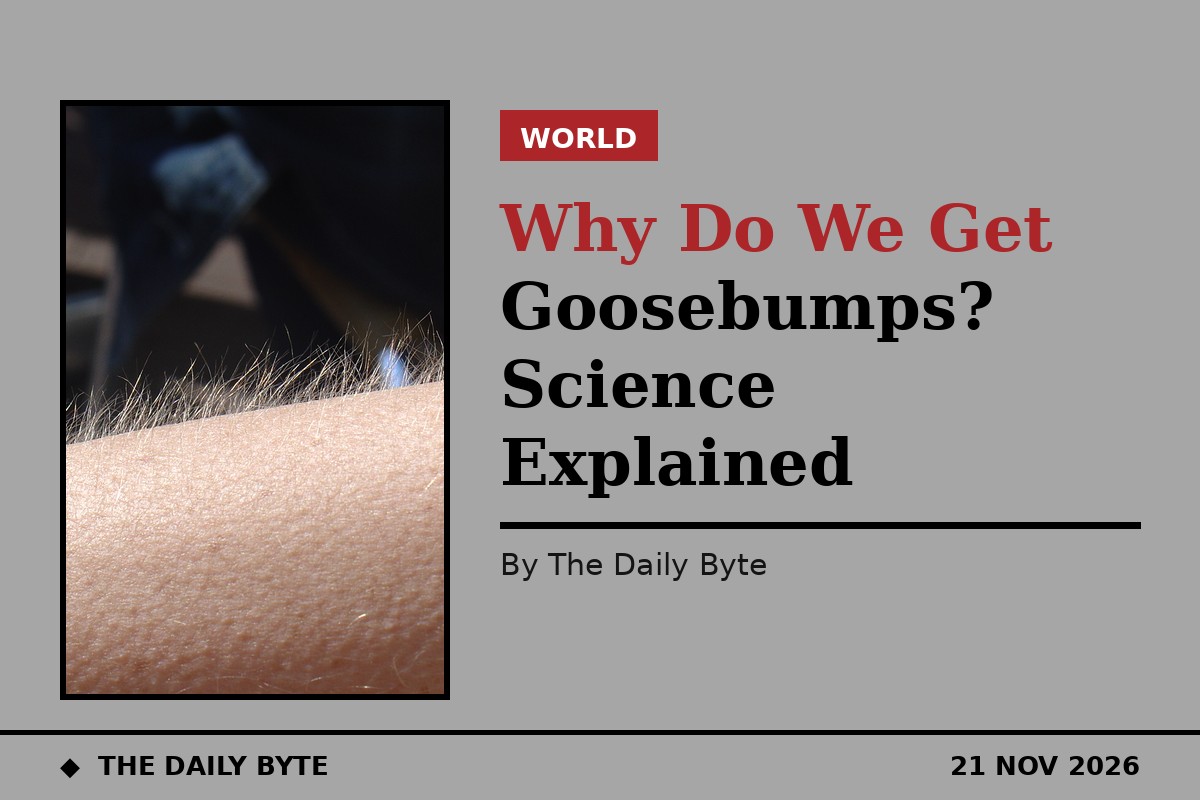
We get goosebumps because tiny muscles at the base of each hair, called arrector pili muscles, contract when our fight-or-flight nervous system switches on. Each muscle tugs its hair upright and puckers the skin around it into a small bump. Cold air is the most familiar trigger, but the same reflex fires when we are frightened, excited or moved by music, which is why a chill down the spine and a cold draught can produce exactly the same bumps.
The medical name for goosebumps is piloerection, and the reflex that produces them is called the pilomotor reflex. It is involuntary and automatic: nobody decides to get goosebumps, and nobody can switch them off by thinking about it. They appear within a second or two of the trigger, and they fade as the nervous system settles again. They are strongest on the forearms, but they also occur on the legs, the neck and other hairy areas of skin.
What happens under the skin?
Every hair on the body grows out of a tiny pocket in the skin called a hair follicle, and attached to each follicle is a sliver of smooth muscle, the arrector pili. These muscles answer to the sympathetic nervous system, the branch of the nervous system that handles the fight-or-flight response. When that system fires, it floods the body with adrenaline, the hormone that speeds up the heart rate, raises blood pressure and prepares the muscles for quick action. The same signal reaches the arrector pili muscles, which contract and pull each hair upright. As the hair rises, the skin around its base is pulled into a small raised bump.
That is the whole mechanism, and it explains why such different experiences produce the same result. A sudden drop in temperature, a frightening scene in a film, an angry confrontation and a piece of music that gives you shivers all activate the sympathetic nervous system, and the arrector pili muscles cannot tell one trigger from another. The reflex is the same whatever set it off.
Why does cold cause goosebumps?
Cold is the original trigger, and its purpose is clearest in furry animals. When an animal gets cold, its arrector pili muscles raise its fur, and the raised hairs trap a thicker layer of air against the skin. Still air is a good insulator, so the thicker the trapped layer, the slower the animal loses heat. The same raised fur also makes the animal look bigger, which can deter a rival or a predator. Both effects come from the same simple movement: hair standing on end.
Humans inherited the wiring but lost most of the fur. Our body hair is short and sparse, so raising it traps almost no air and provides almost no extra insulation. The Cleveland Clinic puts it plainly: in humans the response does not appear to have much of a purpose beyond helping us conserve a little heat, as the raised hairs close the pores and trap what remaining body heat we have underneath the surface of the skin. The reflex still fires because the nervous system that drives it is still there, even though the fur it was built for is mostly gone. Biologists call this a vestigial reflex, a leftover from an earlier stage of evolution that has outlived its original job.
Why does fear cause goosebumps?
Fear works through the same fight-or-flight system. When the brain perceives a threat, the amygdala, a part of the brain involved in decision-making and emotion, triggers the nearby hypothalamus, which links the nervous system to the hormone-producing endocrine system. The pituitary gland releases adrenocorticotropic hormone, and the adrenal glands above the kidneys release adrenaline. Heart rate and breathing quicken, blood is diverted to the muscles, and digestion and other non-essential systems are suppressed, all to prepare the body to fight or run.
The arrector pili muscles are caught up in that same surge. In a furry animal the raised fur would make it look larger and more threatening to whatever scared it, which is a genuine survival advantage. In humans the visible effect is just the familiar prickle across the arms, but the underlying sequence is identical. That is also why goosebumps can appear before we have consciously registered what frightened us: the sympathetic nervous system reacts faster than deliberate thought.
Why can music and strong feelings cause goosebumps?
The third family of triggers is emotional rather than physical, and it is the one people notice most. Goosebumps can be set off by intense or sudden feelings of fear, shock, anger or excitement, by intimacy and sexual arousal, and by what researchers call frisson, the psychogenic shivers that come from music, films, autonomous sensory meridian response videos or an empowering speech. A powerful piece of music, a scene in a film, or a moment of awe can produce the same bumps as a cold wind.
The reason is that strong emotion activates the same sympathetic nervous system. The brain does not keep separate circuits for cold, fear and awe; it runs one arousal system, and the arrector pili muscles respond to it whatever the cause. That is why the shiver from a favourite song feels so physical: it is physical, the same adrenaline-driven reflex as the shiver from stepping into cold air. People who remember their dreams, travel a lot or are highly educated are sometimes said to be more prone to such experiences, but the basic mechanism is the same in everyone.
Why are they called goosebumps?
The name comes from the look of the skin. When the tiny bumps rise at the base of each hair, the skin resembles the skin of a plucked goose, with its pattern of small raised dots where the feathers were removed. The comparison is old and has stuck in English, while other languages use their own bird or animal comparisons. The scientific terms are more precise but less vivid: piloerection for the raising of the hairs, and horripilation for the bristling effect as a whole.
What science found in 2020
For a long time goosebumps looked like a purely historical curiosity in humans, a reflex with no remaining function. Then, in 2020, a team led by Ya-Chieh Hsu at Harvard University, working with colleagues at National Taiwan University, published a study in the journal Cell that gave the reflex a new significance. Working in mice, they found that the sympathetic nerve that triggers goosebumps does not only connect to the arrector pili muscle. It also wraps around the stem cells that regrow hair, forming synapse-like contacts with them.
The finding linked two things that had looked separate. Short bursts of cold make the muscle contract and cause goosebumps, as expected. But longer cold exposure ramps up the nerve’s activity, which wakes the hair follicle stem cells and kicks off new hair growth. In other words, the same nerve that raises the hairs in the cold also tells the follicle to grow a thicker coat for the next cold spell. The work was done in mice, and it does not mean that getting cold will make human hair grow thicker, but it showed that the goosebump reflex is wired into the body’s hair-regrowth system, not just its emergency response.
When should goosebumps worry you?
Goosebumps themselves are nothing to worry about. They are a normal, involuntary response, and they pass on their own. But the Cleveland Clinic notes that if they are persistent without any known cause, they can occasionally be a symptom of an underlying condition, and it is worth knowing what those look like so the bumps themselves are not confused with something else.
One common source of confusion is keratosis pilaris, a harmless condition in which hair follicles become blocked by keratin deposits, leaving rough, bumpy, dry and red skin, usually on the upper arms, thighs or cheeks. Those bumps are permanent, not a reflex, and they do not come and go with cold or emotion. Another is autonomic dysreflexia, a potentially life-threatening overreaction of the autonomic nervous system after a spinal cord injury, in which goosebumps can appear alongside a sudden and severe spike in blood pressure. The goosebumps are not dangerous in themselves, but the blood pressure spike is, and it needs urgent medical attention. In both cases the important point is the same: ordinary goosebumps that come with cold, fear or music and then fade are normal, and persistent bumps with no trigger are worth showing to a doctor.
Frequently asked questions
Are goosebumps useful in humans?
Very little. In furry animals they trap insulating air and make the animal look bigger, but humans have too little body hair for either effect to matter much. The Cleveland Clinic notes they may help conserve a small amount of heat by closing the pores, but the reflex is largely a leftover from our evolutionary past.
Can you control goosebumps?
No. Goosebumps are an involuntary reflex run by the sympathetic nervous system, the same system that controls the fight-or-flight response. You cannot switch them on or off at will, although you can remove the trigger, for example by warming up or calming down, and they will fade on their own.
Why do I get goosebumps from music?
Strong feelings activate the same sympathetic nervous system as cold or fear, and the arrector pili muscles respond in the same way. The shivers from music, films, ASMR or an inspiring speech are called frisson, and they are the emotional version of the cold-triggered reflex.


