Why does Argentina claim the Falkland Islands?
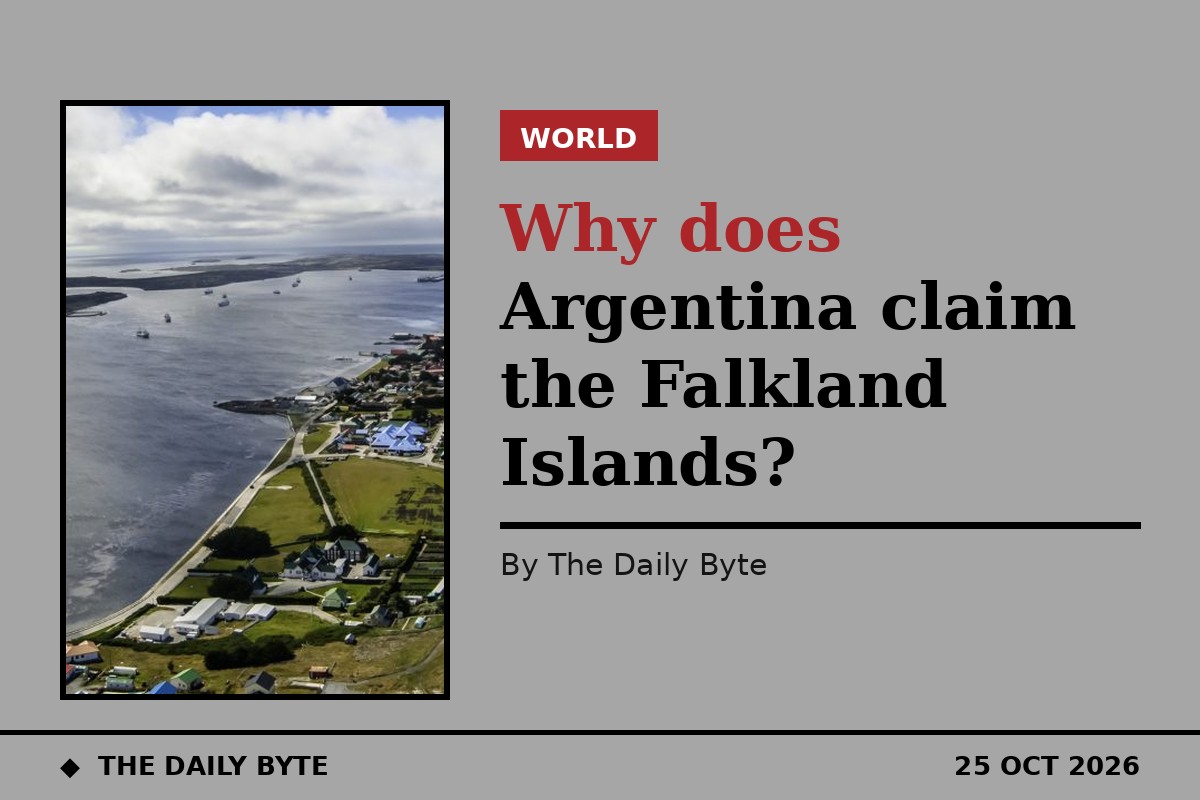
Argentina claims the Falkland Islands — which it calls the Islas Malvinas — because it says it inherited them from Spain at independence in 1816, and that Britain seized them by force in January 1833. Britain says it has administered the islands continuously since 1833 and that the islanders have repeatedly chosen to remain British. The dispute is back in the news in November 2026 over an international tribunal case about oil drilling near the islands.
What happened in 1833?
The islands were uninhabited before Europeans arrived. The first recorded landing was in 1690, by the English captain John Strong, and Britain took formal possession of West Falkland in 1765. After independence in 1816, Buenos Aires argued the islands passed to the new Argentine state under uti possidetis juris — the principle that new states inherit their former colonial power’s territories. An Argentine officer took possession in 1820, and Luis Vernet became governor in 1829. In January 1833 a British naval force reasserted control, removing the Argentine garrison without fighting. Britain calls that the restoration of an older claim; Argentina calls it an unlawful seizure.
What does each side argue today?
Argentina’s position, written into its constitution, is that the Malvinas are an integral part of its territory and that the islanders, implanted by Britain after 1833, cannot vote away its claim. Britain says the islanders have the right to self-determination under the UN Charter and that it will not discuss sovereignty without their consent. In 1965 the UN General Assembly recognised the dispute in Resolution 2065 and called for negotiations. The UN still lists the Falklands as a non-self-governing territory, and no international court has ruled on ownership.
What happened in the 1982 war?
In April 1982 Argentina’s military government, led by Leopoldo Galtieri, invaded, believing Britain would not respond. Britain retook the islands after a 74-day conflict ending on 14 June 1982, in which nearly 1,000 people were killed. There has been no military challenge since.
What did the islanders vote in 2013?
In a March 2013 referendum, 99.8% of voters — 1,513 of 1,517 valid votes — backed remaining a British Overseas Territory, on a turnout of about 92%. Britain cites the result as the islanders’ wishes; Argentina rejected it. Today the islands are a British Overseas Territory of about 3,600 people, some 480 kilometres east of Patagonia.
Why is the dispute in the news again in November 2026?
The trigger is the Sea Lion oil field, about 130 miles north of the islands and operated by Navitas Petroleum and Rockhopper Exploration. It holds an estimated 319 million barrels, with first oil expected in 2028, according to the House of Commons Library. In September 2026 President Javier Milei announced legislation to sanction companies working there without Argentine authorisation, and Argentina asked the International Tribunal for the Law of the Sea in Hamburg to halt the project, saying it breaches a UN resolution against unilateral action. Hearings were held on 10 and 11 November 2026. The UK says the hearing is not about sovereignty. President Donald Trump has said the US position is “under review”.
Frequently asked questions
Are the Falkland Islands part of the UK? No — a British Overseas Territory, not part of the UK itself, though the UK handles defence and foreign affairs.
Has any court decided ownership? No — and the Hamburg case concerns the oil project under the Law of the Sea Convention, not sovereignty.
Why does Argentina cite the UN? It relies on Resolution 2065 (1965), which recognised the dispute and called for negotiations.
Sources: House of Commons Library; Reuters.


