Why Does the Moon Shine?
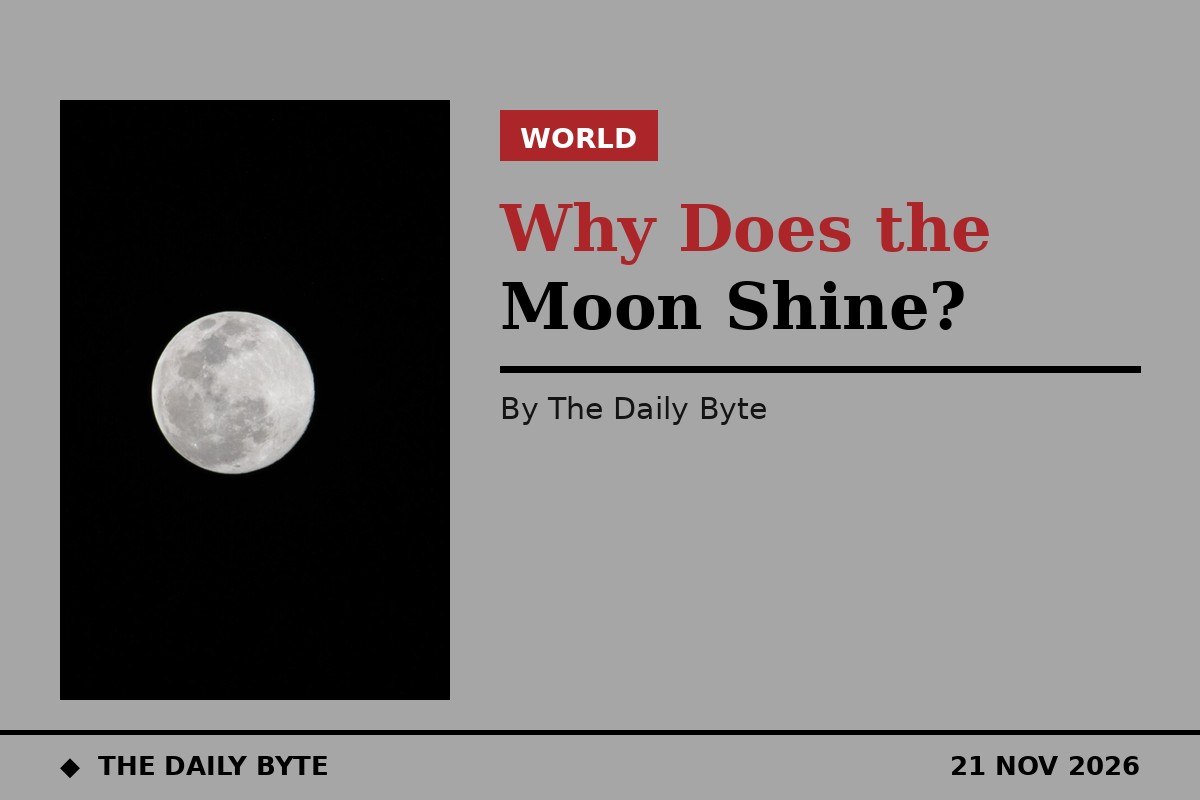
The Moon shines because it reflects sunlight. It makes no light of its own: the glow you see at night is sunlight that has travelled about 150 million kilometres from the Sun, bounced off the Moon's rocky surface, and travelled about 385,000 kilometres back to your eyes. The Moon is, in effect, a giant dusty mirror in the sky, and it looks brilliant only because you see it against the blackness of space, and because it is far closer to us than anything else in the night sky.
This explainer sets out why the Moon looks so bright when its surface is actually darker than asphalt, what the surface is made of, why the Moon appears to change shape through the month, how we know the light is reflected and not the Moon's own, why moonlight is so much dimmer and cooler than sunlight, and what happens during a lunar eclipse, when the Moon can turn red.
The Moon makes no light of its own
The Moon does not make its own light. NASA puts it plainly: moonlight is actually reflected sunlight. At any moment, half of the Moon is brightly sunlit, the day side, and the other half is in darkness, the night side. Throughout the month, as the Moon rotates and orbits, day and night sweep across different parts of its surface, just as they do on Earth. Unlike our planet, though, the Moon takes a whole month to complete one rotation, so lunar day and night are each about two Earth weeks long. The Sun is the only source of the light: take the Sun away and the Moon would vanish from the sky entirely.
That is the crucial difference between the Moon and the stars. A star is a ball of gas hot enough to make its own light through nuclear reactions in its core. The Sun does this, which is why it blazes. The Moon is a cold, solid ball of rock, and rock does not glow. Everything you have ever seen of the Moon, in the sky, in photographs, or in the eyes of the Apollo astronauts who walked on it, was lit by the Sun.
Why does it look so bright when the surface is so dark?
Here is the strange part: the Moon's surface is dark. Much of it is shades of dark grey, like rocks found near volcanoes on Earth, and overall only about one-tenth of the sunlight that hits the Moon is reflected back into space. Scientists call the fraction of light a body reflects its albedo, and the Moon's albedo is only about 0.1. For comparison, Earth bounces about three-tenths of incoming sunlight back into space, thanks to its clouds, oceans and ice, and Venus, wrapped in thick white cloud, reflects well over half. The Moon's surface is, by any objective measure, about as reflective as worn asphalt.
So how does a dark, volcanic rock outshine Venus in our sky? It all comes down to distance. The Moon orbits Earth at an average distance of about 239,000 miles, or 385,000 kilometres. That is a long way by human standards, but almost nothing compared to the tens of millions of miles that separate Earth and Venus. Thanks to this relative closeness, a full Moon directs enough sunlight towards our planet to cast sharp shadows on the ground. The Moon's albedo may be tiny, but even a small amount of reflected sunshine is enough to make the Moon seem brilliant from our perspective on Earth.
The second reason is contrast. You see the Moon against the blackness of space or the dark night sky, and your visual system judges brightness relative to its surroundings. A charcoal-grey ball looks brilliant when everything around it is pitch black. The same trick works on Earth: a grey stone looks white under a streetlight at midnight. The Moon is not bright in absolute terms. It only looks bright because of where it is and what surrounds it.
What is the Moon's surface made of?
The Moon's top layer is not smooth rock. It is covered in a blanket of fine, broken-up material called regolith, built up over billions of years of micrometeorite bombardment. This powdery layer is full of tiny glass beads, mineral fragments and welded clumps of dust, and the way these particles scatter sunlight determines how bright the Moon appears at any given phase. The dark patches you can see with the naked eye, the shapes people call the man in the Moon, are ancient seas of hardened lava, made of a dark volcanic rock called basalt, which reflects very little light. The brighter highlands are made of a paler rock called anorthosite, which reflects more.
That patchwork is why the Moon is not uniformly bright. The dark maria absorb most of the light that reaches them, while the highlands bounce more of it back, and the contrast between them is what gives the full Moon its familiar face. When the Apollo crews brought home 382 kilograms of lunar rock, it turned out to be dull grey stone, the same dark material the telescopes had always shown. The glow was never in the rock. It was in the sunlight hitting it.
Why does the Moon appear to change shape?
The Moon is always a round sphere, but it appears to change shape because of the way sunlight falls on it as it orbits Earth. The Sun always lights exactly one half of the Moon, the half facing the Sun, and what we see depends on how much of that lit half happens to face us. When the Moon is between Earth and the Sun, the lit half faces away from us and we see a new Moon, dark and invisible. As it moves around its orbit, a sliver of the lit side comes into view, a crescent, then a half Moon, then a gibbous Moon, and finally a full Moon, when the whole Earth-facing side is lit. Then the sequence runs in reverse.
The phases are really just the overlap between lunar daylight and the Moon's Earth-facing side, and in every phase the bright edge of the Moon faces the Sun, while the horns of a crescent point away from it. The cycle takes about 29.5 days, which is why the word month comes from the word Moon. It also explains why the Moon is sometimes visible in the daytime: it is up there in daylight too, lit by the same Sun that lights us, but against a bright blue sky it is far less obvious than it is at night.
How do we know the light is reflected sunlight?
Most of us believe the Moon reflects sunlight for one reason: a teacher said so. But the proof is better than the fact, and it was worked out about 2,500 years ago with no telescope. The Greek thinker Parmenides, born around 515 BCE, recognised that the Moon shines by reflecting light from the Sun, and Anaxagoras turned the clue into a proof, arguing that the Moon was a solid ball that light could not pass through, one that reflects light. Anaxagoras was prosecuted for impiety for saying the Moon was a rock, fled Athens, and was right.
Four separate clues prove it, each from a different direction. First, the bright side of the Moon always faces the Sun, in every phase, exactly as a lit ball would. Second, the Moon goes dark only when Earth blocks the Sun's light from reaching it, which is a lunar eclipse, and the Sun goes dark only when the Moon blocks it, which is a solar eclipse: eclipses are one body screening another. Third, moonlight carries the Sun's fingerprint in its spectrum, the same pattern of dark lines, called Fraunhofer lines, that sunlight carries, because it is the same light, bounced. Fourth, the Moon sends back only about 11 to 16 percent of the light it gets, close to old asphalt, which is what a dark rock should do, not what a glowing body would do.
Why is moonlight dimmer and cooler than sunlight?
Moonlight is the same light as sunlight, but far weaker. A full Moon lights the ground about a millionth as strongly as direct sunlight, which is why you can stare at the full Moon comfortably but never at the Sun. The light has been spread out and thinned twice: once on the way from the Sun to the Moon, and again on the way from the Moon to Earth, and most of it was absorbed by the dark rock on arrival. What reaches you is a faint echo of the Sun's blaze.
Moonlight also feels cooler, and in a real sense it is: it carries almost no heat, because the infrared part of sunlight, the part you feel as warmth, is mostly absorbed by the lunar surface rather than reflected. That is also why plants do not photosynthesise by moonlight in any meaningful way, and why the night stays cold under a full Moon. The light is real sunlight, but it is sunlight that has lost almost all of its energy on the round trip.
There is one more brightness effect worth knowing. When the Sun, Earth and Moon line up so that sunlight hits the lunar surface and bounces almost straight back towards you, the Moon brightens sharply. This is the opposition surge, and it happens near the full Moon, when the Sun is directly behind the viewer. Part of the surge is shadow hiding: at very small angles each grain of regolith hides its own shadow from you, so the surface appears to have no dark spots at all. Research over recent decades has shown that a second mechanism, called coherent backscatter, contributes roughly equally: light waves scattering among the fine particles interfere constructively in the backward direction, brightening the return.
What happens during a lunar eclipse?
A lunar eclipse can only happen at full Moon, when the Moon is on the opposite side of Earth from the Sun. If the three bodies line up closely enough, Earth moves directly between the Sun and the Moon, and its shadow falls across the lunar surface. The Moon does not vanish, though, because Earth's atmosphere bends some sunlight around the planet and onto the Moon, and the atmosphere scatters away the blue light, leaving only the red and orange to get through. That is why a totally eclipsed Moon turns a deep copper red, and is often called a blood Moon.
The red Moon is the most dramatic proof of all that moonlight is borrowed light: when Earth blocks the Sun, the Moon goes dark, and the only light that reaches it is sunlight filtered through Earth's own air. Lunar eclipses are also visible from anywhere on Earth's night side, unlike solar eclipses, which are visible only along a narrow path, because the Moon is large enough for the whole night side of Earth to see it at once.
The view from the Moon
The Apollo astronauts saw the other side of the bargain. Standing on the Moon, they watched the Earth hang in a black sky, shining far brighter than the Moon ever shines for us, because Earth is bigger and far more reflective, with its white clouds and blue oceans. From the lunar surface, the Sun is a fierce white disc, and the shadows are pitch black, because there is no air to scatter light into them. The astronauts left mirrors on the surface, and scientists on Earth still bounce lasers off them to measure the Moon's distance to within centimetres.
There is also a faint glow called earthshine. When the Moon is a thin crescent, the dark part of its disc is sometimes faintly visible, lit not by the Sun but by sunlight reflected off Earth. It is the same idea in reverse: Earth lending the Moon a little of its light, just as the Moon lends us the Sun's. On a clear night, with the naked eye, you can see it yourself, and it is a quiet reminder that the Moon's light, and our own planet's, are both borrowed from the same star.
Frequently asked questions
Does the Moon shine during the day? Yes, and it is often visible in daylight, as a pale disc in a blue sky. It shines whenever sunlight hits it, which is always, but against a bright sky it is far less obvious than against the dark of night, so most people only notice it after sunset.
Why is the Moon sometimes orange near the horizon? For the same reason the Sun looks orange at sunset. When the Moon is low, its light passes through much more of Earth's atmosphere, which scatters the blue light away and lets the red and orange through. The Moon itself has not changed colour: the air between you and it has filtered the light.
Is the Moon bigger when it is near the horizon? No, and this is the Moon illusion. The Moon is the same size in the sky wherever it is, but near the horizon your brain compares it with trees, houses and hills, and judges it larger. Photographs prove it: measure the Moon's disc and it is the same width at the horizon as it is overhead.
Why do we always see the same side of the Moon? Because the Moon spins on its axis in the same amount of time that it orbits Earth, about 27.3 days, so the same face is always turned towards us. The far side still gets sunlight, a full day and night cycle of about two Earth weeks each, but we never see it from the ground. The first photographs of the far side were taken by the Soviet probe Luna 3 in 1959.
Can you read by moonlight? Just about, under a full Moon on a clear night, though not comfortably. The full Moon is bright enough to cast sharp shadows and to pick out large print, but a millionth of sunlight is still a millionth of sunlight, and your eyes need far more light to read easily than to walk by. That is why humans invented lamps, and why the full Moon has always been a lantern rather than a reading light.


