Why France Fears Germany's Long-Range Missiles
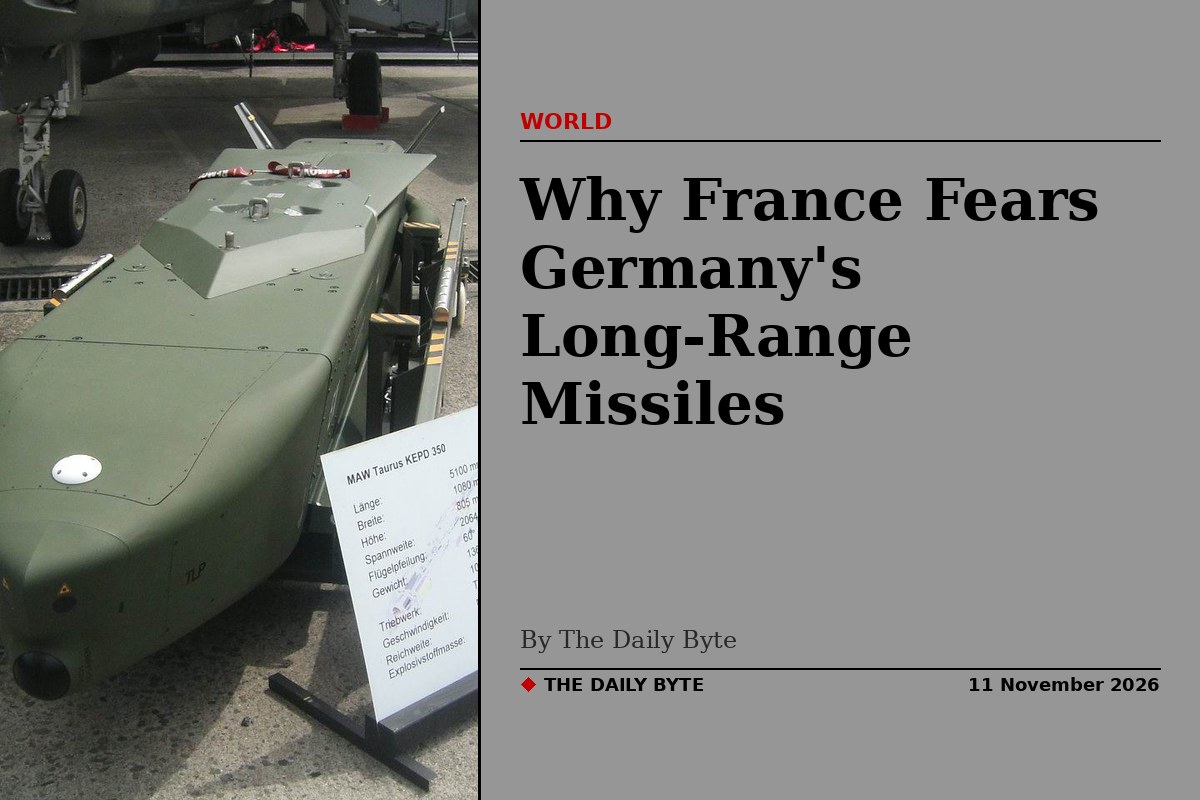
France is pressing Germany to spell out how it would use its planned long-range missiles in a war with Russia, because Paris fears Moscow could mistake a conventional strike for a nuclear attack. According to a Financial Times report published on 11 November 2026, citing six people familiar with the talks, France wants Berlin's rules for deep precision strikes to be aligned with French nuclear strategy. One French official put the danger bluntly: "If the Russians don't get the signal right, you could get to the nuclear threshold without realizing."
The row is not about whether Germany should have long-range weapons. It is about what happens after they are fired. Germany is acquiring and developing ground-launched missiles with ranges of 500 kilometres to more than 2,000 kilometres, giving it the ability to strike deep inside Russia once the weapons are fielded. France's worry is that a missile aimed at a conventional military target could be read in Moscow as an attack on Russia's nuclear forces — and answered accordingly. This explainer sets out what France asked for, what Germany is building, why the confusion is possible, and what happens next.
What did France actually ask Germany?
France has asked Germany to define, clearly and in advance, when and how it would fire long-range missiles in a conflict with Russia. Paris wants Berlin's doctrine for deep precision strikes — the rules governing long-range attacks on targets far behind the front line — to fit with France's own nuclear strategy, so that a conventional strike by one ally does not accidentally cross a line that the other ally treats as nuclear.
One French official argued for a doctrine made public enough to reduce the risk of miscalculation, according to the Financial Times. The logic is that deterrence only works if the other side understands what you are doing. A secret set of rules, or no agreed rules at all, leaves Moscow to guess — and guessing wrong in a crisis is how wars escalate.
Berlin has backed the idea of a common approach. A senior German official said Berlin shared the goal of agreeing on when to use the missiles and how to manage escalation, and that formal talks had gathered pace after delays linked to France's internal debate over its nuclear strategy. A joint statement by France, Germany and the United Kingdom was one possibility, though the German official said it was still some way off.
What missiles is Germany building?
Germany's long-range programme is part of a much wider rearmament effort following Russia's full-scale invasion of Ukraine, and growing uncertainty over American security commitments to Europe under President Donald Trump. Paris has focused on Berlin in part because Germany has earmarked €780 billion for defence over the five years through 2030 — a scale of spending that makes its choices matter for the whole continent.
| Key fact | Detail |
|---|---|
| Missile ranges | Ground-launched systems of 500 km to more than 2,000 km |
| Main programme | Deep Precision Strike, developed through British-German defence cooperation |
| Framework | Trinity House Agreement, signed 23 October 2024 by the UK and German defence ministers |
| Weapons envisaged | Stealth cruise missiles and hypersonic systems able to travel more than 2,000 km |
| Deployment | Operational use envisaged for the 2030s |
| German defence spending | €780 billion earmarked over the five years through 2030 |
| France's demand | Clear, shared rules for when and how the missiles would be used |
The central element is the Deep Precision Strike programme, developed through British-German defence cooperation. Under the Trinity House Agreement, signed on 23 October 2024 by British Defence Secretary John Healey and German Defence Minister Boris Pistorius, Britain and Germany are working on weapons with a range beyond 2,000 kilometres. Among the ambitions is a family of long-range weapons, including stealth cruise missiles and hypersonic systems, with operational deployment envisaged for the 2030s.
Germany's defence ministry has said the two countries are exploring whether France could join the programme. France had earlier been involved in the talks but paused its participation while its own nuclear doctrine was debated internally. The timetable matters: Europe is planning capabilities whose strategic consequences must be considered well before they enter service, not after.
The photograph with this article shows a Taurus KEPD 350 cruise missile on display at an air show. The Taurus is an existing German-Swedish air-launched cruise missile, with an official range in excess of 500 kilometres and in service since 2006. It is not the new ground-launched system at the centre of the French-German dispute, but it illustrates the kind of long-range weapon Germany already operates.
Why could a conventional missile look like a nuclear attack?
The danger is not that Germany intends to acquire nuclear weapons. Its new missile programmes are strictly conventional. The difficulty lies in how Russia might interpret their use during a confrontation — particularly if a strike threatened facilities associated with its strategic military capabilities.
A missile launched from European territory could potentially reach targets deep inside Russia. Depending on its intended target, Moscow might struggle to determine whether the attack was designed to disrupt conventional military operations or threaten assets central to Russia's nuclear deterrent. The distinction could become particularly difficult during a rapidly developing military crisis, when leaders have minutes rather than days to judge what has just happened.
A senior British official explained the intended purpose of the strikes: they are meant to weaken an enemy's ability to fight by targeting sites such as command centres, logistics hubs, ammunition depots and weapons factories. "All of us are conscious of the need not to provoke escalation to nuclear level," the official said. But intent is not the same as perception. If the target happens to sit near a nuclear facility, or if the strike looks like the opening move of a wider attack, the other side may not wait to find out what was intended.
General Ingo Gerhartz, who leads the NATO command responsible for central Europe and the alliance's eastern flank, told the Berlin Security Conference that allies should consult before carrying out deep strikes. He warned that Russia would attribute a strike by an individual member to the alliance as a whole — so a German decision could have consequences for every NATO country, including France.
What is France's nuclear doctrine — and why does it matter here?
France approaches these questions from a different strategic position than Germany. Its nuclear doctrine is based on maintaining an independent deterrent capable of inflicting unacceptable damage on an aggressor threatening French vital interests. The decision to employ nuclear weapons belongs exclusively to the French president. Unlike doctrines built around a series of calibrated nuclear responses, the French approach has traditionally resisted treating nuclear weapons as instruments for managing successive stages of battlefield escalation. Paris has also maintained its independence from NATO's nuclear planning arrangements.
These principles place firm limits on the emerging Franco-German cooperation. Germany cannot authorise a French nuclear strike, exercise a veto over French nuclear decisions, or assume that closer consultations create an automatic French nuclear guarantee. Equally, the existence of a bilateral nuclear steering group does not establish French command authority over German conventional forces. The negotiations concern strategic coordination, not the transfer of sovereign military powers.
Nevertheless, France has a substantial interest in understanding how German long-range weapons might be employed. An independently authorised conventional strike could produce consequences affecting French security, even if Paris had no role in the original decision. That is the heart of President Emmanuel Macron's concept of "forward deterrence": he said in March that he would open a debate on how France's nuclear forces could help protect European partners. French officials worry that under that concept, Moscow could hold Paris responsible for strikes carried out by those partners.
Paris and Berlin have already established a bilateral nuclear steering group for doctrinal dialogue, and the Franco-German declaration of 17 July 2026 provided an institutional basis for bringing nuclear deterrence together with conventional long-range capabilities, deep precision strike systems and missile defence. Germany's participation as an observer in France's strategic nuclear exercise, Exercise Poker, provides another channel for developing familiarity with French deterrence practices.
What is Britain's role?
Britain adds another dimension to the Franco-German negotiations. London is Germany's principal partner in the Trinity House framework, which establishes regular defence consultations and supports joint capability development. Although the agreement is not legally binding, its institutional arrangements provide a continuing basis for cooperation on advanced military technologies and strategic questions.
Britain and Germany are therefore building long-range conventional capabilities through one bilateral relationship, while Germany discusses their nuclear implications with France through another. The two processes are connected strategically but remain institutionally distinct — an arrangement that illustrates the difficulty of coordinating European defence programmes that operate through overlapping national partnerships.
France possesses an independent nuclear deterrent. Britain is also a nuclear-armed European power, while Germany and other European allies are concentrating on expanding conventional capabilities. Their military contributions are complementary in some respects, but their decision-making structures are not unified. For Poland and the Nordic and Baltic states, the implications extend beyond Franco-German diplomacy: long-range conventional weapons could strengthen deterrence by increasing the potential costs of aggression, yet their credibility also depends on an adversary understanding the circumstances in which they might be used.
What happens next?
For now, the most consequential uncertainty concerns what happens when consultation and national military decision-making collide. The practical arrangements made so far — the steering group, the July declaration, observer participation in Exercise Poker — represent steps towards greater understanding, but they do not resolve the hardest operational questions.
Publicly available information does not establish whether France would receive advance notification of particular German long-range strike decisions, whether either government has proposed restrictions on target selection, or how disagreements would be handled during an immediate military emergency. There is also no verified public evidence of a French veto over German targeting decisions. That distinction matters, because consultations conducted during peacetime cannot necessarily reproduce the pressures of a military crisis: political leaders might agree on broad principles concerning escalation while disagreeing about whether a particular target falls within them.
The talks will continue, and a joint statement by France, Germany and the United Kingdom remains a possibility — though officials say it is still some way off. Until then, the argument is a reminder of an awkward reality for European defence planners: countries are developing increasingly powerful conventional weapons without a common system for deciding how their use might affect nuclear deterrence. Stronger European capabilities do not automatically produce a coherent European strategy, and the French-German negotiations are an attempt to manage some of those differences before the weapons themselves arrive in the 2030s.
Frequently asked questions
Why does France fear Germany's long-range missiles? France fears that Russia could misread a conventional German long-range strike deep inside Russian territory as an attack on Russia's nuclear forces, and respond with nuclear weapons. Paris wants clear, shared rules for how the missiles would be used so the signal cannot be misunderstood.
Is Germany building nuclear missiles? No. Germany's new missile programmes are strictly conventional. The concern is about how Russia might interpret their use, not about Germany acquiring nuclear weapons.
How far can Germany's new missiles reach? Germany is acquiring and developing ground-launched missiles with ranges of 500 kilometres to more than 2,000 kilometres. The British-German Deep Precision Strike programme envisages weapons able to travel more than 2,000 kilometres, with deployment in the 2030s.
What is the Trinity House Agreement? It is the UK-German defence agreement signed on 23 October 2024 by British Defence Secretary John Healey and German Defence Minister Boris Pistorius. It established closer military cooperation, including the joint development of long-range weapons under the Deep Precision Strike programme.
Does France control Germany's missiles? No. France cannot authorise or veto German conventional strikes, and Germany cannot authorise a French nuclear strike. The talks are about consultation and coordination between two sovereign governments, not about one controlling the other's armed forces.
Sources: Clash Report — France, Fearing Nuclear War, Wants Germany to Clarify Missile Doctrine (reporting the Financial Times, 11 November 2026); Nexus Europa — France Warns Germany: Long-Range Missiles Could Trigger Nuclear Escalation. Taurus missile facts from Wikipedia — Taurus KEPD 350.


