Why Has Nvidia Lost $430bn in Two Days?
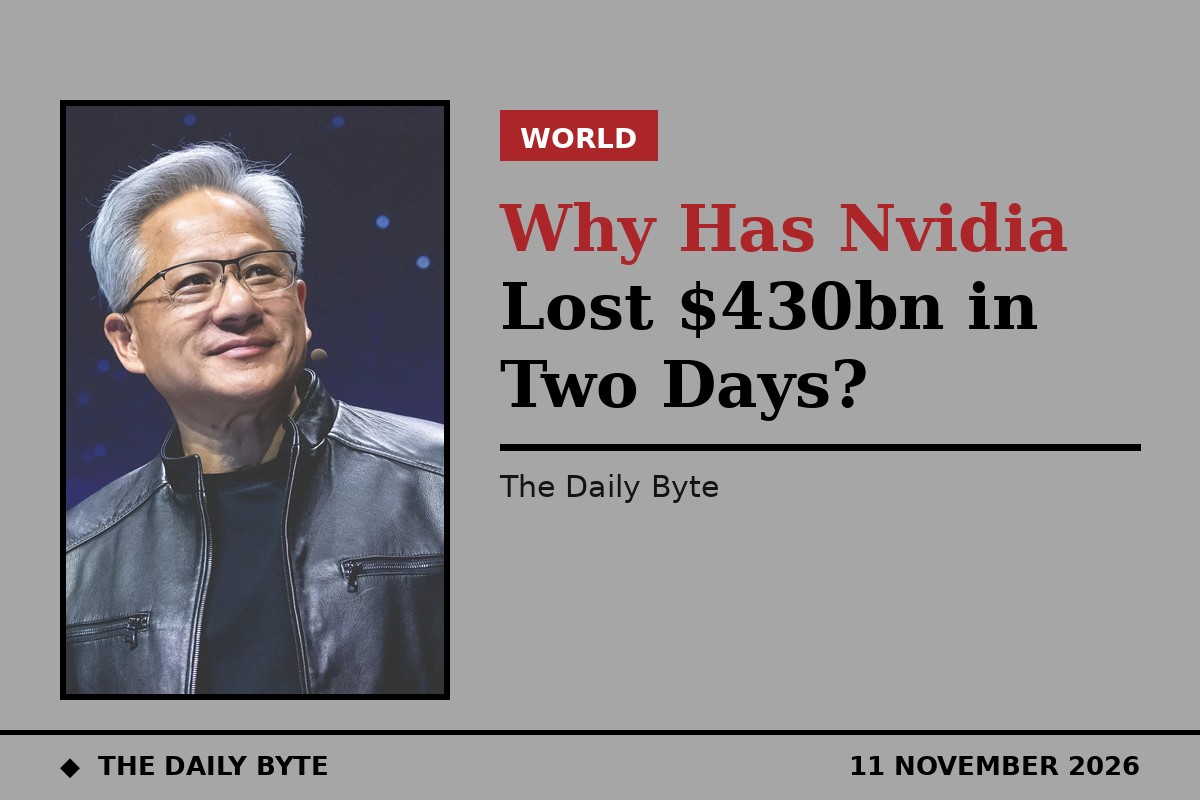
Nvidia has lost about $430 billion in market value in just two trading sessions, after its chief executive, Jensen Huang, admitted to an affair with a woman alleged by US intelligence to be a Chinese spy. The chipmaker's shares fell 4.3 per cent on Monday 9 November and a further 5.5 per cent on Tuesday 10 November, closing at $168.89, as investors weighed a board investigation, a possible FBI inquiry and a shareholder lawsuit. The episode has turned a personal admission into a question about corporate governance, export controls and the leadership of the world's most valuable chip company.
The fall is striking because Nvidia's shares had been almost flat for the year before the reports emerged. Within two days, the company had given up roughly a tenth of its value. This explainer sets out what is known, what is still alleged rather than proven, and what investors and regulators are watching next.
What happened to Nvidia's share price?
Nvidia's shares dropped 4.3 per cent on Monday 9 November, wiping about $190 billion from the company's market value in a single session. They fell again on Tuesday, closing 5.5 per cent lower at $168.89. Across the two sessions, the total loss in market value was about $430 billion, according to Reuters estimates reported by several outlets. That left Nvidia valued at about $4.1 trillion. Since the controversy first emerged, the shares have fallen about 9.5 per cent, underperforming the wider US market.
Who is Jensen Huang and what has he admitted?
Jensen Huang, 63, co-founded Nvidia in 1993 and has led it ever since, turning a graphics-chip maker into the dominant supplier of the processors that power artificial intelligence. He is one of the most closely watched chief executives in technology, and Nvidia's fortunes are widely seen as tied to his leadership. In an open letter posted on Nvidia's website, Huang admitted to having an extramarital affair with a business executive and apologised to his wife. He did not name the woman in that statement. According to CNBC, he also apologised to Nvidia's senior executives at a closed-door meeting on 9 November, before returning to the company's headquarters the following day.
What are the allegations about Alice Huang and China?
The woman at the centre of the reports is Alice Huang, also known as Huang Le, a Chinese businesswoman and former executive at Megaspeed, a Singapore-registered company that is a customer of Nvidia. The New York Times reported that US intelligence had determined she was gathering information for Beijing, and that Secretary of State Marco Rubio had briefed President Donald Trump about the intelligence aboard Air Force One in May. China’s Foreign Ministry has described the espionage allegations as groundless. Alice Huang is not related to Jensen Huang.
A separate report by The Information, a business publication, said the relationship had helped facilitate shipments of at least $7.5 billion worth of Nvidia chips to Chinese companies, including Alibaba and Tencent. The report said about 240,000 H100, H200 and A100 chips were involved, procured through a network of companies in China and Singapore. Reuters said it could not independently verify those reports. The United States restricts the sale of advanced AI chips to China, so any suggestion that the controls were circumvented raises serious questions for regulators, lawmakers and Nvidia itself. None of the allegations has been the subject of announced criminal charges against either Jensen Huang or Alice Huang.
Why are investors so worried?
Investors are weighing three separate risks. The first is governance: whether the chief executive of a company worth trillions of dollars could have been compromised, or exposed to blackmail, by a foreign intelligence operation. The FBI is examining whether Huang was the target of such an operation, and President Trump said on Monday that the FBI was looking into the matter. Trump also said he had spoken to Huang, who told him he had no knowledge that the woman was a spy.
The second risk is regulatory. If Nvidia chips reached China in breach of US export controls, the company could face investigations, fines or tighter restrictions, and its ability to sell into one of the world's largest markets could be further limited. Senate Democratic Leader Chuck Schumer has urged the administration to give transparent answers and to tighten limits on chip exports. The third risk is leadership: Nvidia's board has launched an internal investigation, and a shareholder class action has been filed in a federal court in San Jose, California, accusing the company and Huang of misleading investors over failures to disclose potential national security risks linked to the affair. Some lawmakers have gone further and called for Huang to step down, although Trump has publicly backed him staying in the role.
What is the board investigation?
Nvidia's independent directors have appointed Joon Kim, a partner at the law firm Wachtell, Lipton, Rosen and Katz and a former acting US Attorney for the Southern District of New York, to lead an internal investigation. The board said it currently had no basis to believe that US national security or company secrets had been compromised, and that Huang had committed to cooperating fully with the review. The investigation is expected to examine the circumstances of the relationship, whether any company information or technology was shared, and whether export-control rules were followed. Nvidia has not put a timetable on the inquiry.
What happens next?
Three things will shape what happens next. The board investigation will determine whether Nvidia takes any action against its chief executive or changes its internal controls. The FBI inquiry will establish whether Huang was targeted by a foreign intelligence operation and whether any laws were broken. And the shareholder lawsuit will test in court whether investors were misled. Until those processes produce findings, the share price is likely to remain sensitive to each new report. For now, Huang remains chief executive, the board says it has no evidence that secrets were compromised, and the allegations about espionage and chip shipments remain unproven.
Frequently asked questions
How much value has Nvidia lost? About $430 billion in market value across the trading sessions of Monday 9 and Tuesday 10 November 2026, according to Reuters estimates, after falls of 4.3 per cent and 5.5 per cent.
Has Jensen Huang been charged with anything? No. No criminal charges have been announced against Huang or Alice Huang. The board investigation and the FBI examination are inquiries, not charges, and the shareholder case is a civil lawsuit.
Did Nvidia chips reach China? The Information reported that at least $7.5 billion worth of Nvidia chips reached Chinese firms through a network of companies. Reuters said it could not independently verify that report, and the claim has not been confirmed by Nvidia or by US authorities.
Is Jensen Huang still Nvidia's chief executive? Yes. He remains chief executive, has returned to work at Nvidia's headquarters, and has pledged to cooperate with the board's investigation.
What is Nvidia? Nvidia is an American technology company that designs graphics processing units and AI chips. Its processors power most of the world's large artificial intelligence systems, which is why its share price is watched as a barometer of the AI boom.


