Why is France accusing Iran of hacking fridges?
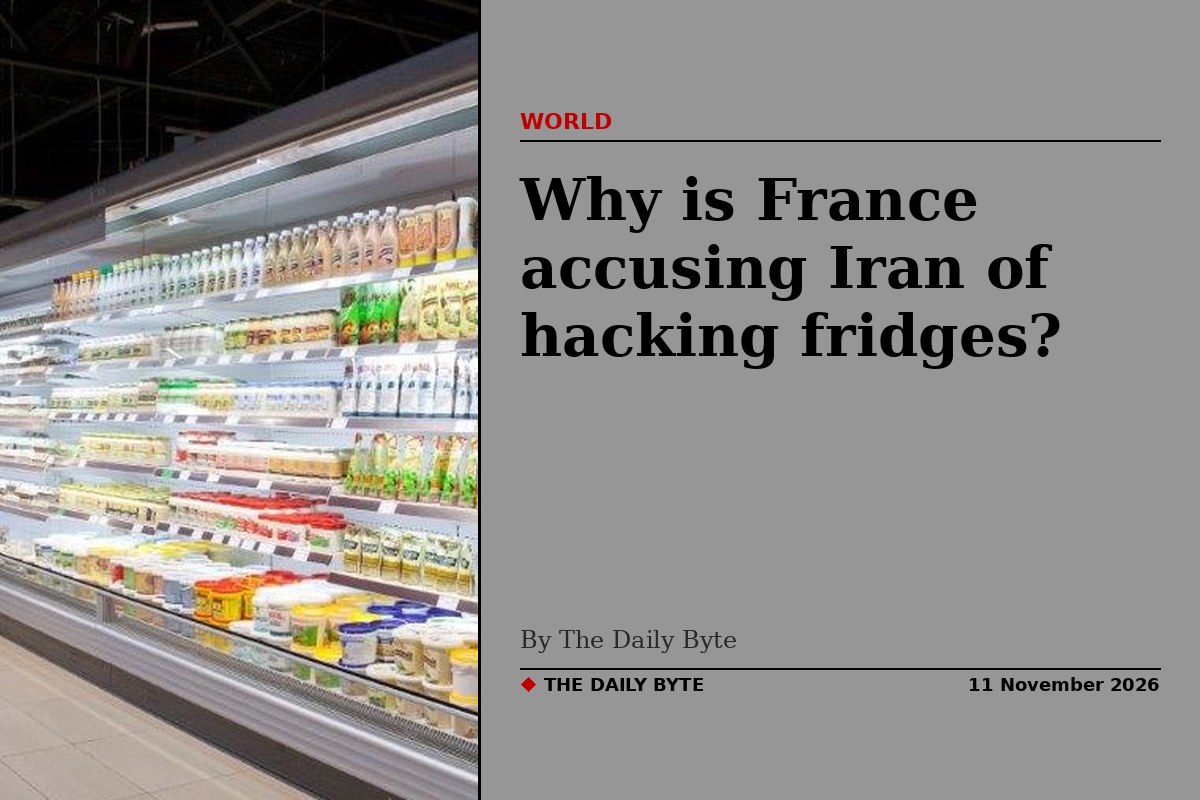
France is accusing Iran of hacking supermarket fridges. On Monday 9 November 2026, French Foreign Minister Jean-Noël Barrot said France had established that the Islamic Revolutionary Guard Corps, Iran's military force, was behind cyberattacks that disabled refrigeration systems in hundreds of French supermarkets in October, spoiling food and prompting Paris to summon Iran's ambassador and seek sanctions at a European level.
The claim is striking because of the target. The hackers did not go after a government ministry, a bank or a military network. They went after the machines that keep food cold. By remotely breaking into the web-based controllers that manage fleets of industrial refrigerators and freezers, they raised the temperature inside the units and switched on defrost cycles, turning ordinary supermarket equipment into a tool of sabotage. France has called it the first large-scale act of sabotage on its national territory.
What happened in the supermarket fridge attacks?
Two waves of cyberattacks ran through October and into November 2026, according to TechCrunch. Hackers remotely broke into web-based controllers that manage fleets of industrial cold and chilling units at grocery stores and retail supermarkets, and raised the temperatures to spoil food and destroy goods. The attacks struck hundreds of stores in early October, Reuters reported, and were among the most disruptive cyberattacks in France since the Iran war began in February.
The scale was large. France described the attack as unprecedented in scale and aggression, and Barrot told reporters in Paris: “This was an attack of unprecedented scale and aggression; it represents the first large-scale act of sabotage on our national territory and constitutes a major assault on the nation's interests and the security of the French people.” He added that the hacks would “not go without consequences”.
Medical blood banks were also hacked, TechCrunch reported, but the attacks were stopped before any blood was spoiled, according to the French Blood Establishment. That detail matters, because it shows the attackers were not only aiming at supermarket shelves. The same kind of industrial refrigeration equipment is used to store blood and other temperature-sensitive medical supplies, and a successful attack on those systems could have had far more serious consequences than spoiled food.
How did the hackers get into the fridges?
The hackers exploited a weakness that security researchers have been warning about for years: industrial equipment connected to the internet. Modern supermarkets do not control each refrigerator individually. They use web-based controllers that let staff manage whole fleets of refrigerated and freezer units from a single system, monitoring temperatures, scheduling defrost cycles and raising alarms when something goes wrong.
That convenience creates a vulnerability. If an attacker can reach the controller over the internet, they can change the same settings a legitimate operator can change, including the temperature. In this case, the hackers raised the temperature inside the units and switched on defrost cycles, which warms the equipment to melt ice. Food stored inside then spoiled, and in many cases had to be destroyed.
Security researchers have since warned that the web-based controllers are vulnerable to remote hacking, and that some of the affected models, made by the Danish company Danfoss, are no longer receiving security fixes. When a manufacturer stops issuing security updates for a product, known flaws in that product stay open, and anyone who can find the device online can try to exploit them. Supermarkets and other businesses that still use those older controllers have been left exposed.
Why does France blame Iran?
France's attribution rests on its own investigation, and the government has been unusually direct. Barrot told reporters in Paris on Monday: “I am able to confirm that responsibility for this act lies with the Islamic Revolutionary Guard Corps,” referring to Iran's military and its hackers. He said France had established “with certainty” that the Revolutionary Guard Corps was behind the attack, but said he would not disclose how that determination was made.
Reuters first reported France's attribution to Iran, citing sources ahead of the foreign minister's remarks. The Paris prosecutor's office has taken up the case, and the matter is now in the hands of the French justice system, Barrot said. The French government has summoned Iran's ambassador, and Barrot said France would push for sanctions at a European level against those who carried out the hacks.
Tehran has rejected the accusation. Iran's Foreign Ministry dismissed the French claim as “baseless and hostile”, saying it was intended to divert public opinion from France's policies towards Iran. Iran routinely denies carrying out malicious cyber operations, and its mission to the United Nations did not return messages seeking comment on the day the attribution was announced.
What has France done in response?
France summoned Iran's ambassador on Tuesday 10 November, a day after the public attribution. The summoning had been announced by Barrot the previous day, and the foreign ministry confirmed that it took place on Tuesday morning. Summoning an ambassador is a formal diplomatic protest: the ambassador is called to the foreign ministry and told, in person, that their government's conduct is unacceptable.
Barrot also set out what could follow. Speaking on France Info television, he said France would push for EU sanctions in response to what he called an “attack of unprecedented scale and aggression in our country”. He warned that there could be further action that would not be disclosed, saying: “We will take whatever measures are necessary, including some that we will not discuss publicly, if we judge them proportionate and necessary to deter any new attacks and punish those responsible for this unacceptable aggression.”
He added that France's cyberdefence doctrine provided the authorities with a range of options. That wording leaves open the possibility of a cyber response of France's own, although Paris has not said what, if anything, it plans to do beyond sanctions and the criminal investigation.
Were other countries hit as well?
Similar cyberattacks targeted supermarkets in Sweden, Belgium and Ireland earlier in November, although it remains unclear whether those incidents are linked to the attacks in France. TechCrunch reported that the French government has formally blamed Iran for launching cyberattacks that targeted thousands of internet-connected industrial refrigerated and freezer units across France and the wider Europe.
The United States is also reported to be looking into whether freezer units on military bases were hacked, following reports of similar outages and disruption earlier in the year. US officials have reportedly also linked the freezer-related cyberattack to Iran, but the American intelligence community has not yet made a formal or public attribution.
The fridge attacks fit into a wider pattern of cyber operations attributed to Iran this year. The US government linked a series of earlier attacks to pro-Iranian hacktivists working for Tehran, including hacks targeting the Los Angeles transit system in March and US water treatment plants in July, as well as online intrusions that caused mass disruption to the US medical device maker Stryker. Those attacks, like the fridge hacks, were linked by Washington to the US and Israeli-led war against Iran, which killed its supreme leader in February.
Why are relations between France and Iran so strained?
The fridge dispute has landed in the middle of a long-running deterioration in relations between Paris and Tehran. Ties have been strained for years over Iran's nuclear and ballistic missile programmes, its regional activities and the detention of several French nationals. Although relations improved after those detainees were released and France distanced itself from the US war on Iran, they deteriorated again over the summer after Iran arrested and later expelled two French diplomats. France responded by expelling Iranian diplomats.
French officials say Tehran has become increasingly hostile towards France, notably over its support for Iranian civil society. The fridge attribution is the latest and most public expression of that hostility, and the first time France has formally blamed Iran for a cyberattack of this kind on French soil. It also comes at a moment when European governments are under pressure to respond to a series of disruptive cyber incidents, and when the question of how to deter state-backed hacking without escalating into open conflict has become more urgent.
The episode also highlights a practical problem that goes beyond diplomacy. Industrial refrigeration, like water treatment and transport, depends on connected controllers that were often designed before cybersecurity was a priority. Until those systems are patched, replaced or taken off the public internet, the same kind of attack can be repeated, in France or anywhere else that uses the same equipment.
| When | What happened |
|---|---|
| October 2026 | Two waves of attacks hit supermarket refrigeration systems in France |
| Early October 2026 | Hundreds of stores affected; food spoiled as temperatures were raised |
| 9 November 2026 | Foreign Minister Barrot publicly blames Iran's Revolutionary Guards |
| 10 November 2026 | France summons Iran's ambassador and seeks EU sanctions |
Frequently asked questions
What did the hackers actually do to the fridges? They remotely accessed the web-based controllers that manage supermarket refrigeration units, raised the temperature inside them and switched on defrost cycles, which spoiled the food stored inside.
How many supermarkets were affected? Hundreds of stores in France were hit in early October 2026, according to Reuters, and thousands of internet-connected refrigeration units were targeted across France and the wider Europe, according to TechCrunch.
Why does France blame Iran? Foreign Minister Jean-Noël Barrot said on 9 November 2026 that France had established “with certainty” that the Islamic Revolutionary Guard Corps was responsible. France has not disclosed the evidence behind that determination.
What does Iran say? Iran's Foreign Ministry rejected the accusation as “baseless and hostile”, and Iran routinely denies carrying out malicious cyber operations.
What happens next? France has summoned Iran's ambassador, the Paris prosecutor's office has taken up the case, and Paris says it will push for sanctions at a European level. Barrot has also warned of further action that France will not discuss publicly.
Sources: Reuters and TechCrunch.


