Why Is Gold Falling So Fast This Week?
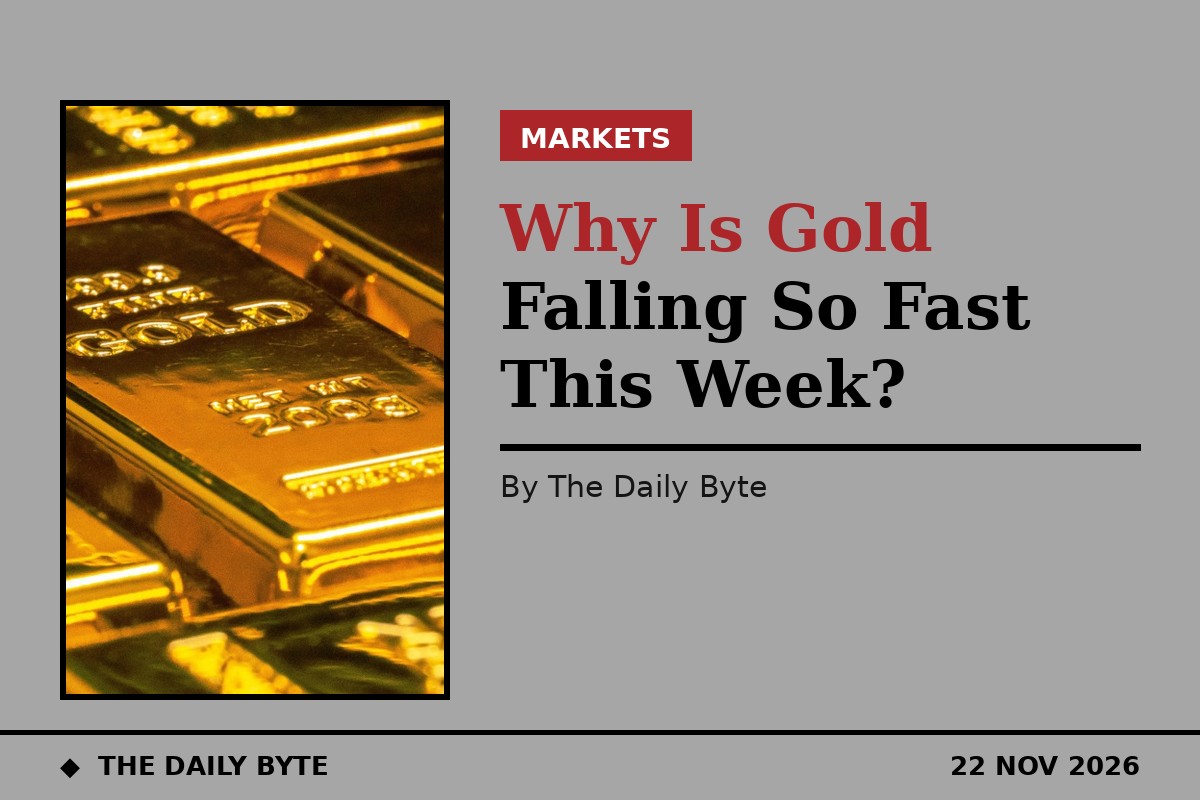
Gold has just suffered one of its worst weeks in years. On Friday 20 November, gold futures fell 4.62 percent to 3,515.40 dollars an ounce, down from 3,685.50 dollars at the previous close, while silver slumped 7.41 percent. Over the week as a whole, gold fell about 9.4 percent, its steepest weekly decline in eight months, and touched a 14-month low near 3,502 dollars an ounce. The short answer to why gold is falling is that the market now expects the US Federal Reserve to raise interest rates again in December, and higher rates, a stronger dollar and rising bond yields all make holding gold more expensive.
That is a sharp reversal for a metal that set a record of about 5,598 dollars an ounce in January. Gold is now roughly a third below that peak, and the fall has happened even though wars, inflation worries and a tech sell-off would normally be expected to support a safe-haven asset.
How far has gold fallen?
Gold lost more than 4 percent last week, its worst week since early June, and then fell again this week. On Wednesday 18 November, spot gold fell 125.90 dollars, or 3.27 percent, in a single session, one of the biggest one-day drops of the year. On Thursday it touched 3,693.13 dollars, its lowest since September 2025. Friday brought the heaviest blow: futures down 4.62 percent to 3,515.40 dollars, with spot gold near 3,537.90 dollars at 5pm in New York, down 2.38 percent on the day.
Gold fell 6.8 percent in October, and silver lost 18.7 percent in the same month. Gold is still up about 418 dollars from a year ago, but most of the year's gains are already gone. In London, one troy ounce of 24-karat gold was worth 2,702.38 pounds on Sunday 22 November. Markets are closed for the weekend, so those prices are Friday's close.
Why is gold falling? The four drivers
The first driver is interest-rate expectations. October's US consumer price data came in hotter than expected: prices rose 0.4 percent month on month against a 0.3 percent forecast, and core prices, which strip out food and energy, rose 0.3 percent against 0.2 percent. Hours before the figures were published, Federal Reserve Governor Christopher Waller had said a 50 basis-point increase should be considered if core inflation came in around 0.3 percent or higher. Traders now price roughly a 91 to 96 percent chance of a 25 basis-point rise at the Fed's December meeting.
The second driver is the bond market. The 10-year US Treasury yield has climbed above 5 percent, reaching about 5.06 percent, and the two-year yield sits near 4.76 percent, roughly 75 basis points above the upper bound of the Federal Funds target range. Gold pays no interest, so when safe government bonds pay more than 5 percent, the cost of holding a metal that pays nothing rises sharply.
The third driver is the dollar. The US Dollar Index has climbed towards a 19-month high, reaching 103.86, its highest since April 2025. Because gold is priced in dollars, a stronger dollar makes it more expensive for buyers holding other currencies. The minutes of the Fed's October meeting, released on Wednesday, reinforced the pressure: almost all officials judged that further rate rises would likely be appropriate.
The fourth driver is forced selling. During broad market pullbacks, institutional desks often sell liquid winners like gold to cover margin calls or raise cash, and gold is one of the easiest assets to sell quickly. That selling can feed on itself: as prices fall through levels where buyers had previously stepped in, more selling follows. On Thursday, dip buyers were not willing to step in at the old floor, and Friday showed the same reluctance.
| Measure | Figure |
|---|---|
| Gold futures, Friday 20 November | 3,515.40 dollars an ounce, down 4.62 percent on the day |
| Spot gold, Friday close | About 3,537.90 dollars an ounce, down 2.38 percent |
| Weekly fall | About 9.4 percent, steepest in eight months |
| 14-month low | Near 3,502 dollars an ounce |
| January record | About 5,598 dollars an ounce |
| December Fed hike priced | About 91 to 96 percent chance of a 25 basis-point rise |
| 10-year Treasury yield | Above 5 percent, about 5.06 percent |
| London gold, 22 November | 2,702.38 pounds per troy ounce, 24 karat |
Why didn't war push gold up?
A major war in the Gulf would normally be expected to bring safe-haven buying into gold, and the Middle East conflict that drove the January peak is still active. Instead, gold has shed more than a quarter of its value since the US-Iran conflict erupted in late February.
The reason is that the conflict pushed crude oil higher, oil fed inflation, and inflation forced the Fed to raise rates. Gold lost the rate argument even though it won the geopolitical one. Uncertainty in the Middle East also supports the dollar, which limits safe-haven flows into gold.
What about central banks and physical demand?
Central banks are still buying gold at a record pace, and that has not stopped the slide. Physical demand has also failed to improve: analysts at Heraeus noted that silver bar and coin sales dropped despite lower prices. Exchange-traded funds have been moving the other way, with the largest gold fund losing 1.37 billion dollars in 30 days. For now, the metal is being driven by the dollar and the Fed, not by war or physical demand.
What could change the direction?
The next big test is the Fed's meeting on 8 and 9 December. Any language that softens the case for a December hike could relieve the pressure. Confirmation of a hike, or hints of more to come, could push gold lower still.
On the charts, the first relief level is 3,800 dollars, and a recovery towards the 3,890 dollar rally high from 17 November is the upside target if the dollar stalls. A break below the yearly low near 3,850 dollars could expose the 24 September 2025 low at 3,717 dollars, bringing the 3,600 dollar area into focus. None of this is investment advice: prices quoted here are Friday's close, and markets reopen on Sunday evening in New York.
Frequently asked questions
Why is gold falling so fast this week? Hot US inflation data lifted bets on a December Fed rate rise, the dollar rose towards a 19-month high, and the 10-year Treasury yield moved above 5 percent. Gold pays no interest, so higher rates raise the cost of holding it.
How much has gold fallen? Gold futures fell 4.62 percent on Friday 20 November to 3,515.40 dollars an ounce, and about 9.4 percent over the week, the steepest weekly fall in eight months. Gold is roughly a third below its January record of about 5,598 dollars.
Is gold still a safe haven? Gold is still bought by central banks at a record pace, but in this sell-off it has fallen alongside shares and cryptocurrencies, because investors have been raising cash and reducing risk across the board rather than rotating between assets.
What is the gold price in the UK today? On Sunday 22 November, one troy ounce of 24-karat gold in London was worth 2,702.38 pounds, based on Friday's close. Markets are closed at the weekend.