Why Is Spain on General Strike Today?
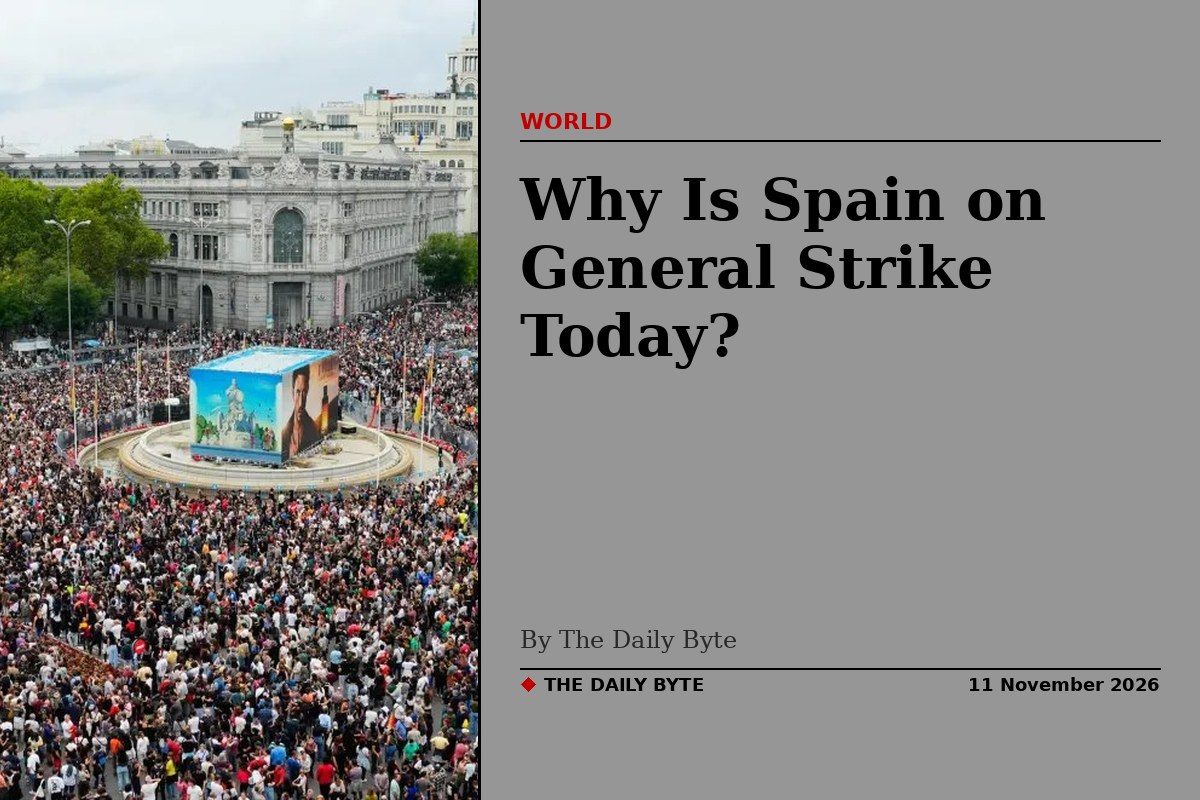
Spain is holding a 24-hour general strike on Wednesday 11 November 2026, the country's first in 14 years. Called by Spain's two largest union federations over wages, housing and the cost of living, the stoppage runs from midnight to midnight and is expected to disrupt trains, flights and public services across the country.
The strike is unusual because it is not centred on a single workplace dispute. Its slogan is 'Salarios, vivienda y precios' — wages, housing and prices — and it was organised after months of protests over housing costs, including a five-week occupation of Madrid's Puerta del Sol square. Here is what the strike is, who called it, what the unions want and what is still running today.
What is a general strike?
A general strike is a coordinated stoppage that cuts across many industries and workplaces at the same time, rather than a dispute in one company or sector. In Spain, general strikes are called by the big union confederations, and any worker can take part, in both the public and private sectors.
Essential services do not stop completely. The government sets minimum service levels by order, so a proportion of trains, flights and other services must keep running. That is why the transport ministry has published the share of services that must operate on 11 November, rather than leaving it to the unions and operators to decide.
General strikes are rare in Spain. The last one jointly backed by the country's two largest unions was in November 2012, during the austerity crisis that followed the financial crash, when the government of the day was cutting public spending. The 11 November stoppage is the first general strike of Pedro Sanchez's time as prime minister.
Who called the strike in Spain?
The strike was called by Comisiones Obreras (CCOO) and the Union General de Trabajadores (UGT), Spain's two largest union federations. They announced it on 7 October, and it later won the support of smaller unions including the CGT, the CNT, Intersindical, Solidaridad Obrera and CO.BAS, with Basque unions covering the Basque Country.
The call originated with the tenants' union, the Sindicato de Inquilinas, which had been leading protests over rents and evictions. Its spokeswoman, Valeria Racu, told public radio that the mobilisation was about housing as much as about pay. Education unions have also joined, saying teachers and support staff face low pay, insecure work and rents they cannot afford in the communities where they work.
Not every union is taking part. The civil service union CSIF, the USO and the retail union Fetico have not backed the stoppage, and the employers' confederation, the CEOE, has strongly criticised it.
Why are workers striking?
Housing is at the heart of the strike. The immediate trigger was the forced eviction in September of Maricarmen Abascal, an 87-year-old pensioner in Madrid, after a rent increase. She died days later, and her case became a symbol of the housing crisis. Protests followed across Spain, including a five-week occupation of Madrid's central Puerta del Sol square, where hundreds of tents were pitched.
On 5 October, Spain's parliament rejected two emergency housing decrees drawn up by the government, which had included protections against evictions of vulnerable tenants. The failure of those measures deepened the anger, and Prime Minister Pedro Sanchez then called a snap general election for 29 November, bringing forward a vote originally scheduled for 2027.
The unions say the underlying problem is that having a job no longer guarantees a decent life. In their joint statement, CCOO and UGT said: 'Working and earning a wage no longer guarantees that you can make ends meet, access decent housing, or build a secure future.' They point to inflation of 4.9 per cent, rents that have risen faster than pay, and a housing shortage that property consultancy CBRE has estimated at more than 750,000 homes, a figure it has warned could pass one million by 2028 if building does not speed up. Spanish house prices rose by more than 12 per cent in 2026, compared with less than 5 per cent across the European Union as a whole.
What are the unions demanding?
The strike's demands go beyond a single pay claim. The unions want real wage rises that keep pace with prices, an end to the deadlock in collective bargaining talks with employers, and government action against housing speculation.
On housing, they are calling for an eviction moratorium, a ban on home purchases by investment funds and the automatic renewal of rental contracts — measures that were in the housing decrees parliament rejected in October. CCOO has also proposed that 1 per cent of GDP be spent on public and protected housing, with a longer-term goal of at least 1.5 million affordable homes.
On pay, UGT has called for the minimum wage, the Salario Minimo Interprofesional, to rise by at least 7 per cent in 2027. The CGT, one of the smaller unions backing the strike, has gone further, demanding a 35-hour working week with no loss of pay and a minimum wage and minimum pension of 1,500 euros a month.
The unions are also demanding better funding and staffing for education, healthcare, care services and public transport, and stronger collective bargaining rights. CCOO leader Unai Sordo has said demonstrations in Madrid and Barcelona will be the main measure of the strike's reach, and that participation is expected to vary by sector and region.
| Demand | Detail |
|---|---|
| Wages | Real pay rises that keep pace with prices; UGT wants the minimum wage up by at least 7 per cent in 2027 |
| Housing | Eviction moratorium; ban on home purchases by investment funds; automatic renewal of rental contracts; 1 per cent of GDP for public housing |
| Working time | CGT calls for a 35-hour week with no loss of pay |
| Public services | More funding and staffing for education, health, care services and public transport |
| Collective bargaining | Unblock stalled talks on renewing the national employment agreement, the AENC |
What is affected on 11 November?
Transport is the most visible disruption. The transport ministry has set minimum services for the day, so some services run and others do not. Renfe, the state rail operator, is running about 73 per cent of its high-speed and long-distance trains on 11 November, and about 75 per cent of commuter trains at peak times. In Madrid, the metro is running at 80 per cent of its normal service at peak times and 50 per cent off-peak, while in Catalonia minimum services are set at 25 per cent.
Flights are also reduced. Between 18 and 85 per cent of flights must operate, depending on the airport and route. Between 39 and 64 per cent of international flights are protected, and between 56 and 80 per cent of flights between the mainland and the Canary Islands, the Balearic Islands, Ceuta and Melilla. Airlines including Iberia and Lufthansa have warned passengers of disruption, and Iberia is offering refunds or rebooking to 26 November for passengers booked to travel on 11 November.
The strike sits in the middle of a wider week of rail stoppages. Train drivers were on strike on Tuesday 10 November and further walkouts are planned for Thursday 12 November, while a further strike day is planned for 17 November. Travellers also face Storm Charles, with Spain's weather agency, Aemet, warning that Wednesday would be the worst day of the storm. One estimate, from the data firm IndexBox, put the one-day cost of the stoppage at about 930 million euros.
For visitors, the practical effect is delays and cancellations rather than a total shutdown. Airports, stations and city transport are running at reduced levels, demonstrations are expected in city centres including Madrid and Barcelona, and the US Embassy in Spain issued an alert on 6 November advising citizens to expect more police presence and possible road closures.
Why is the strike happening now?
Timing is political as well as economic. The strike falls 18 days before the snap general election on 29 November, and two days before the official election campaign begins on 13 November. The day after the strike, on 12 November, the Diputacion Permanente — the parliamentary body that sits while parliament is dissolved — is due to vote on re-issued versions of the housing decrees that were rejected in October.
The unions say the strike is not aimed at any one party, but CCOO leader Unai Sordo has criticised the conservative People's Party (PP), Vox and the Catalan party Junts for blocking the housing decrees. The employers' confederation, the CEOE, argues the demands are not essentially about labour relations and says it is studying a legal challenge to the strike.
Spain is not alone in seeing labour unrest over living costs. France held a nationwide day of strikes and demonstrations on 5 November, Italy's CGIL union has called a general strike for 20 November, and Belgian unions have warned of action in the week of 23 November.
How long will the strike last?
The general strike is a 24-hour stoppage only, running from midnight to midnight on Wednesday 11 November. In companies that work in shifts, it starts with the last shift that begins before midnight on 10 November and ends with the last shift that begins on 11 November. There has been no verified announcement that it will be extended, although separate rail strikes continue through the week.
Frequently asked questions
Is Spain on strike today? Yes. A 24-hour general strike is taking place across Spain on Wednesday 11 November 2026, called by the CCOO and UGT unions over wages, housing and prices.
Why is Spain striking? The unions say wages have not kept pace with prices and housing has become unaffordable. The trigger was the eviction of 87-year-old Maricarmen Abascal in Madrid in September and parliament's rejection of emergency housing measures in October.
Are trains and flights running in Spain on 11 November? Some are, under minimum service levels set by the government. Renfe is running about 73 per cent of long-distance trains, Madrid metro is at 80 per cent at peak times, and between 18 and 85 per cent of flights must operate depending on the route.
When was the last general strike in Spain? The last general strike jointly backed by CCOO and UGT was in November 2012, during the austerity crisis. The 11 November 2026 stoppage is the first in 14 years.
Is the strike connected to the Spanish election? It falls 18 days before the snap general election on 29 November, which Prime Minister Pedro Sanchez called after his minority government failed to win parliamentary approval for a package of housing measures.


