Why Are Prisoners Being Released Early in the UK?
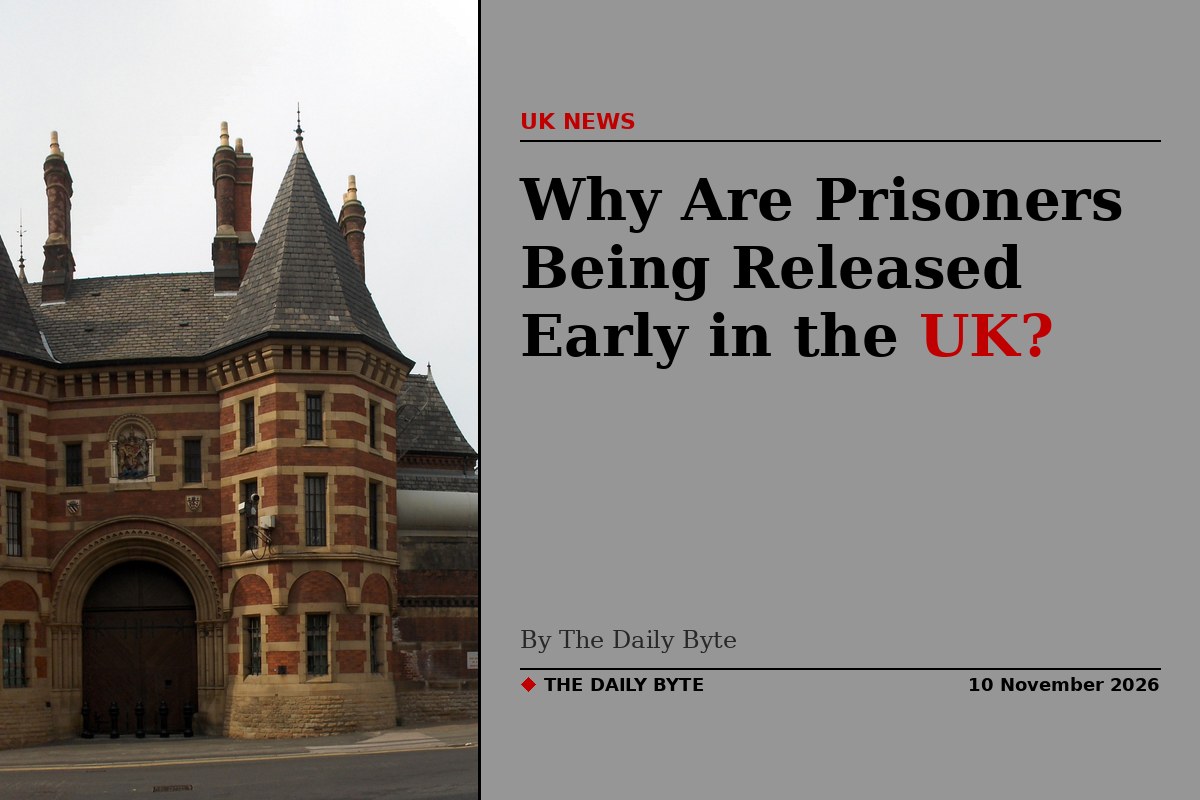
Prisoners are being released early in England and Wales because the prison estate is almost full. Under the Sentencing Act 2026, most prisoners on fixed-term sentences now serve one-third of their sentence behind bars instead of half, and a third wave of about 650 prisoners was released on Tuesday 10 November 2026. Those released early are not free: they remain on licence, are supervised in the community, and can be sent back to prison if they break the rules.
The scheme is one of the most talked-about parts of the Government's response to prison overcrowding, and it is also one of the most misunderstood. It does not apply to every prisoner, it does not wipe out the rest of a sentence, and it does not mean the prison population problem has been solved. This explainer sets out how the scheme works, who qualifies, who is excluded, and what happens next.
What is the early release scheme?
The early release scheme is a change to the point at which prisoners serving standard determinate sentences — fixed-term sentences with a set release date — are let out of prison. The change was made through the Sentencing Act 2026, which the Government passed earlier this year to cut overcrowding behind bars.
Before the change, most prisoners on fixed-term sentences were released after serving half of their sentence. Under the new rules, most now serve one-third of their sentence in prison, with the rest served on licence in the community. Prisoners convicted of more serious offences are released after serving half of their term, rather than the two-thirds that applied before. The total length of the sentence does not change: only the balance between time in prison and time supervised in the community changes.
The Government says the change is needed because prisons in England and Wales are running out of space. The prison population stood at 86,982 on Monday 9 November, according to Ministry of Justice figures, up from 86,883 the previous week. Ministers have warned that without action the estate could run out of usable places altogether, leaving courts unable to send convicted offenders to prison.
Who is being released today?
The third wave of the scheme, on Tuesday 10 November 2026, covers about 650 prisoners serving sentences of more than 882 days — around two years and five months — and fewer than 1,163 days, or about three years and two months. Ministers are releasing groups of offenders on increasingly longer sentences as the scheme goes on: last month, about 650 prisoners serving sentences of between one-and-a-half and two-and-a-half years were released in the second wave.
Overall, about 5,000 prisoners are scheduled to be released in stages over the next year under the scheme. That figure is down from the 6,000 originally planned, after ministers intervened to exempt rapists and the most serious child sex offenders. At least 1,350 prisoners had already been released early since the scheme began on 1 October, before today's third wave.
Reports say the offenders released in this wave include people convicted of affray, burglary and fraud. Some violent offenders, including people convicted of wounding or grievous bodily harm with intent, could also be among those released, because the scheme is based on sentence length and offence type rather than on a case-by-case risk decision by a judge.
Who is not eligible for early release?
Several categories of offender are excluded from the scheme entirely. The rules do not apply to rapists, the most serious child sex offenders, people convicted of manslaughter, terrorists, or murderers serving life sentences. The manslaughter exclusion means the killers of PC Andrew Harper, who died in the line of duty in 2019, are not eligible for release under the scheme.
The exclusions were widened after the original plan was announced. Ministers cut the total number of planned releases from 6,000 to 5,000 when they added the exemptions for rapists and the most serious child sex offenders. Life sentences are unaffected in any case, because prisoners serving life are released only when the Parole Board decides it is safe, not automatically at a fixed point in their sentence.
It is also important to understand that early release is not the same as a pardon or a reduced sentence. The sentence still stands, and the prisoner remains subject to licence conditions for the rest of it. The change is about where the sentence is served, not how long it lasts.
What happens to prisoners after they are released early?
Everyone released early is on licence, which means they are still serving their sentence in the community under supervision. They must keep to conditions set by the Probation Service, which can include living at an approved address, attending appointments, and staying away from certain people or places. If they breach those conditions, they can be recalled to prison to serve the rest of their sentence behind bars.
Government officials have said there is a presumption that all prisoners freed early will be fitted with GPS tags by the contractor Serco, so their movements can be tracked. The Ministry of Justice has also said that some of the most serious offenders released under the scheme will face what it describes as the toughest supervision in British history, with tighter restrictions on where they can go.
That supervision is the Government's answer to critics who say early release puts the public at risk. Ministers argue that a prisoner supervised on licence, wearing a GPS tag and subject to recall, is safer than a prisoner released at the end of a sentence with no supervision at all — and that the alternative, prisons running out of space, would be worse.
Why are prisons in England and Wales so full?
The prison population has grown over many years as sentences have got longer and the number of people sent to prison has risen. At the same time, the prison estate has not grown fast enough to keep up, and some prisons are old, in poor condition, or have cells out of use. The result is a system that has been operating close to capacity for years, with little room to absorb sudden rises in prisoner numbers.
Overcrowding matters for more than just space. When prisons are full, it is harder to run education and rehabilitation programmes, harder to move prisoners between establishments, and harder to keep order on the wings. Inspectors have repeatedly warned that overcrowding damages rehabilitation, which in turn raises the risk that prisoners reoffend after release.
The Government's own projections show the pressure will continue even with the early release scheme. The Liberal Democrats have pointed to Government figures projecting 87,200 adult prisoners against 88,300 places in November 2027, and 89,700 prisoners against 90,900 places in November 2028. In other words, the scheme buys breathing space, but it does not end the overcrowding problem on its own.
Has early release happened before?
Yes. Early release to ease overcrowding is not new in England and Wales. Previous governments have used schemes that let prisoners out weeks or months before their automatic release date when the estate has come under pressure. What is different about the current scheme is its scale and the fact that it is written into law through the Sentencing Act 2026, rather than being a short-term emergency measure.
The current scheme also differs in how far it goes: cutting the proportion of a sentence served in custody from half to one-third is a bigger change than earlier schemes, which typically released prisoners a matter of weeks early. That is why it has attracted more debate, and why the Government has paired it with GPS tagging and tougher licence conditions.
Frequently asked questions
Are prisoners being released early dangerous? The scheme excludes rapists, the most serious child sex offenders, people convicted of manslaughter, terrorists and murderers on life sentences. Everyone released is supervised on licence and can be recalled to prison for breaching conditions, and there is a presumption they will wear a GPS tag. The Government says this supervision makes early release safer than releasing prisoners with no supervision at all, but critics argue that any early release carries some risk.
How long will the early release scheme last? About 5,000 prisoners are scheduled to be released in stages over the next year. The scheme is part of the Sentencing Act 2026, so it will continue until the law is changed or the release-point rules are revised again.
Does early release mean a prisoner's sentence is shorter? No. The sentence stays the same length. Only the point at which the prisoner moves from custody to supervised release in the community changes, from half of the sentence to one-third for most fixed-term prisoners.
What happens if a prisoner released early commits another offence? They can be recalled to prison, and any new offence would be dealt with separately by the courts, which could add further time to their sentence.
Does the scheme apply in Scotland and Northern Ireland? No. Prisons and sentencing in Scotland and Northern Ireland are devolved, so the scheme applies only to England and Wales.
The early release scheme is likely to stay in the headlines as further waves of prisoners are freed over the coming months. The key questions to watch are whether the prison population falls as planned, whether reoffending or recall rates change, and whether the Government builds enough new prison places to end the reliance on early release. For now, the scheme remains the Government's main short-term answer to a prison estate that is almost full.