WiseTech shares jump 17% on revenue confidence
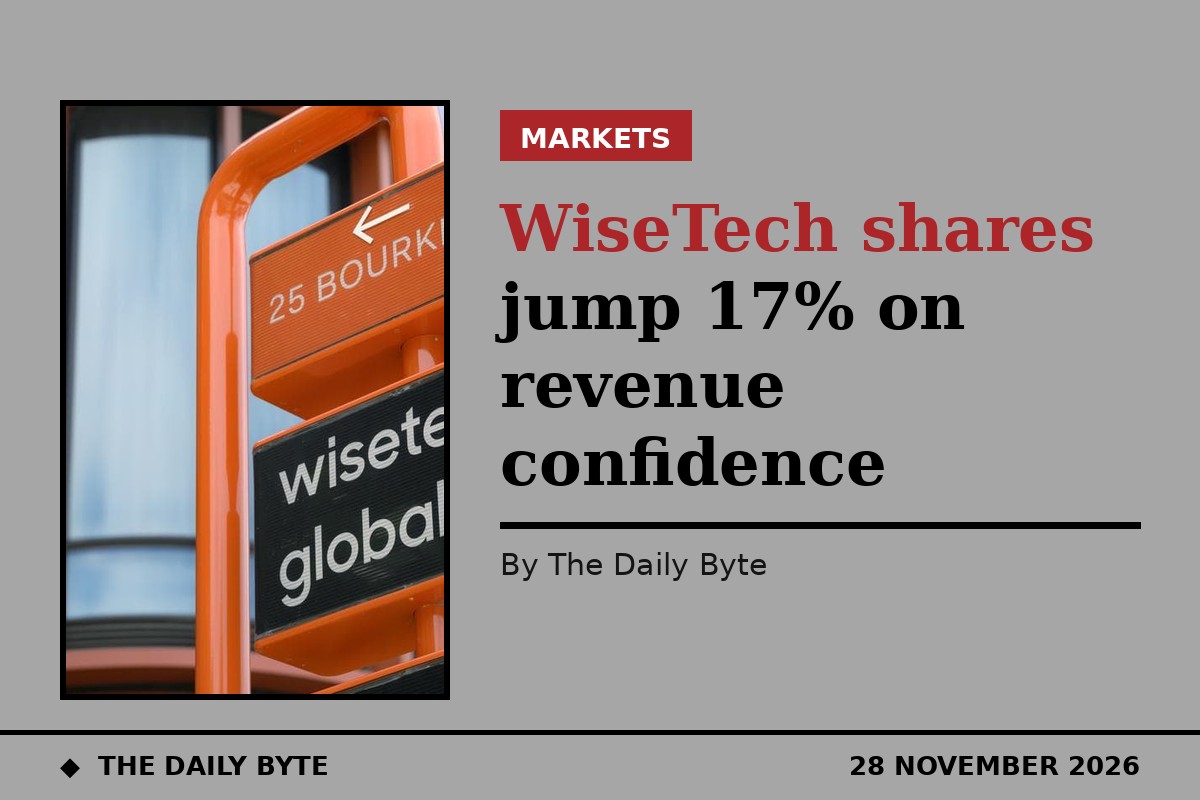
WiseTech Global shares jumped 16.7% on Friday to A$54.61, their highest level since early February, after the Australian logistics software group told shareholders at its annual general meeting that it was confident of meeting its full-year revenue target.
The shares rose as much as 20% during the session, touching A$56.30, before closing 16.7% higher. The rally made WiseTech one of the strongest performers on the Australian market on Friday, sharply outpacing the S&P/ASX 200, which gained 0.8% to 8,833.60 and finished the week 2.8% higher, its best week since August.
What management told shareholders
Chief financial officer Jeff Howard told the meeting in Sydney that trading had started well in fiscal 2027 and that management was confident of achieving revenue of US$1.48 billion to US$1.50 billion before any contribution from its new growth initiatives. The company's full-year revenue guidance remains US$1.48 billion to US$1.54 billion, with underlying earnings before interest, tax, depreciation and amortisation forecast at US$725 million to US$780 million and margins of 49% to 51%.
That message mattered because investors had been waiting for reassurance. WiseTech's shares had been under pressure for much of the year, and the annual meeting was the first formal update since the company reported its full-year results. Howard's comments removed the immediate fear that the bottom of the revenue range depended on unproven new products.
CargoWise drives the growth
CargoWise, the group's core logistics platform, recorded 11% revenue growth through October, driven by higher transaction volumes, increased business from large global freight forwarders and price increases for customers moving to the company's new commercial model. The platform is the engine of the business, handling the software that freight forwarders use to move goods around the world, and its growth rate is closely watched as a sign of underlying demand.
The update also showed the group cutting costs. On a like-for-like basis, costs were 16% lower, and the underlying group earnings margin rose by almost 10 percentage points to just over 47%. That combination of growing revenue and falling costs is what investors wanted to see after a year in which spending on acquisitions and integration weighed on profitability.
The e2open drag remains
Not everything in the update was strong. E2open, the United States supply-chain software company WiseTech bought in 2025 for US$2.1 billion, remained the weak spot. Its reported revenue rose 26% through October, but that figure includes an extra month of consolidation, and on a comparable basis revenue fell 6%. Management said e2open was slightly ahead of plan so far, but the deal still brings interest costs and amortisation charges that weigh on fiscal 2026 earnings, even as revenue trends look healthier heading into fiscal 2027.
The contrast between CargoWise and e2open explains why the market reaction was so strong and yet so conditional. Investors rewarded the core business, but the acquired business still has to prove it can grow on its own terms.
What happens next
WiseTech's full-year revenue in fiscal 2026 was US$1.396 billion, so the guided range implies growth of 6% to 10% in fiscal 2027. The next checkpoint is the half-year result in February, when investors will be able to test whether CargoWise volumes and pricing are holding up and whether the cost savings are lasting.
For now, the shares have recovered much of their recent ground. They are up roughly 55% since mid-October, when the company received letters from the Australian Securities and Investments Commission, although they remain well below their highs of late last year. Friday's jump shows how quickly sentiment can turn when a company gives investors the one thing they were waiting for: a revenue target that looks achievable without a leap of faith.


