World Bank Sees Brent Oil Easing to $79 in 2027
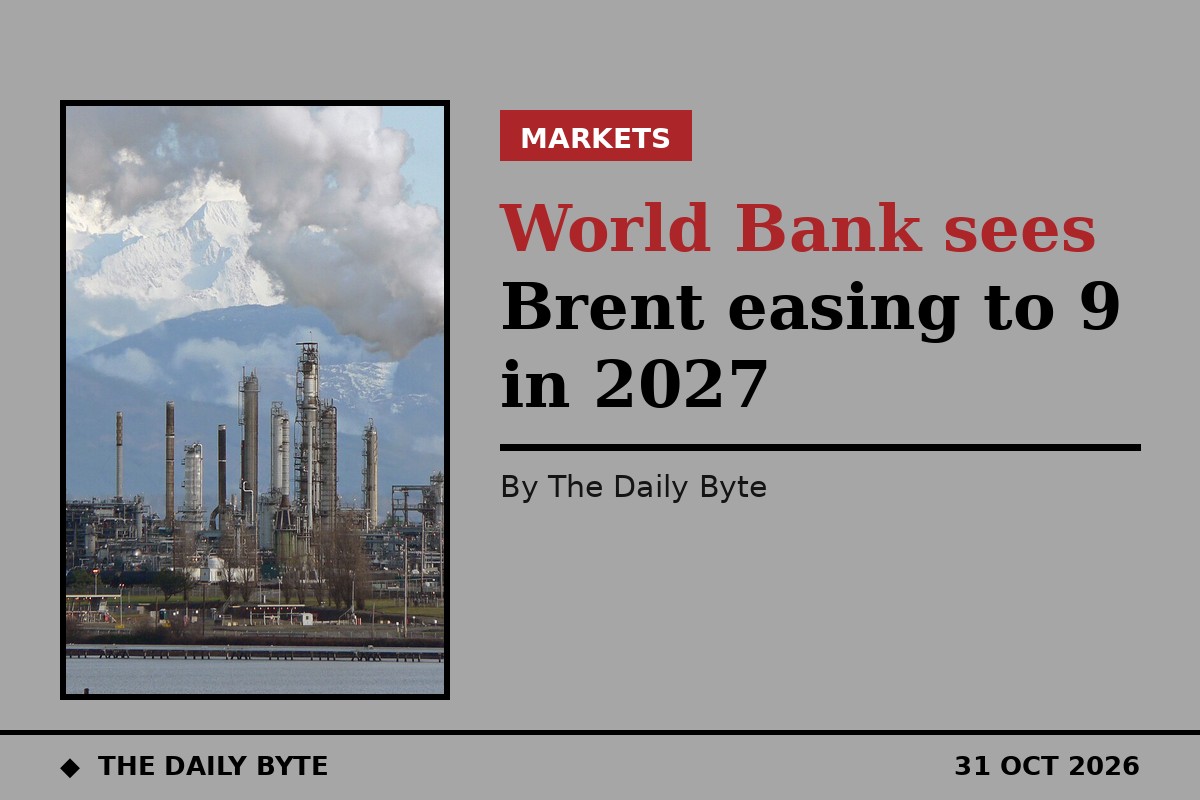
The World Bank's October Commodity Markets Outlook puts the recent oil shock in a longer frame. It expects overall commodity prices to rise 23% in 2026, driven mainly by energy, before falling 7% in 2027. Energy prices alone are projected to climb 32% this year, reversing three years of declines, and to reach a four-year high as Middle East conflict draws down oil stocks.
A sharp rise this year, then an expected easing
For Brent, the international benchmark, the bank forecasts an average of $91 a barrel in 2026, up from $69 in 2025, followed by $79 in 2027. That is an annual-average forecast, not a prediction for any single day's trading price, and it sits apart from the much higher spot prices seen during October's supply disruption.
Why supply, not just demand, drives the call
The outlook expects global oil supply to fall 5.2% in 2026, which it describes as the largest drop in more than four decades outside the 2020 recession, while consumption is expected to fall 2.5%. Production remains below consumption in the bank's account, forcing further withdrawals from inventories and leaving markets exposed to another shock. Food prices are a second pressure point: they are expected to rise about 10% in 2026 and a further 7% in 2027, with higher fuel and fertiliser costs, disrupted grain shipments and the threat from El Niño all cited as reasons.
The warning if shocks combine
The baseline assumes no major intensification of conflicts affecting commodity supply. In an adverse scenario, where Middle East escalation, damage to oil infrastructure, Black Sea grain disruption and a very strong El Niño occur together, Brent could instead average $105 a barrel in 2027, with food prices 12% above the baseline and above their 2022 level. For households and importers, the message is therefore twofold: relief is forecast, but it is conditional, not guaranteed.
Sources: World Bank; BusinessDay.