worse_query iOS sandbox escape risks wallet keys
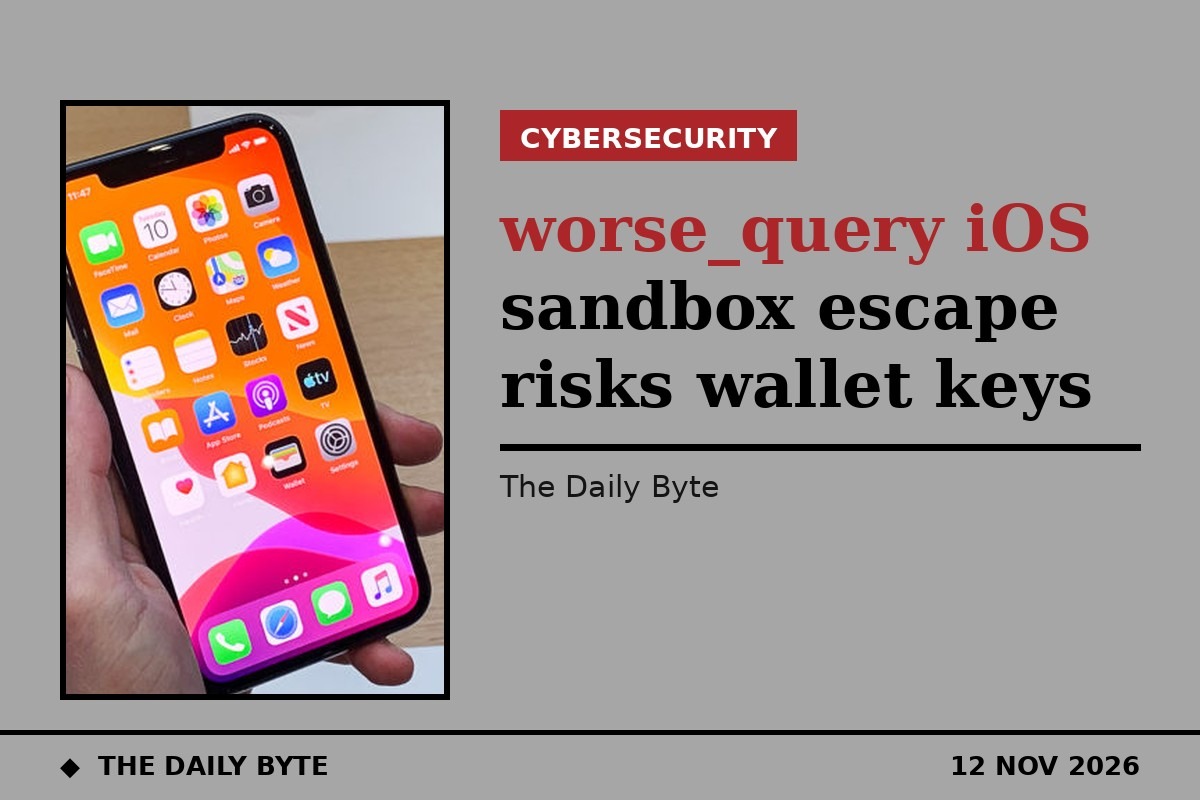
A publicly released iOS sandbox escape called worse_query can let a rogue app read files belonging to other apps on an iPhone, and Apple's latest iOS update does not fix it. Cryptocurrency exchange Binance warned on 10 November 2026 that the flaw could expose wallet seed phrases, private keys and login credentials, and fresh reporting on 12 November confirms the hole is still open.
The proof of concept was published on GitHub on 8 November by a researcher known as forcequitOS, who describes it as a sandbox escape for iOS 26 and 27 and the successor to an earlier technique called bad_query. Security firm Ostorlab published a detailed technical breakdown on 10 November, and Binance issued its warning the same day. Apple shipped iOS 27.2.1 and iOS 26.7.3 on 9 November, a day after the code went public, but neither update's security notes mention a sandbox fix.
How worse_query escapes the sandbox
Every iPhone app normally lives inside its own sandbox, a walled-off space it cannot see out of. The escape abuses the container manager, the iOS service that hands out access to shared folders. An app sets up an App Group container, then deletes its group's Library/Caches folder and replaces it with a shortcut, known as a symlink, pointing somewhere else on the phone.
When the app asks the container manager for access to that folder, the manager follows the shortcut and issues a sandbox extension, a token that extends the app's sandbox, for the target path, without checking that the target is still inside the app's own container. From there the app can read other apps' data containers, and on iOS 27 some system folders too. A helper tool called pathleak brute-forces inode numbers to recover the paths of every app container on the device, turning one known target into a list of them all.
The escape needs no jailbreak and no kernel exploit. It is a logic flaw in how the container manager authorises a path, and the researcher stresses that the code is a developer proof of concept rather than a jailbreak.
Which iPhones are affected
The proof of concept lists iOS 26.0 through 26.7.2 and iOS 27.2 as working. Binance named iOS 26.7.1, 27.0.1 and 27.2 in its warning, and a derivative tool claims iOS 27.2.1 is affected as well. Apple has not confirmed any version range, published an advisory, or assigned a CVE number for the flaw.
The attack is local, not remote. It needs a malicious or sideloaded app to be installed and run on the phone, and sideloading tools create the App Group container the escape needs automatically. No App Store app has been confirmed to use it, and whether an App Store app could reach the vulnerable path remains an open question.
A developer has already built WQ Files, a file browser based on the same technique, which its developer says can open, back up, edit and delete other apps' data. That shows the escape is not only theoretical: installable apps using it already exist.
No fix from Apple yet
Apple's iOS 27.2.1 security notes list nine fixes covering AirPlay, Bluetooth, iMessage group chats, the brotli compression library and other components, but none of them describes a sandbox escape. The iOS 26.7.3 notes are the same. Ostorlab says Apple has published no advisory, no CVE and no patched version for this specific escape, and with no CVE the flaw is not in the US Cybersecurity and Infrastructure Security Agency's Known Exploited Vulnerabilities catalog.
Importantly, neither Binance nor the researcher has reported a single attack or theft tied to the flaw. Binance's warning names the classes of data at risk, not a compromised wallet or a victim count, and the exchange said it had not identified any confirmed cases of cryptocurrency theft through the vulnerability.
What iPhone owners should do
Until Apple ships a fix, the advice is to remove apps installed outside the App Store, including builds installed with AltStore, SideStore or a signing service, along with any configuration profile that cannot be accounted for. On managed devices, installation should be blocked outside the managed app catalog.
Owners should still update iOS to the latest release, because it closes the flaws Apple did fix on 9 November, even though it does not close this escape. Anyone who suspects an untrusted app ran on their phone should treat the data in other apps' containers as potentially read, change passwords and session tokens, and move wallet funds to a new wallet on a clean device.
Source: Ostorlab. See also The Mac Observer.