Xi, Albanese Hail China-Australia Ties Turnaround
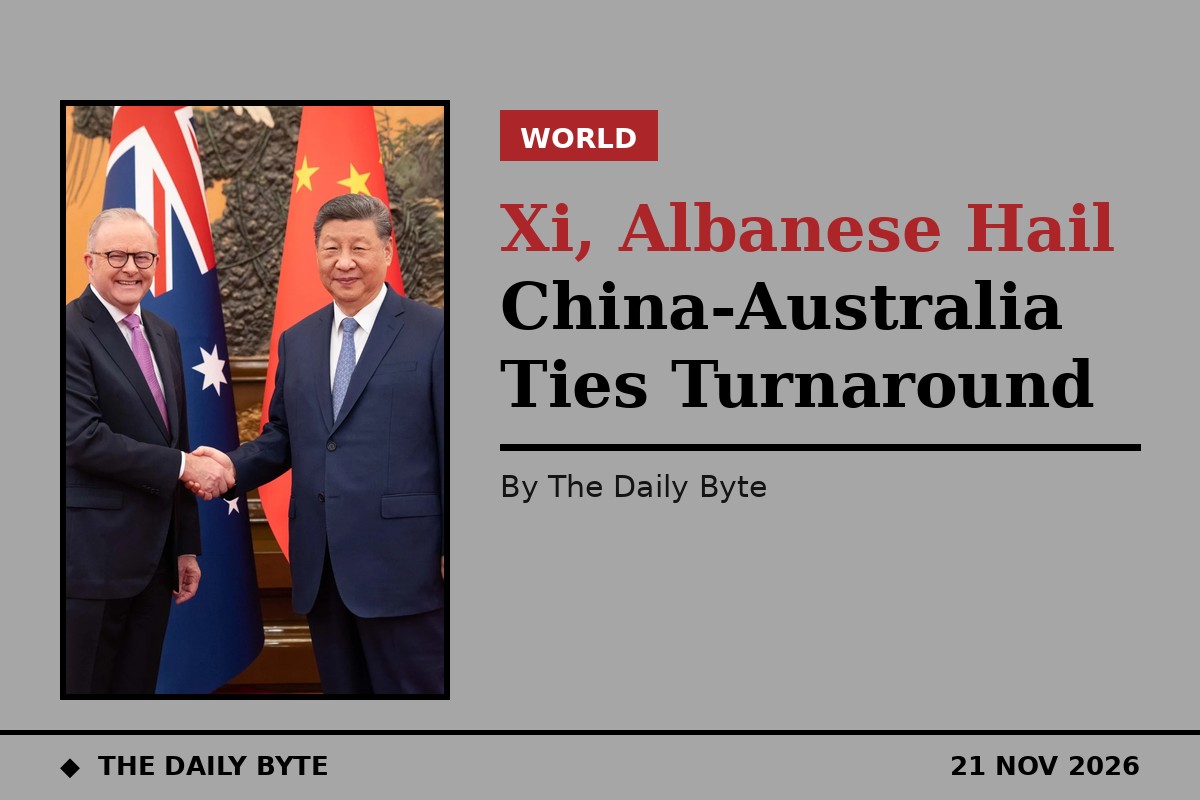
Chinese President Xi Jinping and Australian Prime Minister Anthony Albanese have hailed a “comprehensive turnaround” in relations between their two countries, after meeting in Shenzhen on Friday 20 November on the sidelines of the Asia-Pacific Economic Cooperation summit.
Xi told Albanese that China and Australia, which he said have no historical grievances or conflicts of fundamental interests, should be cooperative partners who trust each other and help each other succeed. The two leaders have now met four times since Albanese took office in 2022, and Xi said that together they had brought about a comprehensive turnaround in the relationship.
The meeting, held on the morning of 20 November in Shenzhen, in southern China’s Guangdong province, was the centrepiece of Albanese’s visit to China for the 33rd APEC Economic Leaders’ Meeting. Albanese later travelled on to Beijing, where he was due to meet Chinese Premier Li Qiang.
Albanese said the improvement in Australia-China relations served the interests of both sides and had brought tangible benefits to people in both countries. He restated Australia’s commitment to the one-China policy and said Canberra wanted close high-level exchanges, stronger practical cooperation in trade, investment and artificial intelligence, and deeper people-to-people ties.
Xi’s four-point proposal
Xi put forward a four-point proposal for taking the relationship forward. He called on the two sides to enhance mutual trust in a changing and turbulent world, to stay committed to their comprehensive strategic partnership, and to accommodate each other’s core interests and major concerns.
On practical cooperation, Xi proposed deepening work in traditional areas such as agriculture, energy and mining, while expanding into emerging fields including the green economy, new energy, the digital industry, artificial intelligence and climate response. He also called for more people-to-people exchanges and stronger coordination in multilateral forums, including the United Nations, the World Trade Organization, the G20 and APEC.
The two sides agreed to designate 2027 as the China-Australia Year of Tourism. Next year also marks the 55th anniversary of the establishment of diplomatic relations between China and Australia, and Xi said the anniversary should be a new starting point for greater progress.
Differences handled directly, Albanese says
Albanese told reporters after the meeting that differences between the two countries would be discussed “constructively and directly”, and that a stable relationship was in the interests of both nations. The two leaders’ joint statement, issued after the annual leaders’ meeting, reaffirmed support for the comprehensive strategic partnership and reiterated the importance of a mature, stable and constructive bilateral relationship.
The statement restated both sides’ commitment to the 1972 joint communique that established diplomatic relations, including mutual respect, equality and mutual benefit, and Australia’s commitment to its one-China policy. It also recorded the dialogues held since the last annual leaders’ meeting in July 2025, including the Foreign and Strategic Dialogue in April 2026, the Joint Ministerial Economic Commission in May 2026, and the Strategic Economic Dialogue in December 2025 and again in November 2026.
The leaders welcomed the statement adopted at the APEC meeting in Shenzhen and supported its tangible outcomes, including advancing an Asia-Pacific community and cooperation on trade digitalisation, connectivity, the digital economy and artificial intelligence. They also attached importance to cooperation under the Regional Comprehensive Economic Partnership and other frameworks.
From strain to stabilisation
The Shenzhen meeting underlines how far the relationship has travelled since the early 2020s, when it was strained by trade disputes and political friction. Since 2022 the two governments have worked to steady ties, restoring ministerial dialogue and easing a series of trade restrictions, and Xi’s language in Shenzhen presented that repair work as complete enough to build on.
For Australia, China remains its largest trading partner, and Albanese has made the case that a stable relationship protects jobs and export income at home. For Beijing, a settled relationship with Canberra fits a wider effort to keep trade and diplomatic channels open with US allies in the region at a time of sharp rivalry with Washington.
Both sides agreed to continue growing the relationship in 2027, the anniversary year. Whether the warmer tone produces new trade openings will be tested in the months ahead, but in Shenzhen both leaders were keen to present the turnaround as real, and the partnership as one they intend to keep building.


