Yonaguni islanders fear war as Japan-China ties sour
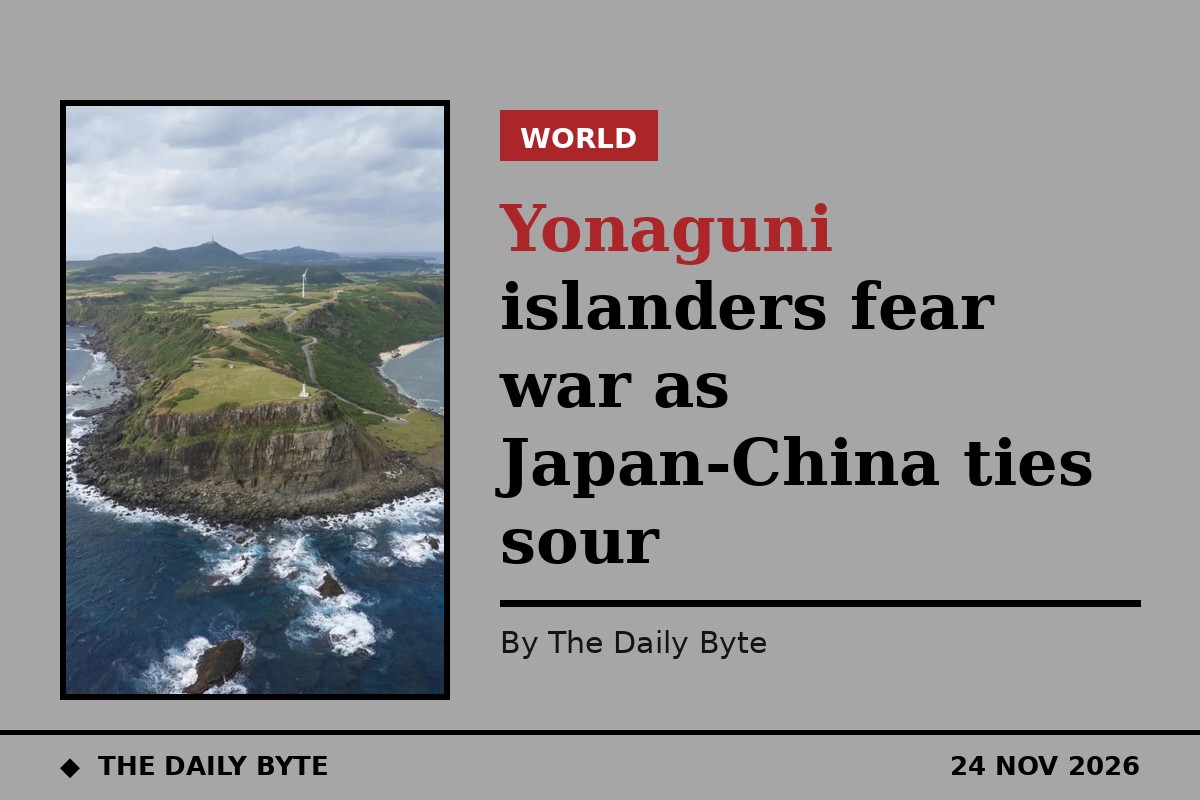
A 92-year-old man on a remote Japanese island near Taiwan worries about another war as ties between Japan and China have deteriorated sharply. “Once a war starts, it cannot be contained,” says Takeshi Sonamoto, who experienced the Pacific War on Yonaguni, Japan’s westernmost island, about 100 kilometres from Taiwan.
For Sonamoto, the rising tension is not an abstraction. It is a memory. The island where he has lived his whole life is once again at the centre of a military build-up, and the prospect of conflict is a growing concern for the small community that calls it home.
A childhood shaped by war
Born on the island as the third of eight siblings, Sonamoto was mobilised as a schoolboy in 1941 to help build the Imperial Japanese Navy’s lookout post on Mt. Urabu. “We were taught that Japan was stronger than any other, and the war was justified” at the time, he said, in an account published by Kyodo News.
Town records show the island suffered intermittent air raids beginning around October 1944, and Sonamoto said he barely survived one of them. He recalled hearing machine-gun fire from an aircraft one day as he went to the chicken coop in front of his home to collect eggs. He and his mother took cover and fled after the noise subsided, but later found six chickens dead. “I cannot forget it. It was a close call,” he said, his voice trembling.
He said he had a vague sense that Japan would eventually be defeated, but no one spoke of it at the time because “if you spoke about it, you would be seen as a spy”.
An island on the front line
That history weighs heavily now because Yonaguni sits closer to Taiwan than to any major Japanese city, and Japan has expanded its Self-Defense Forces presence there in recent years, citing a worsening regional security environment. This year marks 10 years since the establishment of a Ground Self-Defense Force camp on the island, and a new electronic warfare unit is scheduled to be deployed by early next year.
Japan’s defence minister has also confirmed the deployment of a Type 03 Chu-SAM surface-to-air missile system to Yonaguni, a move China’s foreign ministry has described as extremely dangerous. Okinawa’s governor, Denny Tamaki, has urged the central government to prioritise peaceful dialogue and to think carefully about the risks the deployment poses to civilians. In October, a major US-Japan exercise, Keen Sword 27, placed American anti-ship and air-defence systems on the island, underscoring how central Yonaguni has become to military planning for a possible Taiwan contingency.
The Taiwan remarks that soured ties
The latest strain in relations between Tokyo and Beijing followed remarks by Prime Minister Sanae Takaichi in parliament last November, suggesting that an attack on Taiwan could prompt a response by the Self-Defense Forces. China reacted with a series of political and economic reprisals, including restrictions on rare earth exports, and has demanded that Takaichi retract the statement.
The chill was on full display at the APEC summit in Shenzhen, where Takaichi received a notably subdued welcome and, according to Japanese media, was denied a one-on-one meeting with Chinese President Xi Jinping that other leaders were granted. The episode has become a symbol in Japan of how far the relationship has fallen.
“There must never be a war”
Sonamoto supports the Self-Defense Forces presence on Yonaguni. But his support comes with a warning drawn from his own childhood. “There must never be a war. Political engagement to prevent war is necessary,” he said.
His words carry a particular weight on an island that has already lived through one war and now finds itself described, once again, as a front line. For the people of Yonaguni, the debate in Tokyo and Beijing about Taiwan is not a distant diplomatic argument. It is about whether the place they live in becomes a battlefield, and whether the lessons of the last war — the ones Sonamoto still remembers, down to the sound of gunfire over a chicken coop — are heeded before it is too late.
Sources: Kyodo News; The Mainichi.


