Zambia treason trial: Mundubile committed to High Court
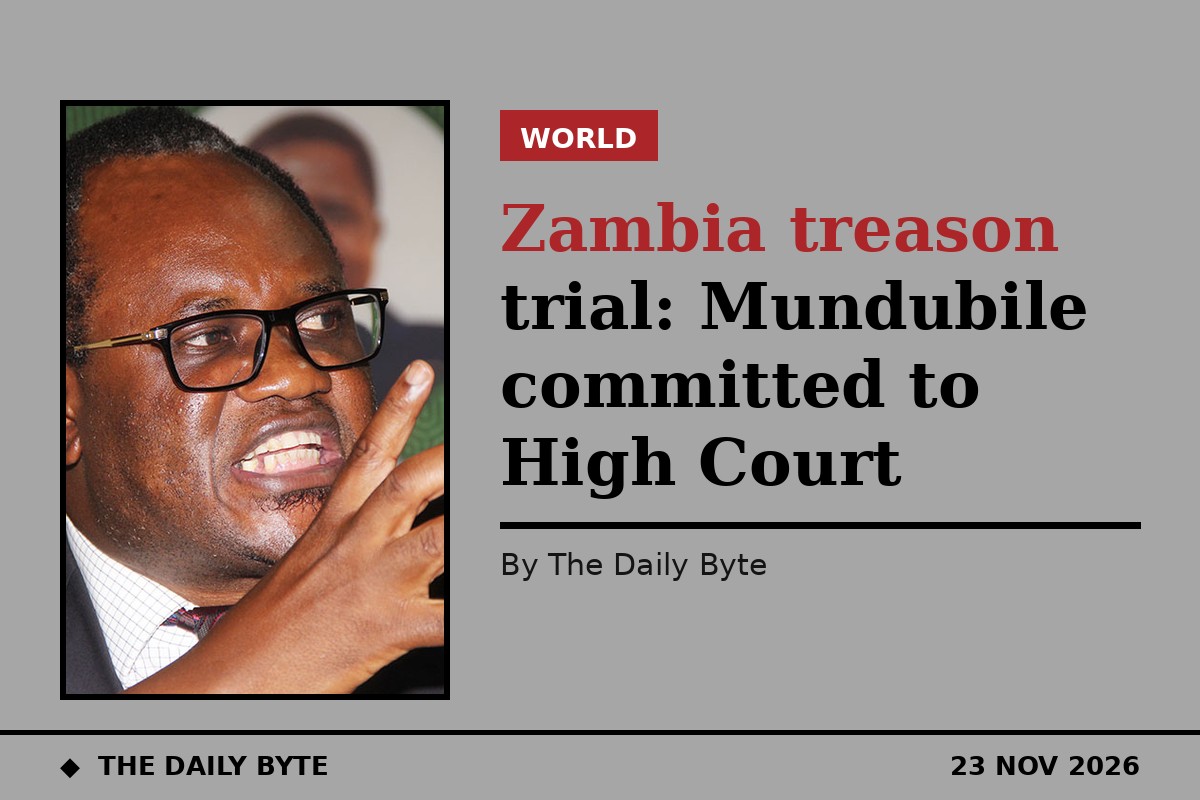
Zambia's opposition leader Brian Mundubile and 13 co-defendants have been committed to the High Court to stand trial for treason, after prosecutors formally presented an indictment in a Lusaka court on Monday, 23 November.
Mundubile, his running mate Makebi Zulu and 12 others appeared before Chief Resident Magistrate Thandose Chabala in the Lusaka Subordinate Court, where the charge was explained to them. No plea was taken, and all 14 were remanded in custody while the High Court lists the case for trial.
What prosecutors allege
The indictment charges the 14 with treason contrary to Section 43(1)(a) of Zambia's Penal Code. Prosecutors allege that, between 1 April and 14 August 2026, the accused conspired and endeavoured to overthrow by unlawful means the government of Zambia as by law established.
According to the charge sheet, the accused held meetings in furtherance of the alleged plot, recruited serving and retired defence and security personnel, and provided financial and logistical support to serving and retired military personnel. Reuters reported that the charge sheet says Mundubile and a businessman, Harry Valden Findlay, provided financial resources for military training in Russia for five people for the purpose of trying to overthrow the government. Prosecutors also allege that some defendants possessed weapons intended for use in the operation.
Three of the accused, Zulu, George Kangwa Chisanga and Patrick Bwalya Mwansa, face an additional alternative charge of misprision of treason, contrary to Section 44(b) of the Penal Code.
Defence rejects the case
Defence lawyer Sakwiba Sikota told reporters the charges did not make sense and described the prosecution as a "fishing expedition". Mundubile has consistently said he is innocent and maintains that the case is politically motivated. Sikota said the trial was expected to start early next year, although no date has been confirmed.
All of the accused remain presumed innocent until proven guilty. None of the allegations has been tested in a criminal trial, and the outcome will depend on the evidence prosecutors are able to present in court.
Months in detention
Mundubile and Zulu have been in detention since 27 August, and were formally charged by police two days later. Monday's proceedings came on the 88th day of their detention, and the pair have been held at Mukobeko Maximum Correctional Facility in Kabwe.
A separate ruling is expected on Tuesday, 24 November, when the Lusaka High Court is scheduled to decide a constitutional bail application involving Mundubile, Zulu and 16 others. The bail proceedings do not cover exactly the same group as the indictment, which names 14 defendants, while earlier proceedings involved 18 detainees.
In a separate but related case, Cindy Mubanga Mutale was also committed to the High Court on Monday to face a treason charge.
An election dispute behind the case
The prosecution follows Zambia's presidential election of 13 August, in which President Hakainde Hichilema won re-election. According to the Electoral Commission of Zambia's declaration of 18 August, Hichilema received 2,965,326 votes against Mundubile's 1,856,217. Mundubile rejected the outcome, alleging electoral irregularities and fraud, claims Hichilema has denied. Analysts and observers said the election was marred by serious irregularities.
The case is unfolding amid wider criticism of Zambia's post-election security operations. In a November 2026 investigation, Human Rights Watch accused police and military personnel of arbitrary detention, enforced disappearances, assaults and intimidation targeting opposition supporters, journalists, lawyers and government critics, documenting 14 apparent enforced disappearances and 61 cases involving allegations of violent abuse during arrests or detention. Zambian authorities have rejected allegations of a politically orchestrated crackdown, maintaining that opposition membership does not exempt anyone from criminal investigation.
The proceedings carry a striking historical parallel. In 2017, Hichilema himself spent about four months in custody on treason charges while leading the opposition against then-President Edgar Lungu, before prosecutors discontinued the case. Under Zambian law, treason is punishable by life imprisonment following the abolition of the death penalty in 2022.


