Zelenskyy Names 15 Settlements for Evacuation Pauses
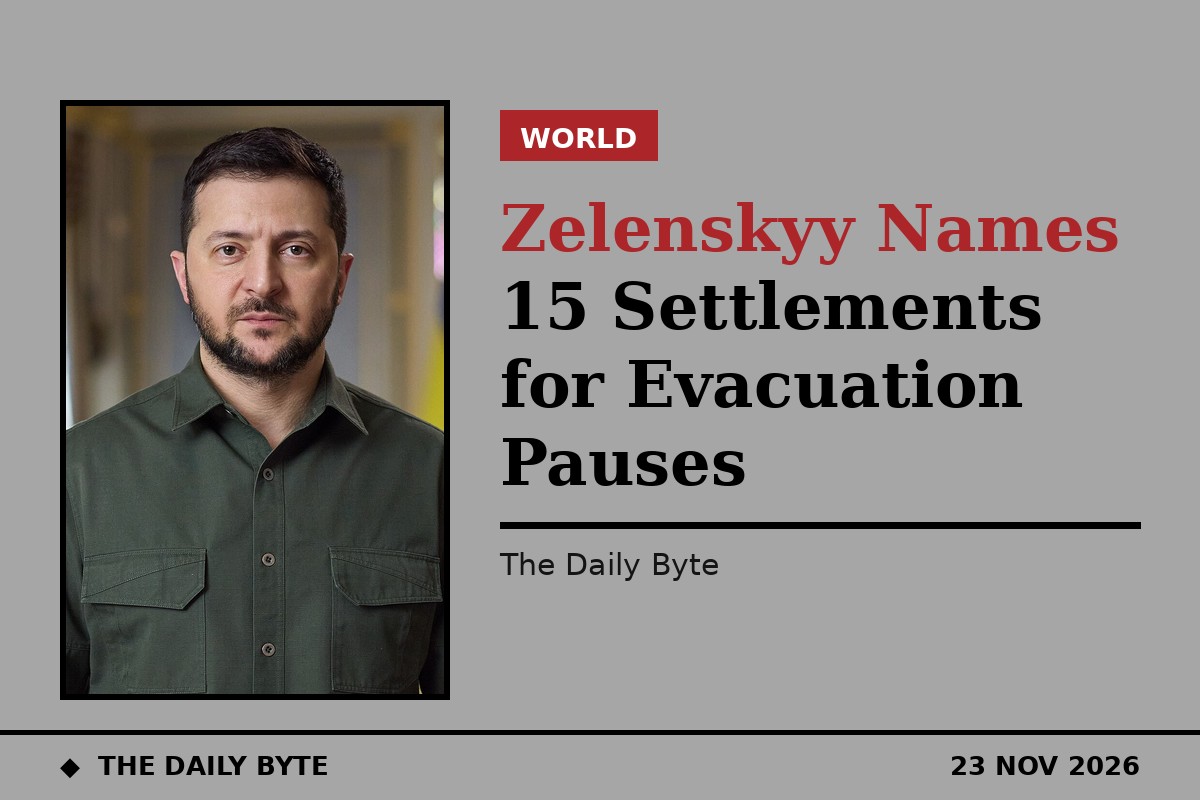
President Volodymyr Zelenskyy has named 15 towns and villages in Russian-occupied parts of Ukraine where Kyiv wants short local ceasefires so civilians can be evacuated, following the model of the operation in Oleshky last month. The list was handed to Ukraine's human rights ombudsman and to the American side on 21 November 2026.
The proposal was announced by Mr Zelenskyy in answers to journalists on Saturday. Nine of the places are in the occupied Kherson region and six are in the occupied Zaporizhzhia region, and all of them lie along or near the Dnipro River. Whether any of the evacuations happen now depends on Russia, which had not publicly responded to the new list by 22 November.
The 15 places on the list
In the Kherson region, the list names Radensk, Kostohryzove, Hola Prystan, Stara Zburivka, Nova Zburivka, Hladkivka, Velyki Kopani, Kardashynka and Velyka Kardashynka. In the Zaporizhzhia region, it names Maiachka, Zlatopil, Dniprorudne, Kamianske, Verkhnia Krynytsia and Vasylivka. Mr Zelenskyy said the list would be updated once officials had confirmed how many people were living in each settlement and what condition they were in.
He said he had gone through the list with Ukraine's commander-in-chief before approving it. The settlements were chosen because the Dnipro gives the area a stable front line, which is what made a local pause possible at Oleshky. The Institute for the Study of War, which also reported the proposal, notes that all 15 places sit immediately along the Dnipro or the Kakhovka Reservoir, or within a few kilometres south of the river in the Russian rear.
How the Oleshky model worked
The model for the plan is the humanitarian operation in Oleshky, in the occupied Kherson region, where a local ceasefire was in effect from 27 October to 1 November so civilians could leave. Ukraine first proposed extending that model on 17 November, when Mr Zelenskyy said Kyiv wanted similar operations in 10 more occupied settlements, without naming them. The 21 November announcement expands that to 15 named places and puts a concrete list, with evacuation plans, in the hands of the American intermediaries.
Mr Zelenskyy thanked the US first lady for her role in the Oleshky evacuation. The Kremlin said on 2 November that it had no similar plans for now, and it had already rejected an earlier set of proposed locations that Ukrainian officials shared with the United States on 14 November, according to the Institute for the Study of War.
What happens next
There is no date for any of the 15 proposed missions, and no agreement with Russia on them has been confirmed. If Moscow agrees, the pauses would be local and temporary, covering only the named settlements, rather than a wider ceasefire. If it refuses, the list remains a proposal. The humanitarian situation in the occupied settlements is severe: the Kherson regional authorities count 34 more villages in the same critical state as Oleshky, and 58 more in a moderately critical state.
Frequently asked questions
Which settlements does Ukraine want to evacuate? Nine in the Kherson region — Radensk, Kostohryzove, Hola Prystan, Stara Zburivka, Nova Zburivka, Hladkivka, Velyki Kopani, Kardashynka and Velyka Kardashynka — and six in the Zaporizhzhia region — Maiachka, Zlatopil, Dniprorudne, Kamianske, Verkhnia Krynytsia and Vasylivka.
Has Russia agreed to the evacuations? No. Moscow had not publicly responded to the 21 November list by 22 November, and it rejected an earlier set of proposed locations shared with the United States on 14 November.
What is the Oleshky model? A local ceasefire that ran from 27 October to 1 November 2026 around the occupied city of Oleshky so civilians could be evacuated, after which Ukraine proposed repeating it elsewhere.
Source: Ukrinform. The Institute for the Study of War also reported the proposal in its Russian Offensive Campaign Assessment for 21 November 2026.


