Zelenskyy: No Written Article 5 Guarantees Yet for Kyiv
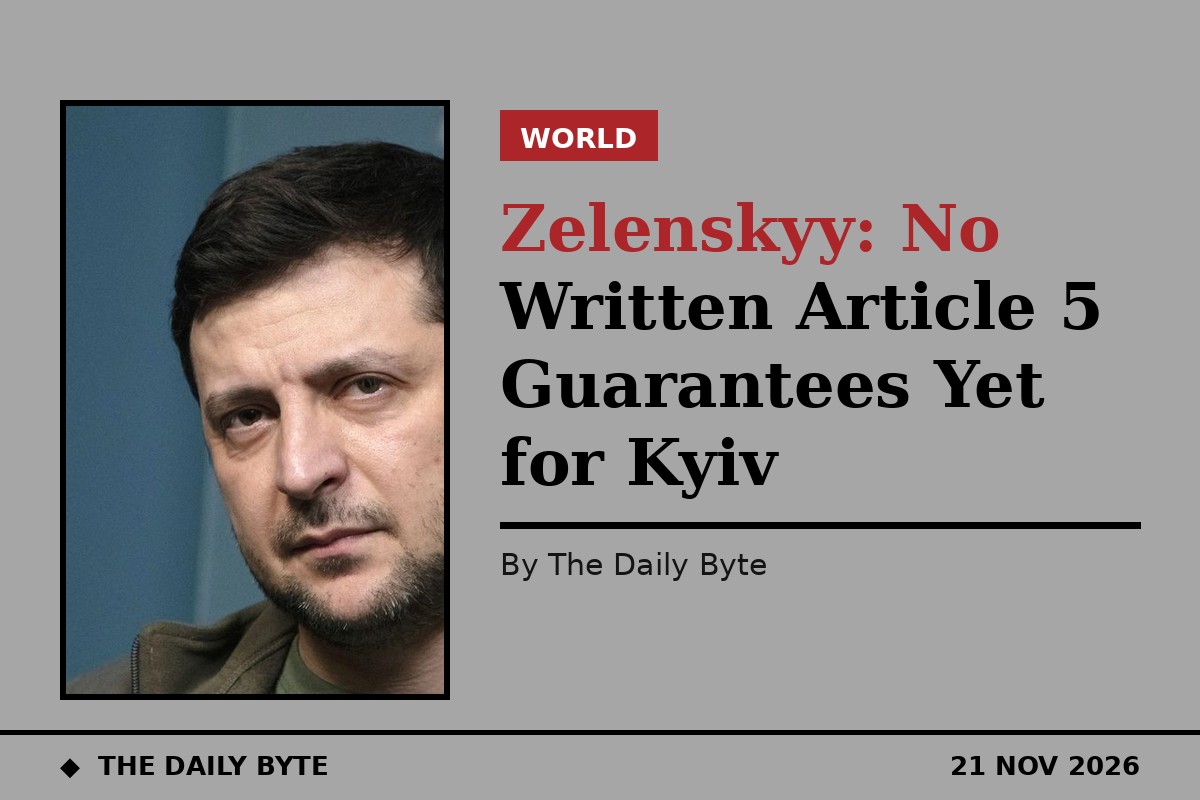
Ukrainian President Volodymyr Zelenskyy has said Kyiv has yet to see any written commitments setting out how proposed NATO-style security guarantees for Ukraine would work, warning that reassuring words are no substitute for promises put on paper. He was speaking to reporters on Saturday, 21 November, in answer to a question from the Kyiv Independent.
“Article 5 is collective defense,” Zelenskyy said. “What remains unclear for Ukraine is who exactly this collective would consist of, how it would defend us, and whether it would be prepared to repel the aggressor.” He added: “The answers must not simply be words, however eloquently they may sound, that ‘of course, nobody will abandon you.’ This must be on paper. So far, I have not seen such commitments on paper.”
The remarks followed talks in Berlin on 19 November, where the Coalition of the Willing — the group of Ukraine’s closest allies — met with US envoys Steve Witkoff and Jared Kushner. Kushner said afterwards that President Donald Trump was “open” to providing Ukraine with security guarantees modelled on NATO’s Article 5 collective defence clause, under which an attack on one ally is treated as an attack on all. “From an American perspective, giving an Article 5-like security guarantee is a really, really big deal,” Kushner said.
What Washington has offered
The Berlin meeting ended with a declaration signed by Germany, France and the United Kingdom that referred, without using the Article 5 label, to “a legally binding commitment, subject to national procedures, to take measures to restore peace and security in the case of a future armed attack by Russia”. Zelenskyy said that wording still left the central questions unanswered, including whether American soldiers would be stationed on Ukrainian soil or US bases established there.
Zelenskyy said he had previously been told by Washington that US troops would not be deployed to Ukraine, and that American officials had described the proposed guarantees as bilateral arrangements similar to those the United States has with Israel and some Middle Eastern states. He argued that Ukraine needed to know exactly what obligations its partners would assume, and how they would respond if Russia attacked again. “What will partners do?” he asked. “What happens if — sorry to be sceptical — not if, but when [Russians] will try to do it again?”
He also stressed that any guarantees must last beyond the current US administration. “We need guarantees not for two years, but preferably forever. At least for decades,” he said. A pause of two years, he argued, would not amount to a strong peace.
NATO membership is the clearest guarantee
Zelenskyy repeated that full NATO membership remains the clearest and most cost-effective security guarantee for Ukraine, and said allies, including France, understood that. “The clearest security guarantees for Ukraine are Ukraine’s membership in NATO. And the clearest strengthening of NATO is to accept Ukraine and have an army like the Ukrainian one among allies,” he said. Without membership, he argued, Ukraine would need to maintain an army of around one million personnel, with aircraft, artillery, missiles and air defences, to defend itself alone. “All of this will certainly exist if Ukraine becomes a NATO member, but it will definitely be cheaper for everyone,” he said.
He acknowledged that accession remained uncertain, with the outcome depending on how and when Russia’s war ends. NATO allies reaffirmed Ukraine’s path toward membership at the alliance’s 2024 Washington summit, but an invitation requires agreement among all members, and no such consensus has been reached. The question of accession has been raised repeatedly within the Coalition of the Willing and is also being discussed with the United States, Zelenskyy said.
‘Yalta 2’ failed in Shenzhen
Zelenskyy also commented on the trilateral meeting in Shenzhen, China, on 19 November between Trump, Russian President Vladimir Putin and Chinese leader Xi Jinping, saying Putin had failed in his bid to negotiate a new division of spheres of influence. “First of all, Putin’s ‘Yalta 2’ did not work out,” he said, noting that China had refused to be drawn into such an arrangement and that no public agreements regarding Ukraine or border changes had emerged from the gathering.
He also released an updated list of temporarily occupied settlements in the southern Kherson and Zaporizhzhia regions that Kyiv has submitted to Ukraine’s Human Rights Ombudsman and to the United States, for possible civilian humanitarian evacuation missions. His remarks came on 21 November, the day Ukraine marks the Day of Dignity and Freedom.
Sources: Kyiv Independent via Europe Says and Ukrinform via Europe Says.


