Zimbabwe Ties Lithium Export Tax to Sulphate Value
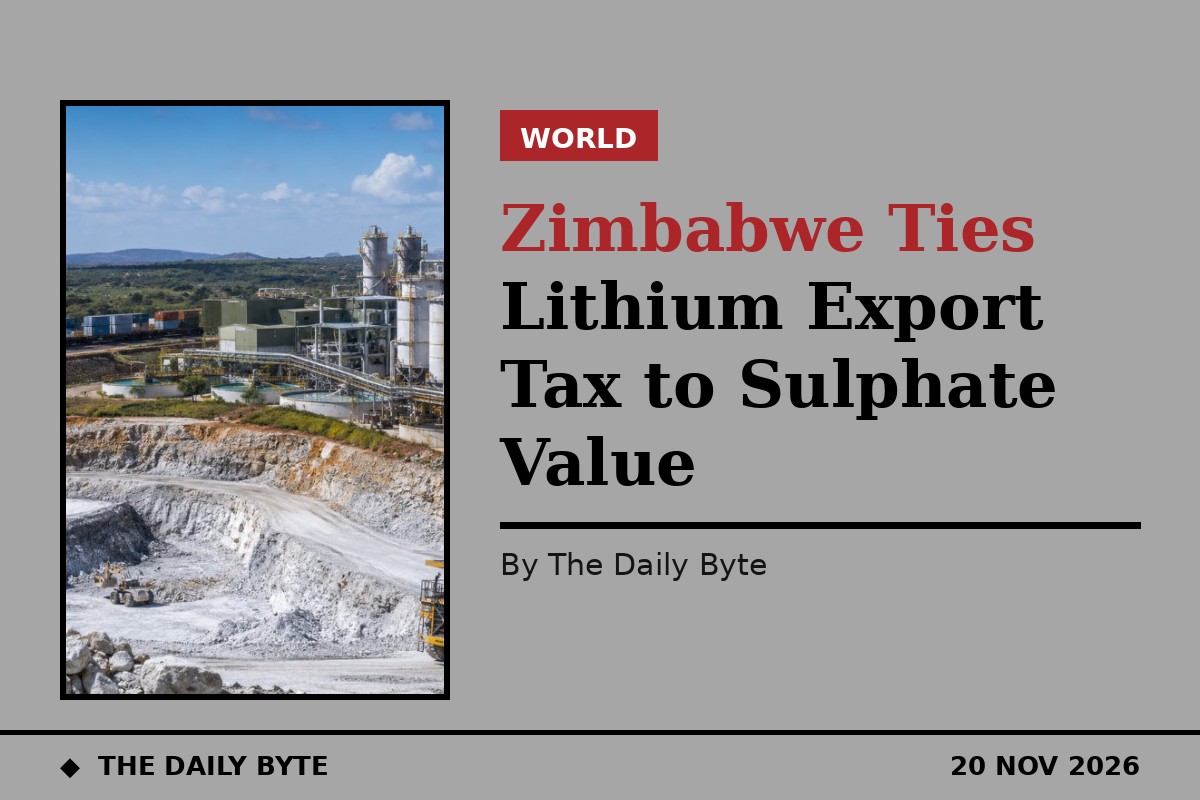
Zimbabwe will tax lithium concentrate exports on the value of the lithium sulphate that could be produced from them, rather than on the concentrate's selling price, Finance Minister Mthuli Ncube announced in his 2027 budget speech on Thursday, 19 November.
The change is designed to make sure Zimbabwe captures a fairer share of revenue from its mineral wealth, Ncube said. At present, export tax is charged on the declared selling price of the concentrate, which the government says does not reflect the full downstream value of the material once it is processed.
Under the new formula, benchmark-grade lithium concentrate containing 6% lithium will be converted at a ratio of five metric tonnes of concentrate to one metric tonne of lithium sulphate for export tax purposes. The tax will then be calculated on the gross fair market value of that equivalent sulphate.
The export tax rate on concentrate itself is unchanged at 10%, according to budget coverage, but the base on which it is charged will now be the sulphate value. Lithium sulphate, a further-processed product, will continue to attract a zero export tax, preserving the incentive for companies to process ore inside Zimbabwe rather than ship it out raw.
New basis can mean a lower bill at current prices
The effect of the change depends on the relative prices of concentrate and sulphate. Market data cited on 20 November put African 6% concentrate at about $1,162 a tonne and lithium sulphate at about $4,090 a tonne. On those prices, the tax on five tonnes of concentrate would fall from about $581 under the old selling-price basis to about $409 under the new sulphate-value basis, because sulphate is currently trading at less than five times the concentrate price.
The new valuation will also be used for royalties and for the Corporate Social Responsibility Levy, according to budget reporting, widening its effect beyond the export tax alone.
Concentrate export ban still undecided
Ncube did not say whether a ban on lithium concentrate exports scheduled for January 2027 will go ahead as planned. Producers have asked the government to delay it until July 2027, and the minister left the question open in his speech.
Zimbabwe is Africa's leading lithium producer. Lithium sulphate production is projected to reach 208,000 metric tonnes in 2027 as new processing plants come online, while lithium concentrate production is expected to rise to 2.3 million tonnes next year, from a projected 2.2 million tonnes in 2026.
Miners told to buy 15% of inputs locally
Alongside the tax change, Ncube announced that mining companies, government entities and other large businesses will be required to source at least 15% of their inputs from local manufacturers. The rule is due to take effect from 1 January 2027, with a framework to guide it expected by 31 March 2027.
The government says the requirement will support domestic manufacturing and keep more mining-related spending inside the economy. The same budget speech introduced tiered export taxes for platinum group metals from 1 January 2027: 10% on washed ore, 5% on concentrate, 2.5% on matte, 1% on platinum-group-metal-rich concentrate with base metals and zero on refined individual metals.
Ncube also disclosed that the government paid $229.7 million in cash and tax credits between January and September 2026 to platinum mining companies against outstanding claims relating to unpaid export proceeds.


