Zugspitze ski season opens as avalanche risk rises
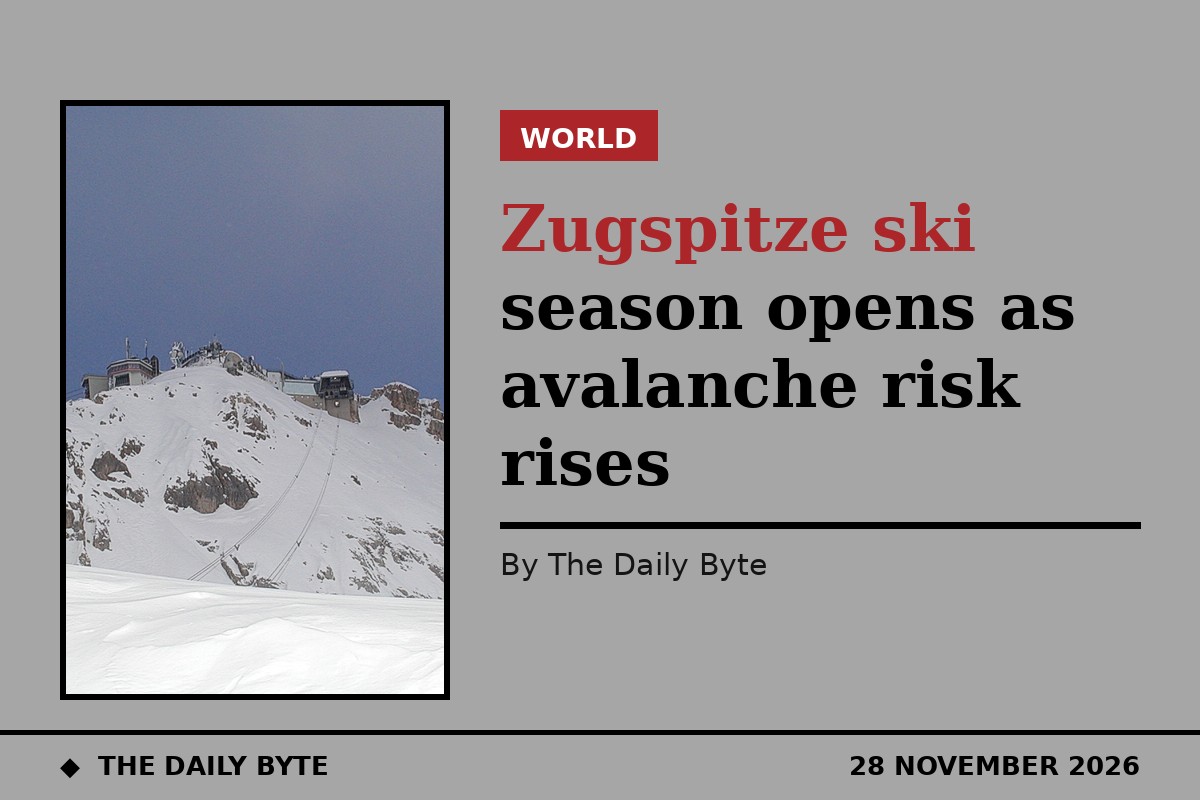
The first ski lifts on Germany’s Zugspitze began operating on Friday, officially opening the winter season on the country’s highest mountain — and with it, the start of avalanche season in the Bavarian Alps.
Conditions at the start of the season underline why experts are urging caution. Temperatures on the Zugspitze are around minus 7C, and a monitoring station at about 2,070 metres has recorded 47 centimetres of snow. On the nearby Nebelhorn, the snow is already 67 centimetres deep.
Thomas Feistl, head of the Bavarian Avalanche Warning Service, told Euronews that older layers of snow and strong winds can create unstable layers in the snowpack and deposits of windblown snow, two of the most common causes of avalanches. A slope can look perfectly stable even when the snow underneath is not, and years of experience in alpine terrain are no guarantee of safety.
Most fatal avalanches are triggered by people skiing, snowboarding or snowshoeing away from marked and secured pistes, and the most common type in such cases is the slab avalanche. Successive layers of snow build up through the winter, some compact and others loose and unstable. The weight of a skier can cause a weak layer to collapse, triggering a fracture that spreads rapidly across the slope. Within seconds, a slab of snow breaks away and slides downhill.
A skier does not need to displace large amounts of snow to set one off. All it takes is for a weak layer to fracture at a vulnerable point, and the fracture can spread over hundreds of metres, meaning that even someone moving below an unstable slope can trigger an avalanche. Slopes angled between 30 and 45 degrees are particularly prone.
Other factors add to the danger. Heavy snowfall can form unstable layers, while strong winds carry snow across mountainsides and deposit it in places where it forms wind slabs. At lower and medium altitudes in the Bavarian Alps, snow is currently lying on relatively warm ground. The base of the snowpack is already moist and is expected to become more so as temperatures rise over the coming days, which could trigger spontaneous glide-snow avalanches on smooth ground, whatever direction the slope faces.
Feistl stressed that the first minutes after burial are critical. How long a person can survive under the snow depends on how much oxygen is available: if the airways become blocked while the avalanche is still moving, suffocation can follow within minutes, while a larger air pocket can allow survival for several hours. The chances of survival fall rapidly, making the first 15 minutes after burial particularly important. Digging yourself out is almost never possible, because avalanche debris is extremely heavy and people buried completely are usually unable to move or free themselves.
When an avalanche strikes, Feistl said, the search should begin immediately if the buried person and their companions are carrying avalanche transceivers, probes and shovels. Rescuers must also consider their own safety, and the emergency services should be alerted as soon as possible to give rescue teams the best chance of reaching the scene in time.
Most avalanche accidents in Germany, Austria and Switzerland happen in the Alps, particularly in high-altitude areas with heavy snowfall and popular ski-touring routes outside secured pistes. In Germany, the Allgäu Alps, the Wetterstein mountains and the Berchtesgaden Alps are among the areas most at risk. Feistl’s message is that prevention and responsible behaviour are the key to avoiding accidents, and that anyone heading off piste without standard safety equipment has only a very slim chance of being rescued in time.


