ADB approves $500m disaster financing for Pakistan
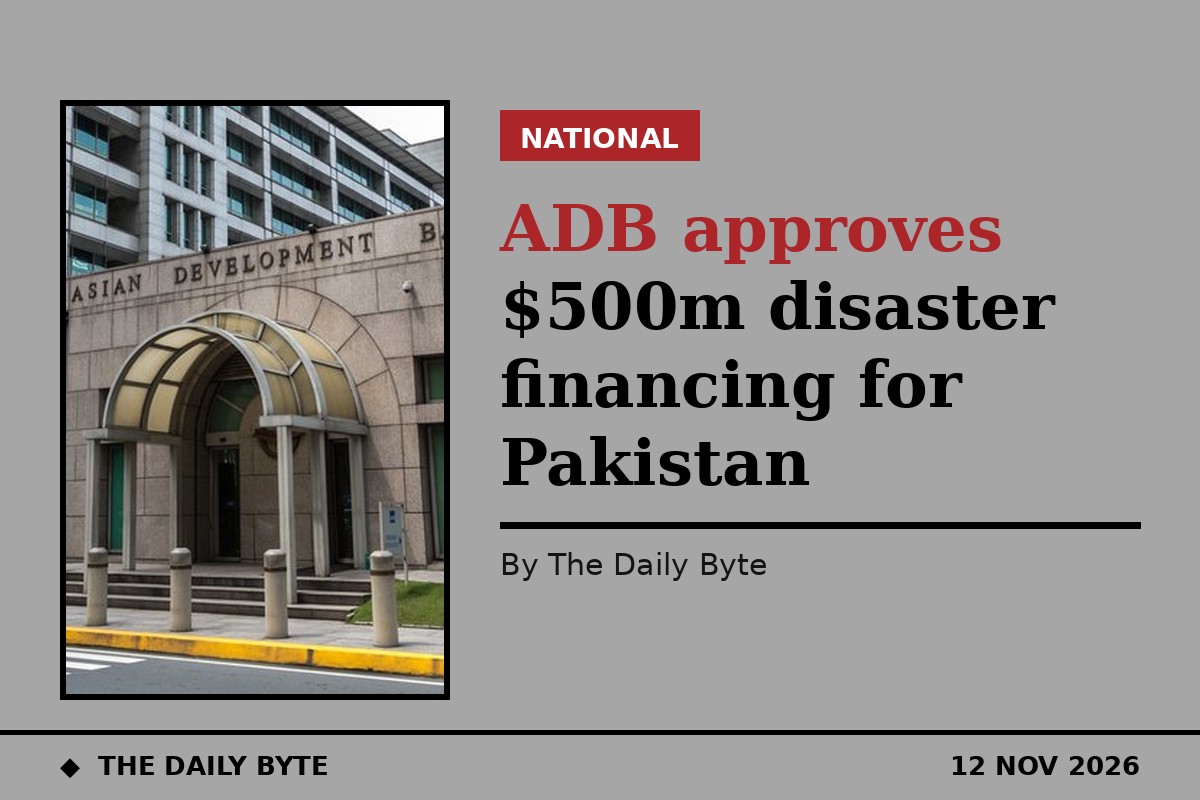
The Asian Development Bank (ADB) has approved $500 million in contingent disaster financing for Pakistan, giving the government a ready source of budget support that can be released quickly when a major flood, earthquake or other eligible disaster strikes. The Manila-based lender announced the approval on Tuesday, 11 November 2026.
The money is not a grant and it is not spent in advance. Under the arrangement, the financing sits ready under the ADB's policy-based lending and is drawn down as budget support only after an eligible disaster event, so the government can pay for emergency response and recovery without waiting months for a new loan to be negotiated and approved.
What the $500 million covers
The facilities form the second subprogram of the ADB's Climate and Disaster Resilience Enhancement Program. Alongside the financing, the program supports reforms to strengthen disaster preparedness and risk management, to build resilience into development planning and investment, and to improve the way disaster risk is financed in Pakistan.
That design matters because Pakistan faces repeated, costly disasters. The ADB said floods, earthquakes and other hazards cost the country an estimated $2 billion a year on average. The 2022 floods, which inundated large parts of Sindh, Balochistan and southern Punjab, remain the starkest recent example of how a single season of extreme weather can overwhelm public finances and push millions of people into hardship.
Why speed matters after a disaster
After a major disaster, the first weeks are usually the hardest for a government to fund. Rescue and relief spending rises sharply at the same time as tax revenue falls and borrowing becomes more expensive. A contingent facility agreed in advance is meant to close that gap: the terms are settled before disaster strikes, so the money can move as soon as the agreed trigger is met.
ADB Country Director for Pakistan Emma Fan said the people worst hit by disasters are usually from vulnerable and deprived groups, and that investment in preparedness could help protect lives and livelihoods, reduce economic losses and safeguard development gains. Her point reflects a wider shift in disaster finance, away from appealing for help after the event and towards having money and plans in place beforehand.
Part of a longer program
This is not the first time the ADB has backed Pakistan's disaster and climate resilience in this way. The bank approved a $500 million policy-based loan in 2024 to support climate change action and disaster risk reduction, and the new facilities build on that work under the same program umbrella.
The approval also comes as Pakistan continues to press its case at the COP31 climate summit in Antalya, where Prime Minister Shehbaz Sharif has been seeking concessional finance for the country's clean energy transition. Disaster resilience and climate finance are closely linked for Pakistan: the country contributes less than one per cent of global greenhouse gas emissions, yet it is among the countries most exposed to flooding, heat and glacial melt.
What happens next
The financing will only be drawn if an eligible disaster occurs, and the reforms attached to the second subprogram will be tracked as they are put in place. For households in flood-prone districts, the practical test will be whether help arrives faster the next time rivers rise — and whether the money reaches the communities that need it most.
Sources: Asian Development Bank and Mettis Global.