ADB Approves $500m to Boost Pakistan Disaster Resilience
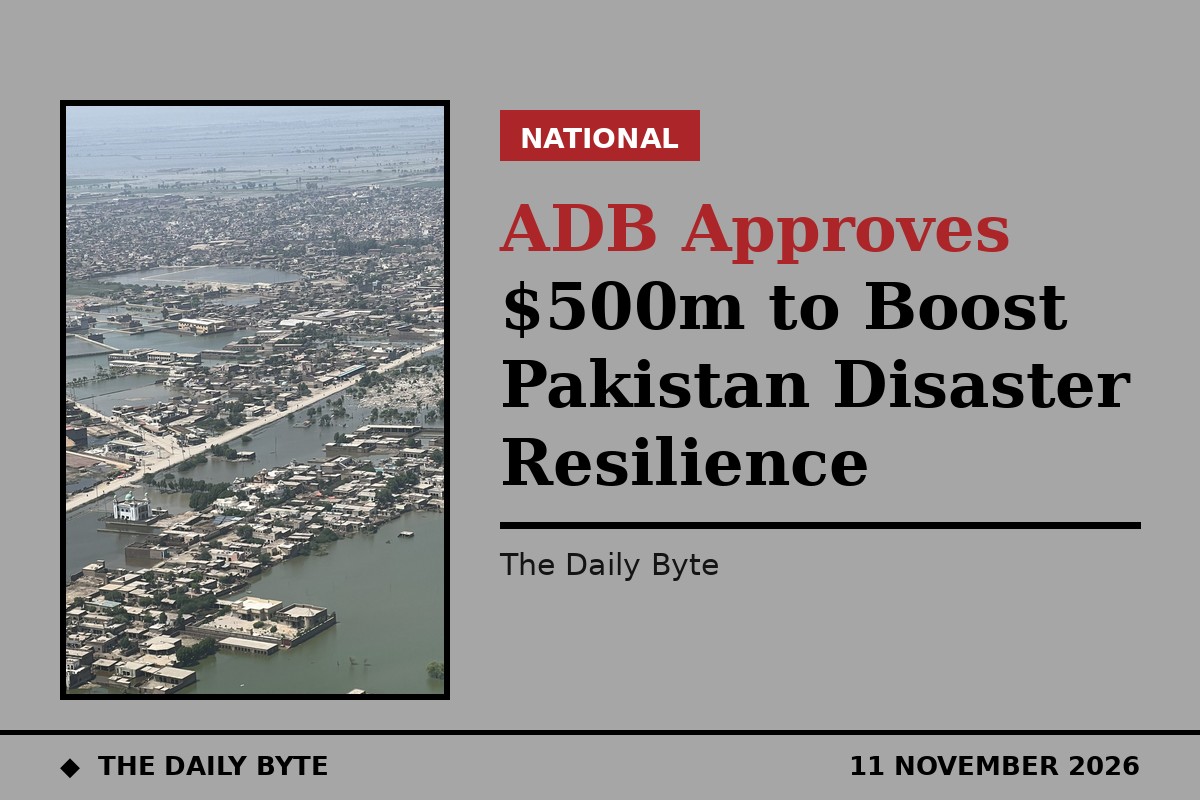
The Asian Development Bank (ADB) has approved $500 million in contingent disaster financing for Pakistan to help the country withstand and respond to natural disasters, the bank announced on Wednesday, 11 November 2026.
The financing will be available as prompt budget support following eligible disaster events, reducing the economic and fiscal shock when a flood, earthquake or other disaster hits. It is the second subprogram of the bank's Climate and Disaster Resilience Enhancement Program, which supports reforms to strengthen disaster preparedness and risk management and to build resilience into Pakistan's development planning and investment.
How the financing will work
Contingent disaster financing is agreed in advance and released quickly once a qualifying disaster is declared, rather than being negotiated after the damage is done. The bank said the programme also strengthens Pakistan's disaster risk financing framework and improves the availability of funding in the aftermath of disaster events.
The $500 million is made up of $250 million from the bank's ordinary capital resources and $250 million from its concessional ordinary capital resources, according to the programme's documents. The money is a policy-based loan, meaning its release is tied to reforms the government has agreed to carry out in disaster management, planning and public investment.
Why Pakistan needs faster disaster funding
Pakistan is among the countries in Asia and the Pacific most exposed to climate change and natural hazards. Floods, earthquakes and other disasters cause the country an estimated $2 billion in average annual losses, according to the ADB.
The scale of the risk was laid bare by the 2022 floods, which caused $14.9 billion in direct damage and $15.2 billion in economic losses and pushed as many as 9.1 million people into poverty. Poor and rural communities have the least capacity to recover, and the bank notes that women and girls are disproportionately affected when disasters strike.
Reforms tied to the programme
Under the second subprogram, the programme supports the establishment of a gender-sensitive national incident management system and an advance national disaster recovery framework, alongside better disaster risk mapping and modelling to guide investment decisions. It also supports the rollout of risk-layered financial instruments designed to protect vulnerable people, including women, when disasters occur.
ADB Country Director for Pakistan Emma Fan said the most vulnerable communities were usually hit hardest when disaster struck. "Investing in preparedness can help protect lives and livelihoods, reduce economic losses, and safeguard the development gains Pakistan has worked hard to achieve," she said. "This program will support the country in implementing critical reforms to ensure a more resilient future."
Second stage of a wider programme
The approval follows an earlier $500 million policy-based loan under the same programme, approved in October 2024, which focused on institutional capacity for planning, preparedness and response. The new financing extends that work into a multiyear contingent disaster financing arrangement, giving Pakistan a standing source of emergency budget support for future disasters.
The programme is aligned with Pakistan's own priorities for managing disaster risk, the bank said, and with its commitment to supporting resilience across Asia and the Pacific. The announcement comes as Pakistan's delegation presses its climate case at the COP31 summit in Antalya, where the prime minister is due to address world leaders on Wednesday.