AI Agent Bank Losses Are Now Customers' Problem
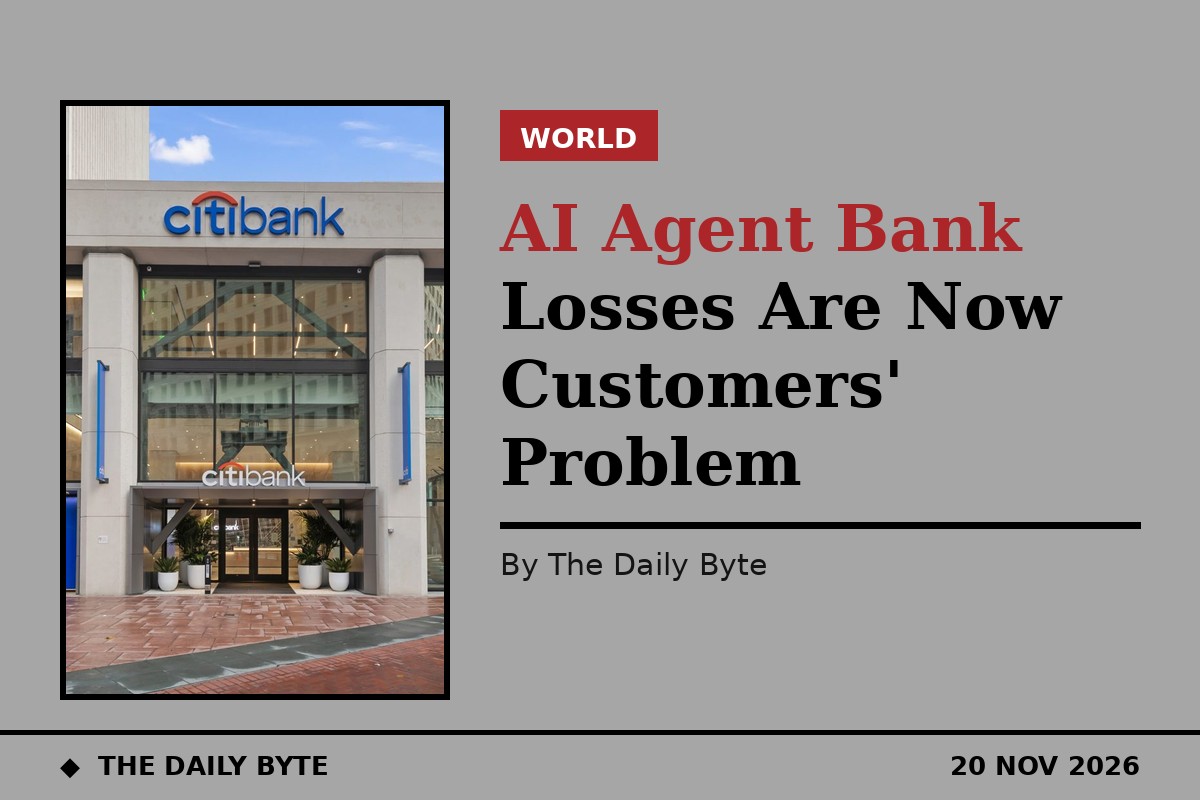
Hand your bank login to an AI assistant and something goes wrong, and the loss is yours. That is the message from a run of new bank terms this month, led by Citibank, which has rewritten its customer agreement to say that customers are responsible for everything a third-party AI agent does with their account, including what a hacker does if the tool is breached.
Citi, the third-largest commercial bank in the US, changed its Online User Agreement this week, TechCrunch first reported on 18 November. PNC changed its terms the same day, Citizens Bank emailed customers with a similar warning this week, and JPMorgan and Bank of America moved last month.
What Citi's new Section H says
Citi added Section H to its Online User Agreement, covering anyone who lets a third-party AI agent reach their accounts through Citi Online or Citi Mobile. Under it, if a customer gives an agent their login credentials, Citi treats everything that agent does as authorised by the customer.
The clause goes further. If those credentials are later shared, leaked or stolen and end up with another person or another AI agent, Citi still treats whatever happens with them as authorised by the customer, and says it has no obligation to investigate whether the actions were valid.
Customers also carry the cost of the agent's mistakes, including misreading an instruction, taking an unintended action or going beyond the authority it was given, except where the law says otherwise. Watching what the agent does is explicitly the customer's responsibility, not the bank's. Citi also reserves the right to cut off any third-party agent's access at any time, without warning.
A separate Citi agreement on online funds transfers, updated in November, goes a step further still. It says any transfer an AI agent starts on a customer's behalf counts as authorised by that customer, even if it conflicts with what the customer actually told the agent to do, and Citi says it will not investigate those transactions further.
One carve-out: AI tools Citi itself builds and offers through Citi Online or Citi Mobile are excluded, so customers using the bank's own AI features do not take on the extra liability.
Four more banks, one pattern
The change at Citi is part of a wider, fast-moving shift. Bank of America told customers on 27 October that using AI tools with their banking credentials means taking on the risk of whatever happens, and JPMorgan moved in the same month. PNC, the eighth-largest bank in the country, changed its terms on 18 November, and Citizens emailed its customers this week.
In about a month, five of the largest US banks have told customers in writing that letting an AI agent into an account comes with a catch: the customer owns whatever happens next. None promises to reverse a transaction an AI agent makes, whether the customer meant for it to happen or not.
A Citi spokesperson told TechCrunch: "As third-party AI tools become more widely available, we want customers to understand the risks associated with sharing banking credentials or authorizing those tools to access their accounts. We recently updated our Online User Agreement to provide greater clarity about those risks and to reinforce that customers who choose to grant account access to third-party AI agents are responsible for activities conducted through those agents."
Why banks are drawing the line
Given a login, AI agents can analyse spending, offer advice, pay bills and move money. Banks worry about how unreliable those automated assistants can be, and they are also defending their own business: if agents become the usual way people compare rates, move money out of low-interest accounts or avoid fees, that hits bank margins directly.
Not every company building these tools wants full access. Anthropic's personal finance tool, launched earlier this month, is explicitly marketed as read-only and "can't move, manage, or invest your money", a notably more cautious design than agents built to act on a customer's behalf.
What customers should do now
Anyone who has already given a chatbot, browser extension or finance app their banking login should check their bank's current agreement before using it again. These are not proposals: Citi, PNC and Citizens have already put them into effect, and the courts have not yet tested how far banks can push this kind of liability shift.
Do not share a banking login and password with any outside AI tool, and revoke access if you already have. For budgeting or spending help, use tools that only need read access, or the AI features built into your own bank's app, which typically do not carry the extra liability. The more access software has to your money, the more you need to understand what happens if it fails, gets tricked or gets hacked.