Albanese COP31 speech omits fossil fuels
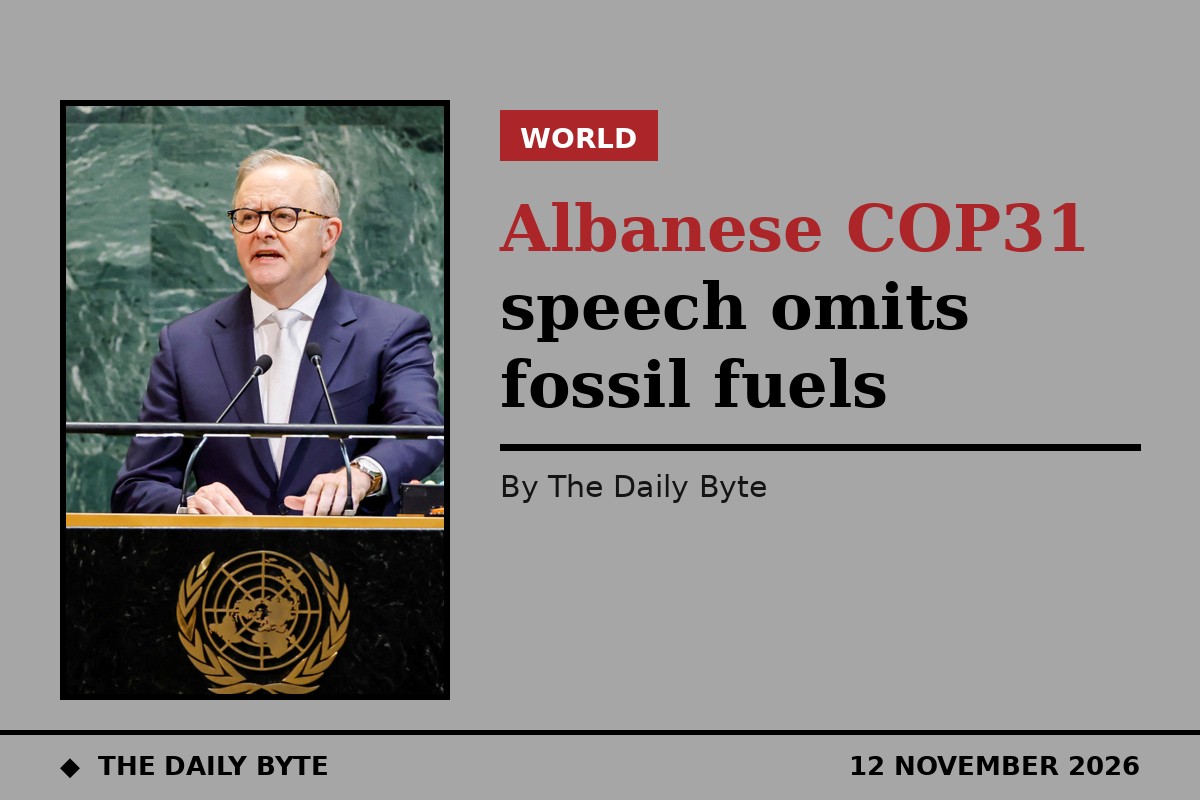
Australian Prime Minister Anthony Albanese has told world leaders at the COP31 climate summit that governments have a “solemn responsibility” to act on climate change — but his address in Antalya, Türkiye, on 11 November did not mention fossil fuels at any point, even though coal, oil and gas are the main drivers of the crisis the summit is meant to tackle.
Albanese insisted that “real and rapid progress is possible” from the talks, and linked climate action to a stronger economy. “We must ensure we are heading towards a future where our energy is clean, reliable and affordable, and our economies are strong,” he said. “While the Paris Agreement is under pressure, its call to arms can still be heard.”
The omission stood out because of what had been said on the same stage only moments earlier. United Nations Secretary-General António Guterres told leaders that keeping the goal of limiting global heating to 1.5 degrees Celsius alive “means no new coal”. He said fossil fuels “must go the way of the dinosaurs” and warned: “Leaders – and in particular those from developed countries – cannot keep expanding fossil fuel production while claiming to be committed to 1.5 degrees.” Guterres has said coal power must fall by at least 75 per cent by 2035 to keep the 1.5C goal within reach.
Renewables praised, fossil fuels unmentioned
Albanese used his speech to highlight Australia’s progress on renewable energy. He said the country had doubled its renewable energy generation in six years, so that renewables now account for half of its electricity, and pointed to Australia building one of the world’s biggest rooftop solar and battery markets.
What he did not do was address Australia’s continued expansion of coal and gas. Australia continues to approve new oil, gas and coal projects, including a large extension to the Hunter Valley Operations coal mine in New South Wales. That contrast — rapid growth in renewables at home alongside new fossil fuel approvals — is at the centre of the criticism his speech has drawn.
Bill Hare, chief executive of Climate Analytics and a veteran of climate talks, described it as “disturbing” that Albanese had failed to mention fossil fuels. Adam Bandt, chief executive of the Australian Conservation Foundation, accused the prime minister of failing to heed Guterres’s warning, saying: “This is crunch time, and Australia can’t keep dodging this issue.” Nicki Hutley, of the Climate Council, said building renewables while approving new coal and gas was like “filling the bath with the plug pulled out”.
Pacific plea at the centre of the speech
Albanese made the plight of Australia’s Pacific neighbours central to his address, urging world leaders to hear nations confronting a climate crisis they had done little to create. He recounted meeting 13-year-old Melelusi Sokotia in Tuvalu last month, who told him she dreamed of becoming a doctor but feared for the future of her island home.
He quoted her message to the summit: “We are not asking for pity, we are asking for help and partnership.” The prime minister called for greater investment in clean energy and climate adaptation, pointing to the Pacific Resilience Facility as an example of how vulnerable nations could be supported.
What the summit must decide
COP31, hosted by Türkiye and presided over in the negotiations by Australia’s climate change minister, Chris Bowen, is focused on implementing existing climate commitments rather than setting new emissions targets. Even so, the question of how quickly countries should move away from coal, gas and oil remains a major sticking point.
Last year’s COP30 in Brazil failed to secure an agreement on fossil fuels, although a proposed roadmap would see countries plan their national energy transitions by 2028. Guterres and several countries are pushing for the talks in Antalya to advance that proposal, with countries developing detailed plans to move away from fossil fuels.
Finland, by contrast, announced a plan at the summit to phase out oil, gas and coal — a move that underlined the gap between countries setting out an exit from fossil fuels and those, like Australia, that have so far avoided naming one. For the next two weeks, with Bowen steering the negotiations as COP co-president, Australia will be at the centre of pressure to turn its stated climate leadership into a clear plan for phasing out the fuels driving global heating. Renew Economy and the ABC both reported the speech and the reaction to it.


