Allgäu Glacier Loses Status After Record Summer Melt
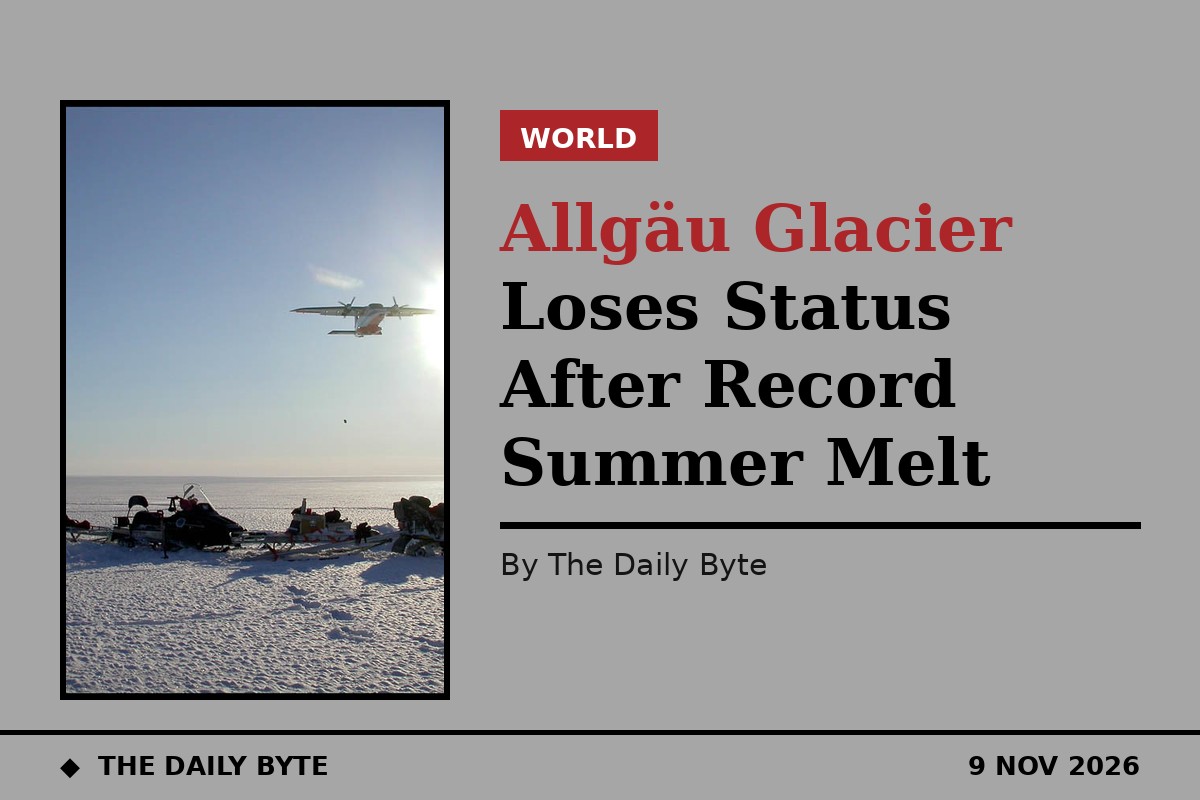
The last glacier in the Allgäu Alps has lost its status as a glacier after an exceptionally hot summer stripped away more than four metres of its thickness and around half of its volume.
Researchers confirmed on Saturday that the Schwarzmilzferner, on the Austrian side of the Allgäu Alps near the border with Germany, no longer meets the definition of a glacier because its ice has stopped flowing under its own weight. The ice field sits at an altitude of around 2,450 metres, on the south-east side of the Mädelegabel and Hochfrottspitze peaks.
Christoph Mayer, a glaciologist at the Bavarian Academy of Sciences, has monitored the ice with colleagues for 26 years. He said the glacier had been losing significant mass since 2016, the trend had intensified since 2022, and this summer's heat finished the process. "It is highly likely to have disappeared completely by next summer," Mayer said.
The loss matters beyond a single ice field. The Schwarzmilzferner was the last glacier in the Allgäu Alps on the Austrian side, and its fate shows how quickly even long-monitored ice is now vanishing. Mayer warned that the phenomenon is not isolated: several small glaciers in the Alps disappear every year, and even heavy winter snowfall can no longer offset the losses caused by increasingly hot summers.
Under current conditions, Mayer expects the entire Eastern Alps to be ice-free between 2060 and 2070. That would change mountaineering routes, reduce summer meltwater flows and alter high-alpine ecosystems that depend on glacial water through the warm months.
The wider picture in Bavaria is equally stark. A 2023-25 survey by geographer Wilfried Hagg and Mayer found that Bavaria's four remaining glaciers lost more than a quarter of their area in just two years, amounting to about one million cubic metres of ice. Researchers warn that several named Bavarian glaciers — including the Blaueisgletscher, the Watzmanngletscher, the Nördlicher Schneeferner and the Höllentalferner — are likely to lose glacier status within years, or at most a decade.
The pattern is repeated across the Alps. French experts reported that Mont Blanc had reached 4,807.47 metres after its ice and snow cover grew by nearly two metres compared with 2023, although they cautioned against reading too much into a single measurement. Switzerland's Glamos monitoring network announced further volume losses for Swiss glaciers: another 5.5 percent this year, with the decline reaching nearly 20 percent over the past five years.
A glacier is defined not only by the presence of ice but by movement. When ice becomes so thin and fragmented that it can no longer flow downhill, it is classified as dead ice rather than a glacier. That is what has happened to the Schwarzmilzferner: the remaining ice is still visible on the mountainside, but it no longer behaves as a glacier.
The Bavarian Academy of Sciences has documented similar endings before. The Southern Schneeferner on the Zugspitze was officially stripped of glacier status in 2022, and researchers expect the Northern Schneeferner to follow around 2030. The Schwarzmilzferner now joins that list, and scientists say it will probably be gone entirely after one more summer.
For walkers in the Allgäu, the change is already visible. The ice field that once marked the high route between the Lech valley and the Allgäu peaks is now a shrinking patch of dead ice, and the researchers who watched it for a quarter of a century say there is no realistic prospect of recovery while summers keep getting hotter.


