AMD launches Instinct MI450X AI chip with 288GB memory
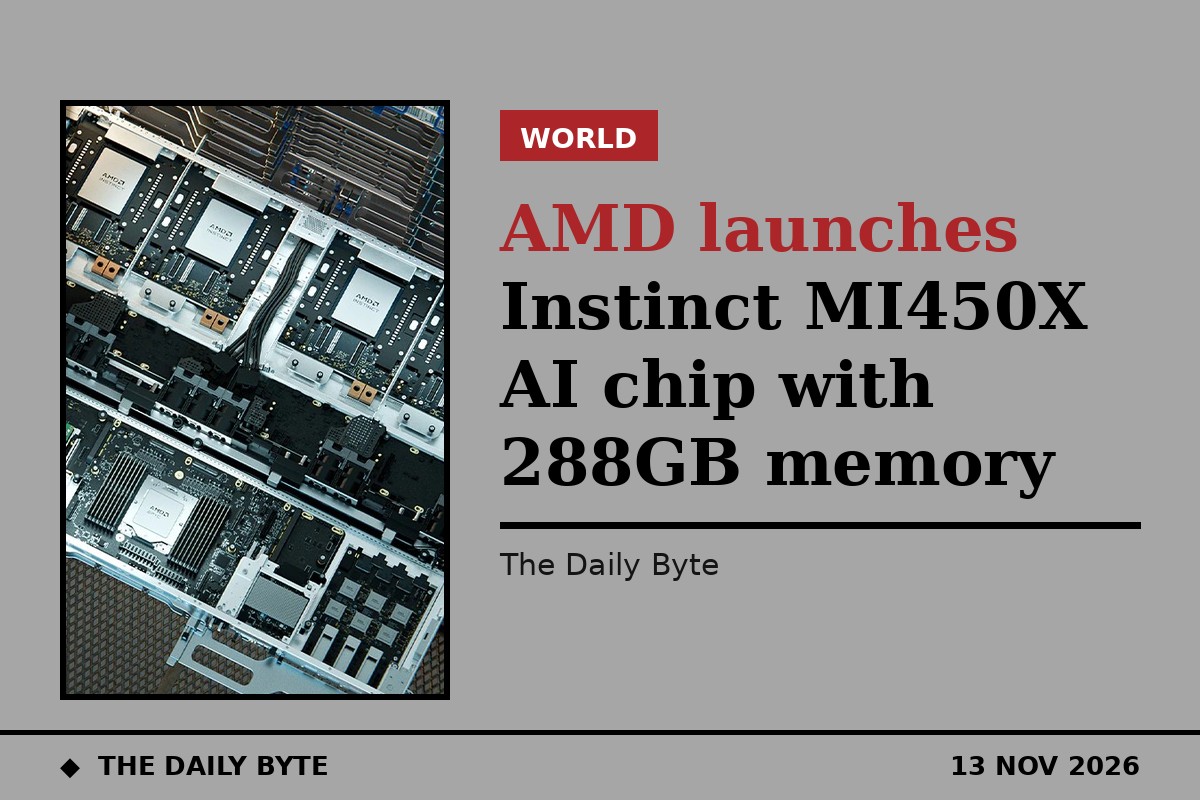
AMD has introduced a new data-centre graphics chip, the Instinct MI450X, giving customers building its Helios rack systems a second memory option for running large artificial intelligence models. The company announced the chip on 12 November, alongside new measured inference results for its larger MI455X chip.
The MI450X carries 288 gigabytes of HBM4 memory per graphics processing unit (GPU). According to AMD, it delivers the same core compute, memory bandwidth and scale-up and scale-out connectivity as the MI455X, so customers can choose between the two chips on the same Helios rack-scale platform and the same ROCm software.
What the MI450X offers
Helios is AMD's rack-scale system, in which dozens of GPUs are linked together in a single rack to run very large AI models. The MI450X is aimed at workloads that fit within its memory capacity, where it can meet throughput and response-time targets while keeping operating expenses in check, AMD said. The MI455X, with more memory, keeps the headroom for larger models, longer contexts or higher concurrency.
AMD said the new chip shows how it can respond quickly to changing customer requirements, and that the shared architecture should make it simpler for partners to bring systems up and integrate them. The company did not give a price or an availability date for the MI450X in the announcement.
AMD's 30 percent claim against Vera Rubin
The headline figure in the announcement concerns the MI455X rather than the new chip. AMD said testing by AMD Performance Labs in October 2026 showed the MI455X reaching 21,333 tokens per second per GPU on the DeepSeek-R1 model, using an MLPerf Inference Offline configuration. That is up to 30 percent higher throughput than the latest published MLPerf offline result for Nvidia's Vera Rubin NVL72 system, according to Engineering.com, which reported the announcement.
The comparison deserves care. The result comes from AMD's own testing, measured against Nvidia's published MLPerf Inference v6.1 results, retrieved from MLCommons on 11 November. AMD's own notes say results may vary with model, configuration, software version and other factors. It is a claim about one model on one benchmark configuration, not a finding that AMD's chips are faster on every workload.
AMD also said Helios offers up to 20 percent higher HBM bandwidth and higher scale-up bandwidth than Nvidia Vera Rubin, based on its own calculations from published specifications.
Science chip MI430X also detailed
The same announcement gave more detail on the Instinct MI430X, a chip aimed at high-performance computing and AI for science. It offers native double-precision compute for demanding scientific calculations, with 432 gigabytes of HBM4 memory and up to 23.3 terabytes per second of memory bandwidth.
AMD said new research examined 47 workload configurations across 11 applications and benchmarks, looking at where emulated double precision helps and where scientific codes depend on native double-precision compute.
What AMD did not say
Andrew Dieckmann, corporate vice president and general manager of AMD's data-centre GPU business, said the MI400 series gives customers more options to power their next generation of AI and high-performance computing workloads.
The timing is notable. Nvidia, the company AMD is measuring itself against, announced on 12 November that co-founder Jensen Huang had resigned as chief executive after 33 years, with chief financial officer Colette Kress stepping in as interim chief executive. AMD's announcement does not mention Nvidia's leadership change, but the benchmark comparison puts the rivalry in plain view at a moment when the market leader is in transition.
For buyers, the practical question is now whether independent testing confirms AMD's figures, and when MI450X systems reach customers at what price. Until then, the MI450X is best read as a wider choice on the Helios platform, and the 30 percent figure as AMD's own measurement, not an independent verdict.