AMD MI455X Beats Nvidia Vera Rubin by 30%, AMD Claims
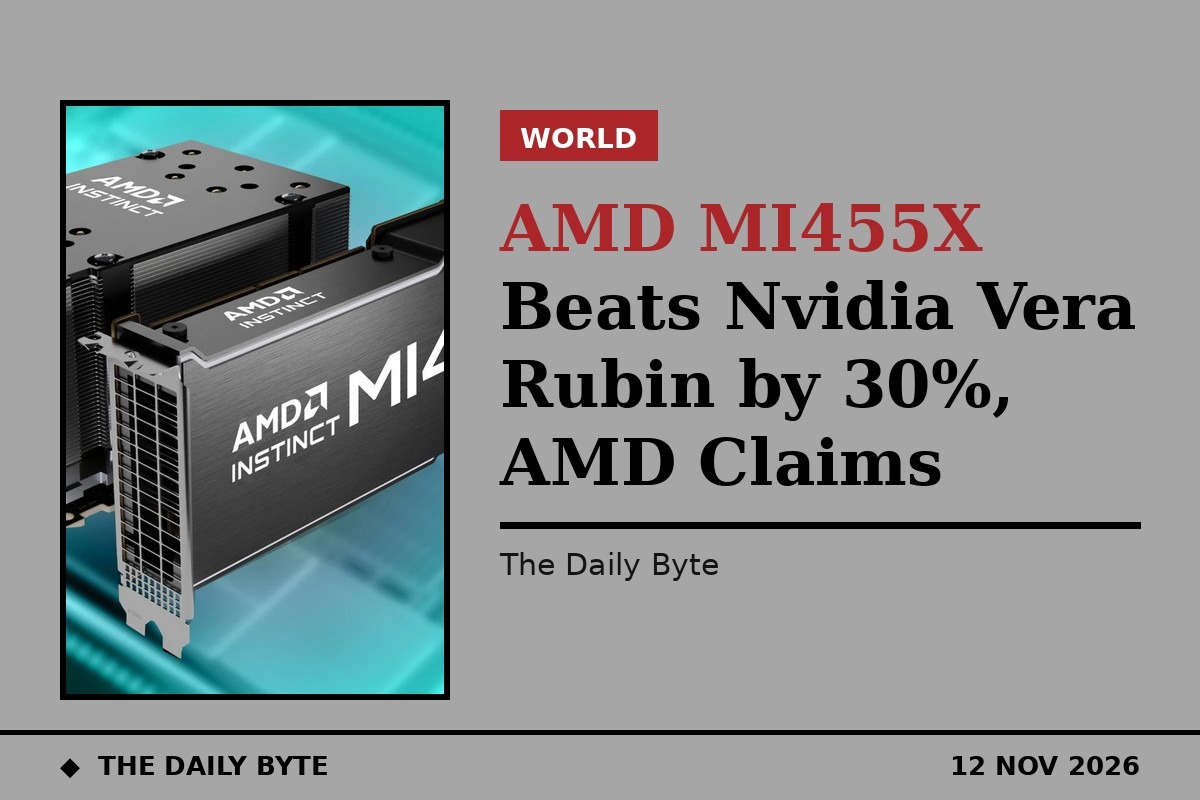
AMD has claimed its newest AI chip beats Nvidia's latest system by up to 30%, releasing test results for the Instinct MI455X on its Helios rack platform on Thursday 12 November. The company said the chip processed 21,333 tokens per second running DeepSeek-R1, the popular open AI model, in an MLPerf Inference Offline configuration.
The comparison is against Nvidia's latest published MLPerf result for its Vera Rubin NVL72 system, and the testing was carried out by AMD itself, so the claim is AMD's own rather than an independent verdict. AMD also introduced a second chip, the Instinct MI450X, giving customers another option for its Helios rack-scale systems.
What AMD actually measured
AMD's announcement says the MI455X result comes from testing by AMD Performance Labs in October 2026, measured against the published MLPerf Inference v6.1 results for Nvidia's Vera Rubin NVL72 in the Closed Division, which AMD retrieved on 11 November. AMD says the Helios rack also delivers up to 20% higher HBM memory bandwidth than Vera Rubin, a figure calculated from the two systems' published memory specifications.
The MI450X, the new chip in the announcement, is aimed at the same Helios platform but with a different memory capacity, letting customers match the hardware to the size of the models they run. AMD did not publish a price or a general availability date for either chip in the announcement.
Why the claim matters, and its limits
The claim matters because Nvidia's Vera Rubin platform is the benchmark every AI chipmaker is measured against, and AMD is pitching Helios as a rack-scale alternative built on open standards. AMD's data-centre business is already growing fast: the company reported third-quarter revenue of $13.38 billion, up 45% year on year, with data-centre revenue of $8.55 billion, almost double a year earlier, and forecast fourth-quarter revenue of about $17 billion.
But the 30% figure should be read with care. As TechDefused noted, the tests were run by AMD using the MLPerf benchmark rather than by an independent body, and the comparison is not an independent MLPerf-certified AMD submission. The two vendors also use different low-precision formats, so a single throughput number does not prove one chip is faster on every workload. AMD itself notes that results may vary with the model, configuration and software.
Market reaction
AMD shares rose about 6% on Thursday after the announcement, as investors welcomed the latest sign that AMD is closing the gap with Nvidia in AI data-centre hardware. The move came on a turbulent day for the chip sector, with Nvidia's own shares under pressure following the resignation of its chief executive Jensen Huang.
For buyers of AI hardware, the practical test will be whether cloud providers and large AI labs adopt Helios at scale. AMD already counts Anthropic, Microsoft, Meta, OpenAI and Oracle among the customers running workloads on early Helios systems, and its collaboration with Anthropic includes plans to deploy up to 2 gigawatts of MI450-series GPUs, with the first large-scale deployment scheduled for 2027.
Sources: AMD Newsroom; TechDefused


