Apple Depth Pro 2 Brings Open-Weight Depth to Video
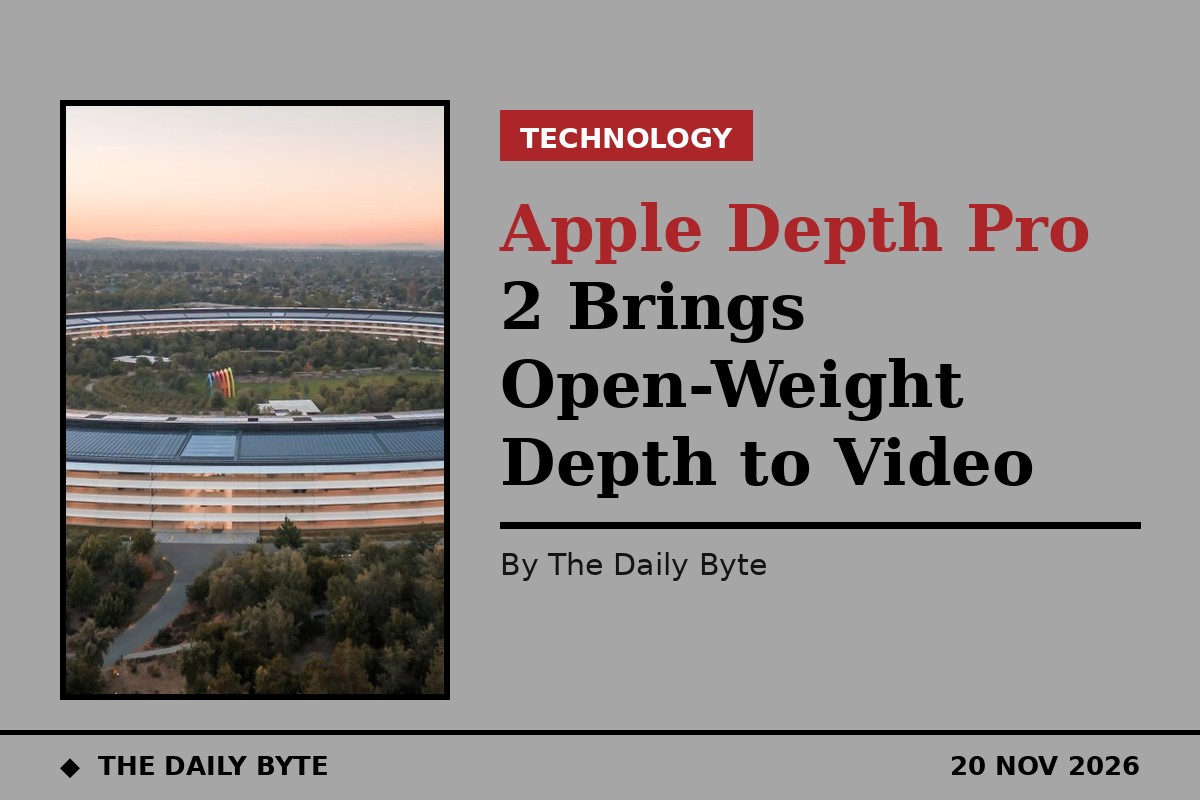
Apple has released Depth Pro 2, a family of four open-weight models that estimate metric depth from a single ordinary camera, whether the input is a photo, a video clip or a live feed. The weights and code are published on Hugging Face and GitHub, and the accompanying technical report, titled "Depth Pro 2: Sharp and Temporally Consistent Metric Monocular Depth", was published on 19 November 2026.
Depth estimation is a building block for much of modern computing. A depth map records how far every pixel in an image sits from the camera, and it is what makes portrait-mode blur, augmented-reality placement and robot navigation work. Doing it from one camera, with no stereo pair and no lidar, is the hard version of the problem, and doing it in real units, metres rather than nearer-or-farther, is harder still. That is the gap Depth Pro 2 is aimed at.
What the four models offer
The family comes in four sizes. The smallest, S, has 24 million parameters and downloads at 97 MB; B has 97 million parameters and 386 MB; L has 334 million parameters and 1.3 GB; and the default model, H+, has 872 million parameters and 3.5 GB. Apple suggests the S model for laptops and quick tests, and H+ for the best quality, including video at native resolution.
Alongside the four depth models sits a separate focal-length estimator of 23.5 million parameters. Pixel measurements only turn into metres if the camera's focal length is known, and many photos and videos carry no reliable metadata. The estimator predicts the focal length in pixels from the frames themselves, so the depth model can work on arbitrary footage. A video clip gets one focal length for all its frames, which suits fixed-lens footage but not material shot while zooming.
Why video is the headline change
The first Depth Pro, released in 2024, handled single images. Depth Pro 2 processes video too, using a multi-view transformer that looks at several frames jointly so the model can agree with itself over time instead of guessing frame by frame. It offers a buffered mode that processes 16-frame clips with a 4-frame overlap, and a per-frame streaming mode for live use.
Apple pitches the release on two qualities: sharpness and temporal consistency. Sharpness refers to edges, where many depth models smear at object boundaries and ruin effects such as background blur. Temporal consistency refers to video, where a model run frame by frame gives depth that flickers. The project page says Depth Pro 2 outperforms prior work on Boundary F1, a measure of edge accuracy, and on Jitter, a measure of frame-to-frame instability, averaged over the Sintel and Spring datasets. It does not print the scores, name the baselines or give a comparison with the first Depth Pro, so those claims remain Apple's own until the full paper and its tables are public.
What it runs on
The code runs on an NVIDIA GPU, an Apple silicon GPU or the CPU, using bfloat16 precision on GPUs and float32 on the CPU. Core ML exports are published on Hugging Face, and the repository includes a Mac live-depth demo that needs Apple silicon, macOS 15 or later and Xcode 16 or later. The quick start is short: install the uv package manager, clone the repository and run a single prediction command that writes out a colour depth image, or an MP4 for video.
The catch: research only
The weights ship under the Apple Machine Learning Research Model licence, which permits use exclusively for non-commercial research and academic work. They cannot be put into a shipped app, a paid API or an internal tool that supports revenue. The code has its own licence, but the weights are the valuable part, and they are the restricted part. The repository also contains inference code and weight links only, with no training or evaluation code, so the results cannot be reproduced or the models retrained from what is published. The arXiv identifier for the technical report was still a placeholder when the release was checked.
For researchers and prototype builders, the realistic uses today are portrait-style blur on video, rough scene scale for augmented-reality sketches, or a depth input for a robotics or mapping experiment, all on non-commercial terms. Anyone planning around it should test the models on their own footage first: no speed figures are published for any model size or device, and the quality claims have no public numbers behind them yet.