Argentina and Chile Plan Cross-Border Copper Push
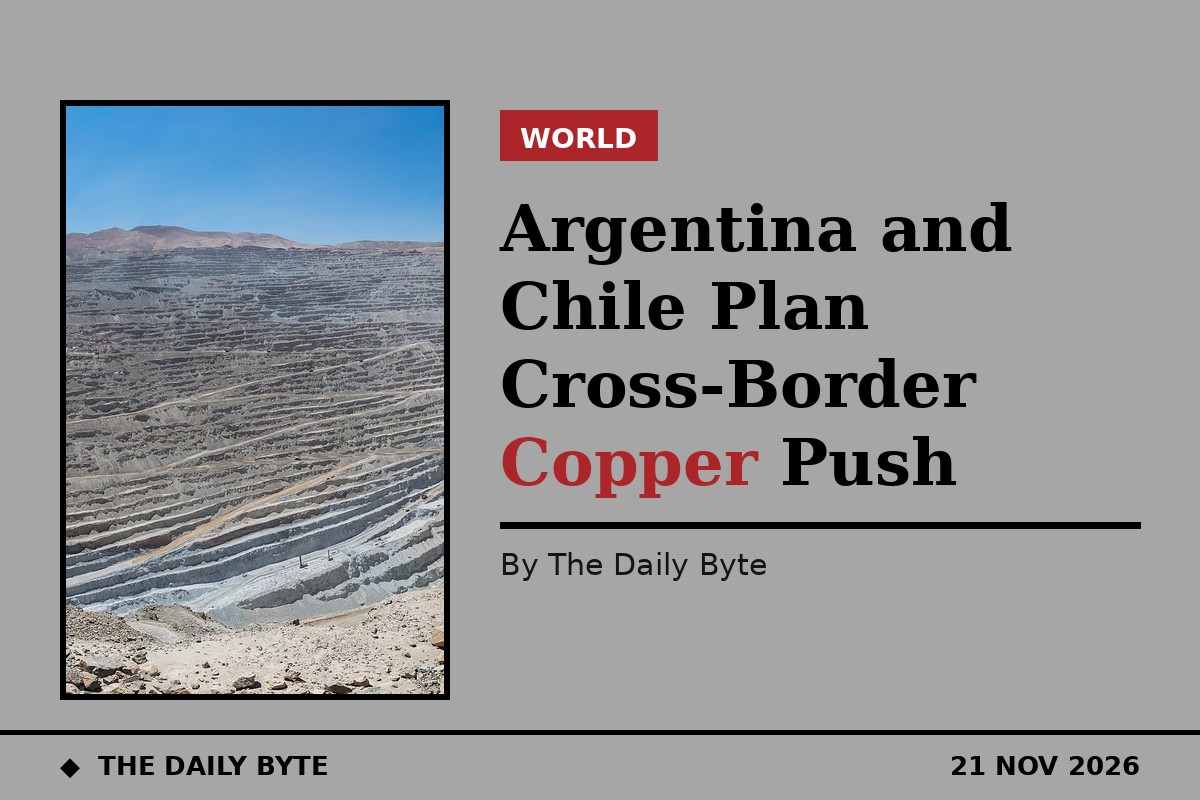
Mining companies are discussing cross-border partnerships to unlock Argentina’s largely untapped copper belt, looking to Chile’s ports, power, water and mining know-how to get huge deposits built. Chile’s Mining and Economy Minister, Daniel Mas, said his government was aware of talks between companies with projects and operations on opposite sides of the Andes about ways to integrate or work together. “It’s natural,” Mas said of the cooperation between companies. “The government wants to be a facilitator. We want the private sector to develop its ideas.”
The stakes are large. Some of the world’s biggest miners are preparing to invest a combined 40 billion dollars or more in Argentina’s copper belt, and Mas said the framework under discussion could unlock more than 20.7 billion dollars in investment and add 540,000 tons to annual copper production. MINING.COM reports that three major projects in San Juan Province sit at the centre of the plans: Vicuña, a cross-border project of BHP Group and Lundin Mining; El Pachón, owned by Glencore; and Los Azules, owned by McEwen Copper, which has a projected 22-year mine life with the potential to extend to 33 years.
Officials from both countries were due to hold fresh talks under the Mining Integration and Complementation Treaty, a 1997 agreement revived in July after decades of limited progress, as they look to advance a new generation of copper projects. Representatives of the three projects were scheduled to meet in Santiago at a mining integration seminar. Engineering News, reporting on the talks, said the renewed push had gained momentum under Argentina’s libertarian President Javier Milei and Chile’s conservative President Jose Antonio Kast, who took office in March, as both administrations seek to attract private investment.
Why Chile matters
Argentina has not produced copper since the Alumbrera mine closed in 2018, and it has no deep copper-mining industry of its own. Chile, by contrast, runs the world’s largest copper-producing industry. For investors, a key attraction is that Argentine projects near the Andes border could access Chilean ports and tap into infrastructure linked to that industry, reducing costs, shortening transport routes and helping to bring new mines online sooner.
Chile could provide power, water, ports and mining expertise to help develop those resources, Mas said. Vicuña has been cited as a project that could use Chilean ports as an export route, and it has said it plans to use desalinated water from the Pacific Ocean. Chilean officials travelled to San Juan earlier this year with mining companies and industry groups to discuss cross-border investment and logistics, while the two governments reactivated cooperation under the 1997 mining treaty.
A new source of copper for a hungry world
Unlocking those deposits would open an important new source of copper at a time when the global mining industry is struggling to keep pace with rising demand from power grids, electrification and data centres. Analysts say the pipeline of projects under development could place Argentina among the world’s 10 largest copper producers by 2030, alongside Chile, as part of a key supply hub for a metal critical to the energy transition.
President Milei has sought to overcome Argentina’s history of policy volatility and economic interventionism through his RIGI investment regime, which offers large projects tax and trade incentives as well as protections designed to reduce political risk. Still, miners committing billions of dollars to projects with multidecade lives must weigh whether the improved investment framework will endure under future governments.
Politics still in the way
Mas acknowledged that deeper cooperation also faces political obstacles. Using Chilean water and infrastructure, and shipping Argentine copper through Chile, raises sensitive questions, including over where taxes accrue. “It’s not so easy politically,” he said, adding that Chile is engaging with both Argentina’s federal and provincial governments to promote mining cooperation rather than competition.
Chile is also working with mining suppliers interested in expanding into Argentina, including by helping address practical issues such as moving personnel between the countries. Chile’s deputy mining minister, Alvaro Gonzalez, told Reuters there was no fixed timeline for implementing the measures under consideration by the two governments, so the tie-ups remain talks and plans rather than done deals. For now, the framework offers Argentina a route into copper production that it cannot build on its own, and Chile a bigger role in a metal the world needs more of every year.