Dak'Art Biennale Opens in Dakar With a Call for Repair
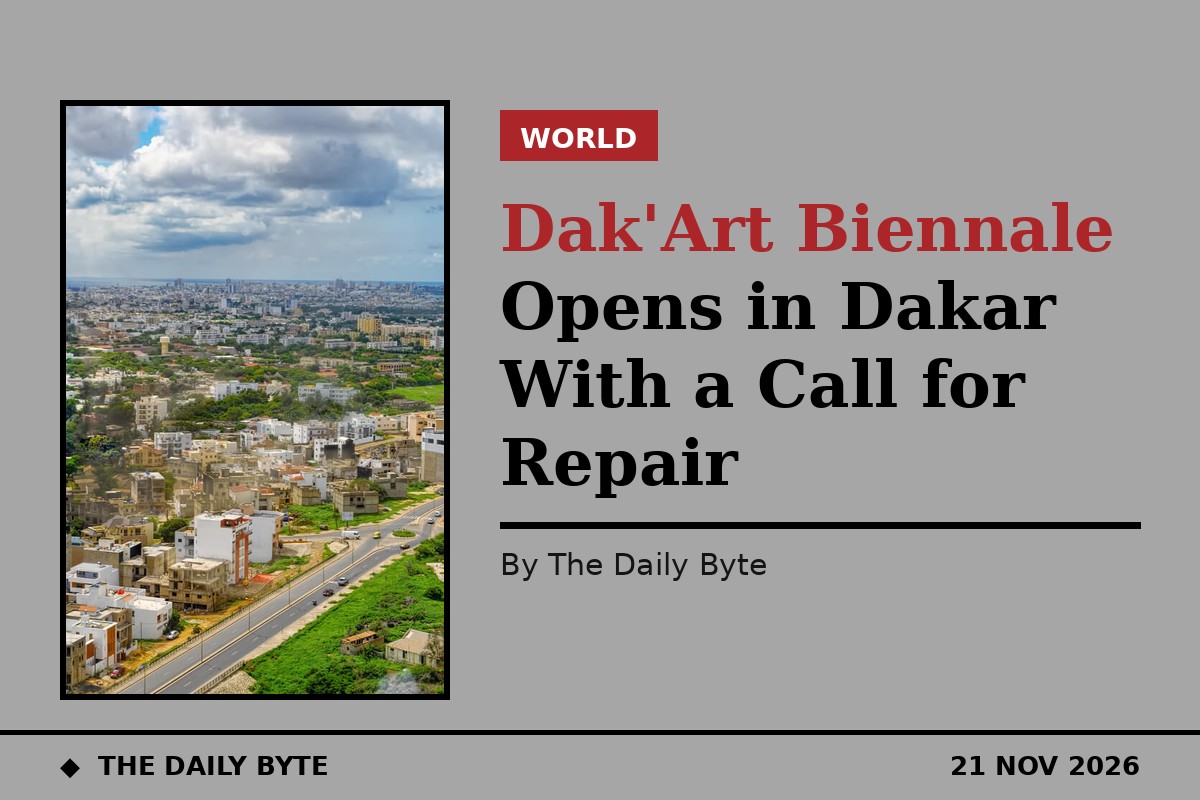
The 16th edition of the Dakar Biennale of Contemporary African Art, widely known as Dak’Art, officially opened in Senegal on 19 November 2026, bringing together artists, designers and cultural practitioners from across Africa and its diaspora for a month of exhibitions running until 19 December. This year’s edition explores how art can respond to fragility, conflict and uncertainty through practices of care, repair, resilience and collective imagination, according to Africans Column, with Sugarcane Magazine also reporting the opening.
Titled (Anti)fragility: Arts of Repair and Counter-Shock Strategies, the 2026 edition is led by artistic director Morad Montazami, an art historian, curator and publisher whose work has focused on modern and contemporary African, Arab and Asian art. He is joined by curators Madeleine de Colnet, Oulimata Gueye, Delphine Lopez and Fatima Bintou Rassoul Sy, while Youssouf Fofana oversees the Design Section. The official selection brings together 79 artists, designers and special invitees: 54 artists and collectives in the International Exhibition, 22 participants in the Design Section and three special invitations.
At the centre of the edition is the idea that fragility does not necessarily represent weakness. Instead, it can become a starting point for new forms of expression, knowledge and social organisation. The exhibition is organised around five thematic strands, described by the Biennale as its five lines of flight: Reverdir le Palais (Greening the Palace), on decolonial ecology and medicinal plant knowledge; Les arts du marronnage (The Arts of Marronnage), exploring escape, refuge and forms of resistance; Être et créer (Being and Creating), on art and therapy in the city; Partager les savoirs (Sharing Knowledge), centred on alternative ways of circulating knowledge; and Relier les continents (Connecting Continents), which considers dialogue between Africa and its diasporas.
The main exhibition at the former Palais de Justice
The International Exhibition, which opens to visitors on 20 November at the former Palais de Justice in Cap Manuel, brings together 54 artists and collectives. The selection reflects a broad geographical and generational range, with participants from across the African continent, the Caribbean and the wider diaspora. Among the artists representing Senegal are Aliou Diack, Ibrahima Cissé Déb’s, Serigne Ibrahima Dieye, Pape Diop, Mbaye Babacar Diouf, Eva Diallo, Carla Gueye, Cheikh Ndiaye, Ibrahima Niang Piniang and El Hadji Sy.
The wider selection includes Beninese artists Georges Adéagbo, Kolawolé Atcho, Mélinda Fourn and Dominique Zinkpè; Ghanaian participants Dela Anyah and the Studio Dialogues collective; Nigerian artists Victor Adewale, Kelechi Agwuncha and KESSWA, Onyeka Igwe and Linda Lamignan; and South African artists Lungiswa Gqunta, Alexandra Karakashian and Wezile Harmans. Kenyan, Sudanese and Ethiopian artists are also among the participants.
Design, national pavilions and a tribute
Alongside the International Exhibition, the Design Section, titled Les unités d’habitation Pan-Af (Pan-African Housing Units), brings together 22 designers, artists and studios. Curated by Fofana, it places design, material culture, craft and the built environment within the Biennale’s wider programme, spanning architecture, furniture, textiles, sculpture, product design and ceramics.
The Democratic Republic of the Congo is the guest country of honour for the 2026 edition. Its presentation, titled Quatrième temps: le temps comme matière vivante (Fourth Time: Time as Living Matter), is curated by Congolese artist Steve Bandoma. Senegal will also present a national pavilion titled La voix des temporalités inaudibles (The Voice of Unheard Temporalities), curated by Amadou Kane Sy. Another major component is Sunu Patrimoine: Trajectoires et mémoires des collections publiques du Sénégal 1960–2026, curated by Kalidou Kassé, which examines the development of Senegal’s public art collections since independence.
The Biennale’s special invitations include Moroccan artist and educator Faouzi Laatiris, named Grand Témoin, and Senegalese artist Serigne Mbaye Camara, who receives the Carte Blanche presentation. The edition will also honour the late Senegalese artist Abdoulaye Niokhor Bob, widely known as Ngoor, with a dedicated exhibition at the National Art Gallery titled La Sagesse de l’Épreuve, curated by Ndèye Rokhaya Guèye. That tribute exhibition is scheduled to open on 22 November, two days after the International Exhibition begins welcoming visitors.
The official exhibitions at the former Palais de Justice run from 20 November to 19 December, open daily from 10:00 to 19:00, with free admission except for invitation-only events. The National Art Gallery on Avenue Hassan II opens its Biennale presentation on 22 November, also operating from 10:00 to 19:00. Beyond the main venues, the OFF programme extends across Dakar and other regions of Senegal through exhibitions by galleries, institutions and independent spaces. The edition follows Dakar’s staging of the Youth Olympic Games, which ran until 13 November.