Army Delays Iowa Blast After Court Halts Toxic Detonation
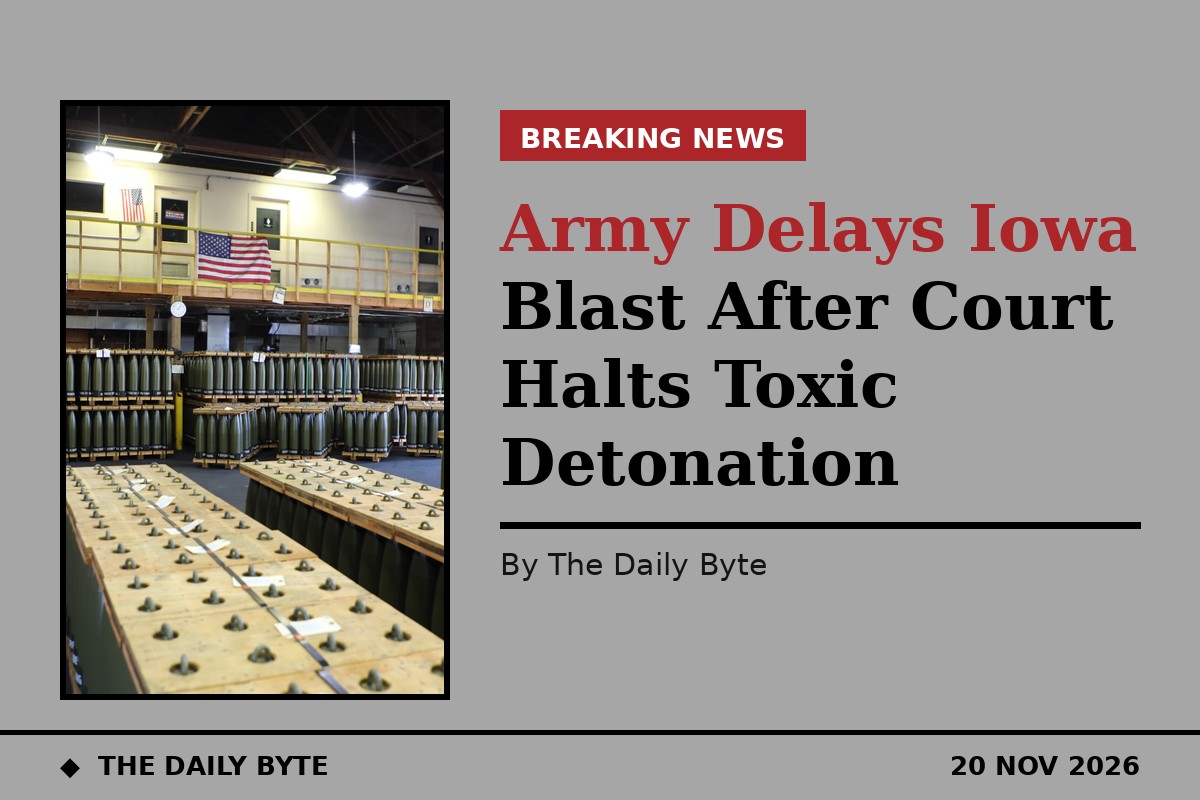
The United States Army has delayed the planned detonation of 68 barrels of unstable lead azide at the Iowa Army Ammunition Plant, pushing the operation from Friday 20 November to Monday 23 November, after an outpouring of public concern and a last-minute legal challenge. Hours after the delay was announced, a federal appeals court put the blast on hold altogether.
Adam Telle, the acting secretary of the Army, announced the postponement on the evening of Thursday 19 November, saying public safety was the Army's top priority. The delay moves the detonation to what he called the latest possible moment before a forecast drop in temperature, which the Army fears could further destabilise the material and risk an uncontrolled explosion.
The operation involves nearly 9,500 pounds of lead azide, a highly sensitive explosive used in blasting caps and detonators. Army officials said the material had been stored at the plant near Middletown in south-eastern Iowa for more than 20 years and had become too unstable to transport or process anywhere else, leaving an on-site detonation as the safest option. The degraded stockpile was discovered during an inspection in March 2026.
Fears of a toxic lead plume
The plan alarmed residents across south-eastern Iowa and north-western Illinois after Army air-dispersion modelling showed a plume of lead dust could extend close to 100 miles downwind, potentially reaching towns including Wapello in Iowa and New Boston in Illinois. People living in the Middletown City Park neighbourhood were advised to leave the area temporarily during the blasts, while other residents were told to stay indoors from 8am to 2pm or shelter at the Armed Forces Reserve Center.
Lead azide is a primary explosive, and the US Environmental Protection Agency, which issued an emergency permit for the detonation, warned that recrystallisation of the stored material had increased its sensitivity to friction and shock, so that disturbing the containers could create an unacceptable risk of unintentional detonation. The Army said the barrels would be detonated inside earth-covered concrete magazines surrounded by sand-filled Hesco barriers about two storeys high, with soil wetting and air sampling before and after the blasts.
Court steps in hours after the delay
The controversy intensified on 19 November when the Iowa Environmental Council and the Sierra Club asked the US Court of Appeals for the Eighth Circuit to halt the EPA permit, arguing that regulators had failed to weigh the health risks and alternative disposal methods properly. Late that evening the court issued a one-sentence order staying the permit while it considers the lawsuit. The order did not say how long the pause would last.
The plant, which makes medium- and large-calibre ammunition for the Department of Defense, has a troubled recent record. In 2023 inspectors found that workers had incorrectly detonated explosives, and in 2024 the EPA fined the Army and the plant's operator, American Ordnance, for alleged violations.
For now the timetable is uncertain. The Army says Monday is the latest it can safely wait before colder weather makes the stockpile more dangerous, but the court's stay means the blast cannot go ahead until the judges decide. Residents in the modelled impact area have been told to follow updates on the Army's website for revised forecasts and instructions.