ASEAN Summit Manila: 19 World Leaders to Attend
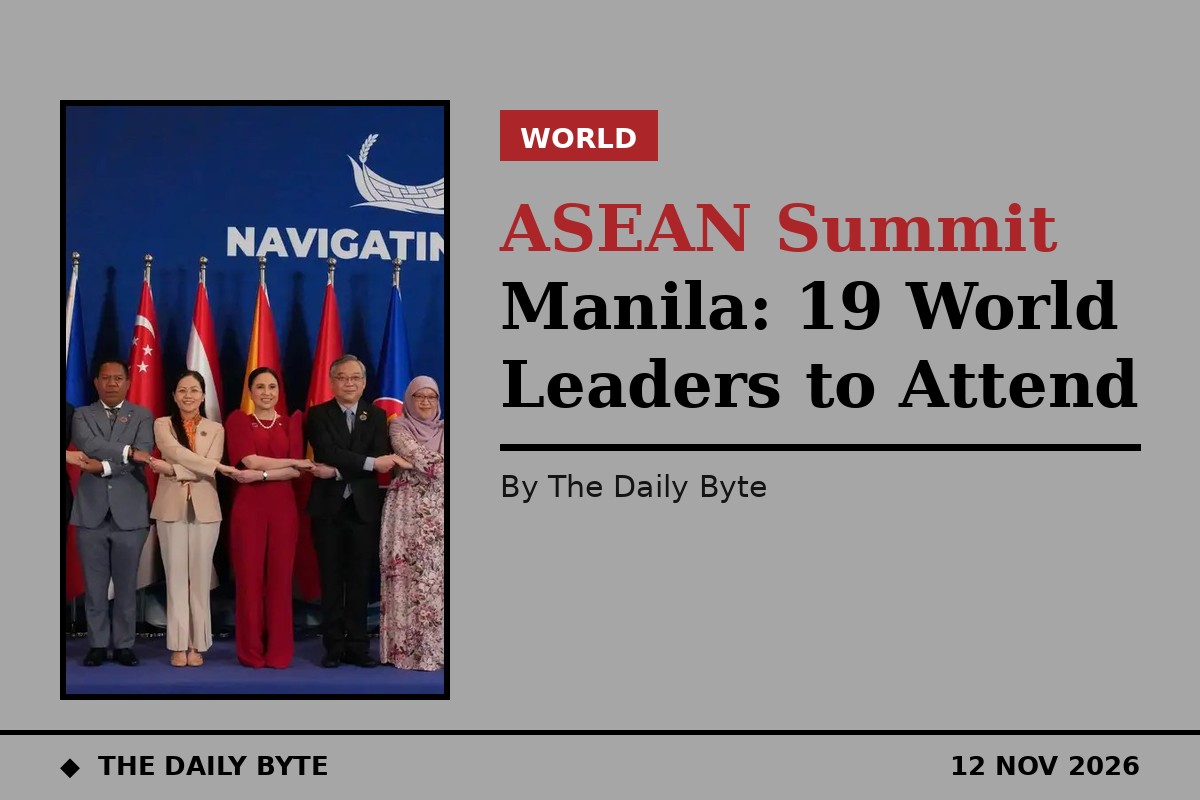
The Philippines will host at least 19 world and global institution leaders at the 49th ASEAN Summit and Related Summits in Manila this week, the Department of Foreign Affairs (DFA) said on Wednesday, 12 November.
The high-level engagements will begin on Sunday, 15 November, with the summit opening ceremony at the Philippine International Convention Center (PICC), followed by plenary and retreat sessions where ASEAN leaders will take stock of the Philippines' chairship achievements.
President Ferdinand R. Marcos Jr., who chairs the summit, will be joined by the leaders of Brunei Darussalam, Cambodia, Lao PDR, Indonesia, Malaysia, Singapore, Thailand, Timor-Leste and Viet Nam. Myanmar will be represented by the director-general of the ASEAN Affairs Department of its Foreign Ministry.
Who else is coming to Manila
The plenary will also feature remarks from Canadian Prime Minister Mark Carney, Brazil President Luiz Inacio Lula da Silva and International Monetary Fund Managing Director Kristalina Georgieva. The DFA said their participation highlights the value of ASEAN's engagement with key global partners in pushing for regional economic resilience, and is well aligned with the Philippines' chairship priorities, particularly under its Prosperity Corridors.
The Related Summits, or Plus One Summits, will follow on 16 to 17 November, and will be co-chaired by the leaders of Australia, China, India, Japan, New Zealand, Korea, Russia, the United Nations and the United States. New Zealand will be represented by its Deputy Prime Minister and Minister of Foreign Affairs, David Seymour, while Russia will be represented by Foreign Minister Sergey Lavrov.
Marcos will also convene the 29th ASEAN Plus Three Summit and the 21st East Asia Summit on 17 November, the main leaders-led forum for dialogue on strategic, political and economic issues in the region. He will later hand over the ASEAN chairship to Singapore. The day will end with the ASEAN-United States Special Summit, to be attended by US President Donald Trump.
A crowded agenda
On the expected agenda for the summit from 15 to 17 November are energy security, artificial intelligence and transboundary pollution, as well as concerns over Myanmar, Thai-Cambodian tension and South China Sea disputes, according to Reuters.
Energy security has become more urgent as the Middle East conflict threatens fuel supplies and prices. The Philippines has also made artificial intelligence a priority during its term as ASEAN chair.
ASEAN's five-point Myanmar peace plan has failed to halt fighting in the civil war-torn country. The Thailand-Cambodia ceasefire has held since December, but the border dispute remains unresolved. Transboundary haze has returned as a regional issue after months of Indonesian wildfires choked Singapore and Malaysia, while South China Sea tensions persist as the bloc negotiates a code of conduct with China amid confrontations at sea.
What ASEAN is
ASEAN was founded on 8 August 1967, when Indonesia, Malaysia, the Philippines, Singapore and Thailand signed the Bangkok Declaration, setting goals for economic and other types of cooperation and regional peace and stability. Brunei joined in 1984, Vietnam in 1995, Laos and Myanmar in 1997 and Cambodia in 1999. Timor-Leste became the 11th member in October 2025.
Its combined population of 693.2 million in 2025 accounts for 8.4 percent of the world's population. The bloc's combined output of 4.3 trillion dollars would rank it as the fifth-largest economy in the world if considered as a single unit, while ASEAN data shows goods trade stood at 4.4 trillion dollars.
Unlike the European Union, ASEAN has no body that can impose decisions on members. Its forums bring China, the United States, Russia, Japan and India to the same table, and it has built a network of free-trade pacts as well as the Regional Comprehensive Economic Partnership linking Southeast Asia with China, Japan, South Korea, Australia and New Zealand.
Economic crises have tested the bloc. The 1997-1998 Asian financial crisis exposed its vulnerability to cross-border shocks and helped spur cooperation with China, Japan and South Korea, including the Chiang Mai Initiative, now a 240-billion-dollar regional financial safety net. In 2026, it added a facility to provide rapid liquidity during sudden shocks such as natural disasters and pandemics.
As the Philippines brings together ASEAN leaders and dialogue partners from across the region and the wider international community, the country looks forward to engagements that will reinforce the value of dialogue, deepen partnerships and strengthen collective responses to shared challenges, the DFA said.
Sources: Philippine News Agency and Reuters.