Asian markets mixed as Nikkei, Kospi rise; Hang Seng falls
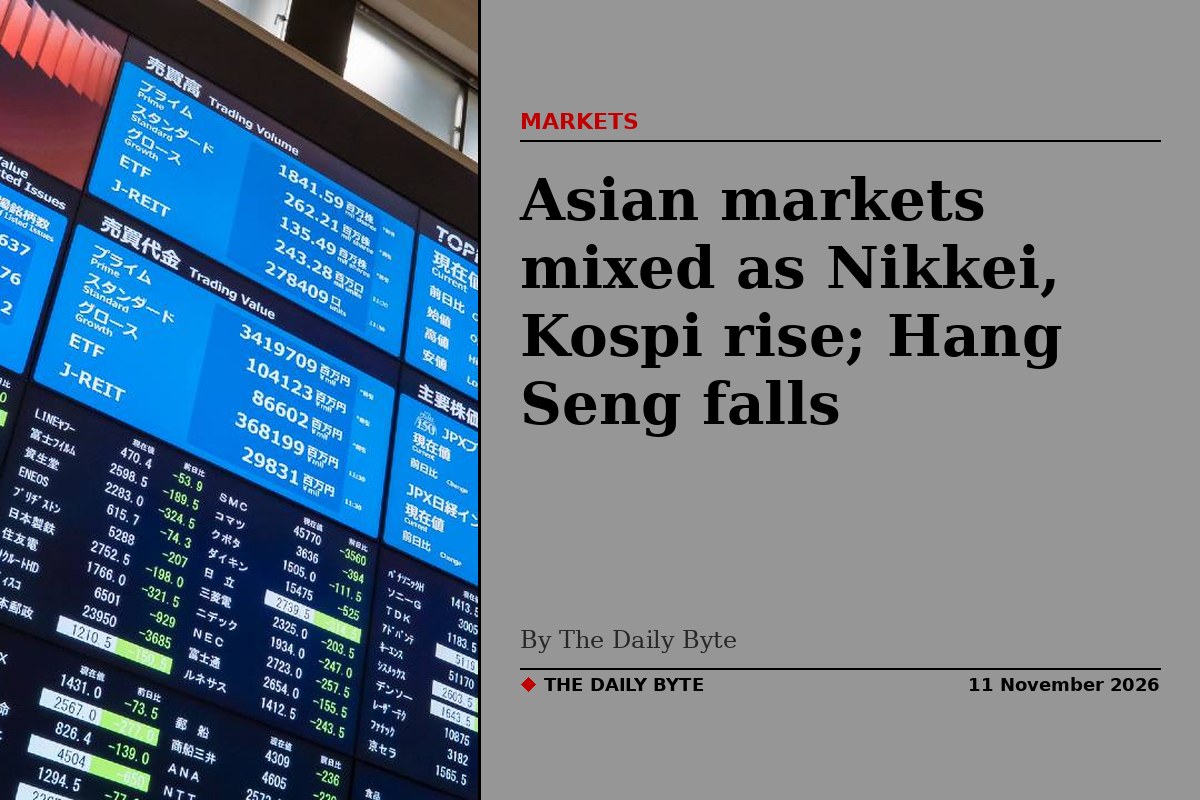
Asian markets were mixed in early trading on Wednesday, 11 November 2026, as gains in Japan and South Korea were offset by falls in Hong Kong and mainland China. The split followed a lower close on Wall Street, where hotter-than-expected United States inflation data strengthened expectations of a Federal Reserve interest rate rise in December.
Japan's Nikkei 225 stood at 60,886.95 in morning trade, up 0.7%, while the broader Topix was also 0.7% higher at 3,922.45. South Korea's Kospi rose 1.0% to 5,293.58. In contrast, Hong Kong's Hang Seng Index fell 0.8% to 24,360.12 and China's CSI 300 was down 0.5% at 4,038.55. Australia's S&P/ASX 200 was 0.1% lower, while Singapore's Straits Times Index rose 0.3%.
Nikkei and Kospi lead gains as chip stocks climb
Technology and semiconductor shares led the advance in Tokyo and Seoul. In Japan, chip equipment makers Tokyo Electron and Advantest each rose more than 2%. In South Korea, Samsung Electronics gained more than 1% and SK Hynix rose nearly 3%, lifting the Kospi to the top of the region's leaderboard.
Taiwan's market also benefited from the chip rally. Shares in Taiwan Semiconductor Manufacturing Co. (TSMC) rose 3% after the company's board approved investments of up to $1 billion in the US artificial intelligence firms Anthropic and OpenAI, including up to $500 million in Anthropic shares at its initial public offering price and $500 million in OpenAI preferred stock.
SoftBank Group was the main drag in Tokyo, with its shares down more than 3% after the company reported a net loss of $7 billion for the September quarter, weighed down by losses on power equipment ordered for US artificial intelligence data centres.
Hong Kong and China fall as tech shares slide
Hong Kong moved in the opposite direction, with the Hang Seng TECH Index down more than 1%. Heavyweights HSBC, Alibaba and Tencent each fell more than 1%. In mainland China, CSI 300 heavyweights Kweichow Moutai and Contemporary Amperex Technology were each down more than 1%, although Zhongji Innolight rose more than 6%.
Government bond yields rose across the region, with the yield on the 10-year Japanese government bond up 6 basis points and the 30-year yield up 3 basis points, as investors repriced the chances of higher US interest rates.
India surges after Diwali as foreign investors buy
Indian markets reopened sharply higher after closing on Tuesday for Diwali Balipratipada. The Sensex gained 1,166.54 points, or 1.44%, to 82,273.19 in early trade, while the Nifty 50 rose 307.80 points, or 1.23%, to 25,352.45, crossing 25,350 for the first time in the session.
The rally was powered by foreign institutional investors, who have bought Indian shares worth 53,170 crore rupees so far in November, including net purchases of 7,212 crore rupees on Monday alone. The Nifty 50 has risen 8.6% in six trading sessions this month. A sharp fall in crude oil prices also helped, with Brent crude trading near $92 a barrel and US West Texas Intermediate near $86 a barrel.
Hot US inflation sets the tone
Wall Street closed lower on Tuesday after US consumer prices rose 0.4% in October, above the 0.3% increase economists had expected. Core inflation, which excludes food and energy, rose 0.3%, against a forecast of 0.2%. The Dow Jones Industrial Average fell 0.3% to 52,231.89, the S&P 500 lost 0.4% to 7,520.93 and the Nasdaq Composite fell 0.7% to 25,065.87.
The yield on the benchmark 10-year US Treasury note rose 10 basis points to nearly 5% after the data. Traders now see a more than 90% chance of a 25 basis point Federal Reserve rate rise at its December meeting, according to the CME FedWatch tool, after Fed Governor Christopher Waller said a rate rise was likely. Nvidia fell more than 5% and was the biggest drag on the major indices.
What to watch next
Investors in Asia will watch whether Japan and South Korea can hold their early gains into the close, and whether Hong Kong's technology slide deepens. US producer price data due on Friday and earnings from Cisco and Applied Materials later in the week are the next tests for the technology rally.
Frequently asked questions
Why did Asian markets move in different directions? Japan and South Korea rose because chip and artificial intelligence shares rebounded, while Hong Kong and China fell as technology stocks there came under pressure and investors worried about higher US interest rates.
What did the US inflation data show? US consumer prices rose 0.4% in October, above the 0.3% economists expected, while core prices rose 0.3%. The figures pushed US Treasury yields higher and increased bets on a December rate rise.