Asian Markets Slide as Kospi Falls 3.3% on Chip Rout
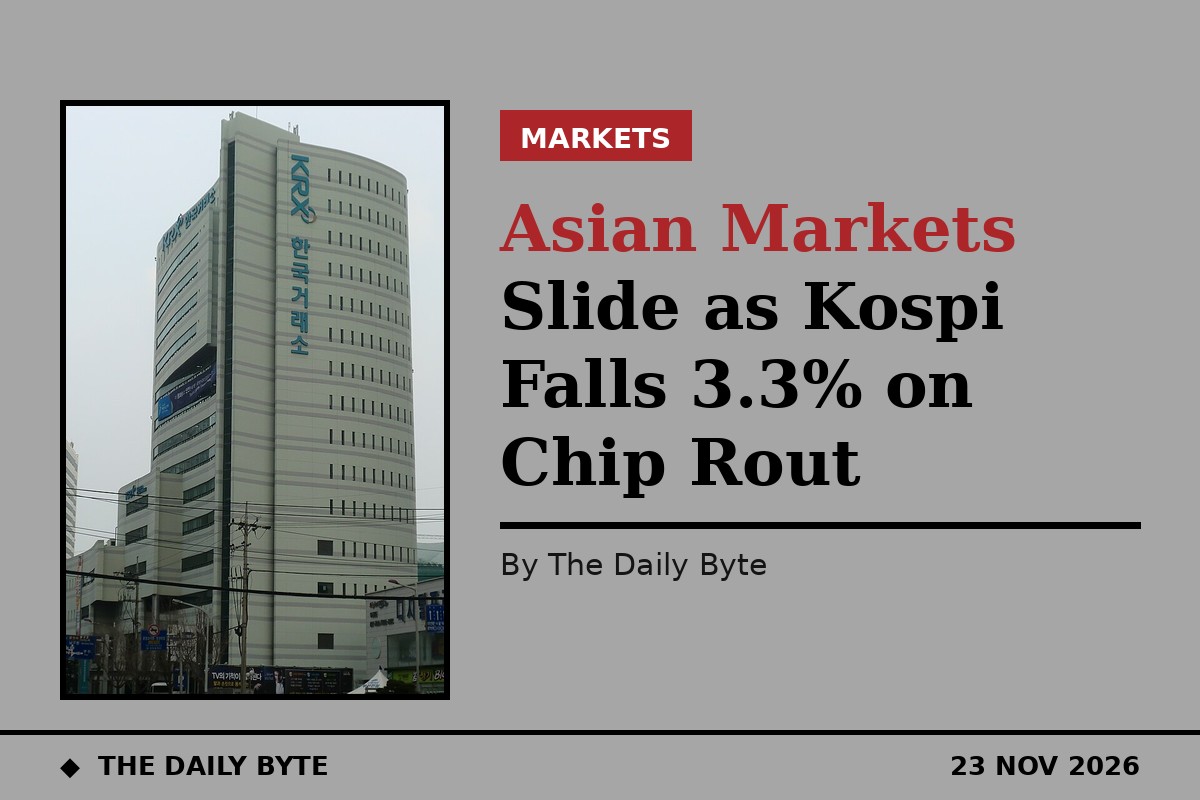
Asian stock markets struggled to recover on Monday, 23 November 2026, with technology shares again in the firing line as investors tracked a heavy sell-off on Wall Street. South Korea's Kospi index closed down 3.3 percent, Hong Kong finished slightly lower, and only a few markets in the region managed gains, even as United States stock futures pointed to a rebound.
Seoul led the losses. The Kospi closed down 3.3 percent at 4,708.54, according to AFP, after falling more than 5 percent at one point during the session. Hong Kong's Hang Seng Index finished down 0.1 percent at 22,383.74, while Shanghai's Composite index rose 0.2 percent to 3,538.95. Tokyo was closed for a public holiday, Labour Thanksgiving Day, leaving Japan's Nikkei 225 on Friday's close of 56,436.65, down 5.06 percent.
Seoul leads the losses again
Chipmakers were at the centre of the selling in Seoul. Samsung Electronics fell 3.06 percent and SK Hynix dropped 2.52 percent on Monday, extending a slide that had already cut the Kospi by 5.21 percent on Friday to 4,869.96. The two companies are among the most important suppliers of memory chips for the artificial intelligence boom, and their continued weakness suggested investors were still more interested in reducing exposure than in buying the dip.
Stephen Innes of SPI Asset Management said the two chipmakers were not peripheral players in the AI boom but two of its most important semiconductor suppliers, adding that their continued weakness suggested investors were still more interested in reducing exposure than in celebrating a few hours of improved sentiment in United States futures.
South Korea's authorities have been preparing a response. The government has pledged to deploy market stabilisation funds, a tool not used since the global financial crisis, but the promise failed to steady semiconductor shares on Monday, according to SmartXSignals.
Taiwan rallies as others fall
Not every market in the region fell. Taiwan's main index ended more than 2 percent higher, helped by gains in TSMC and MediaTek, after the island's Financial Supervisory Commission banned short selling below the previous day's close across the board from 23 November. China also made it easier to borrow money to buy shares, and Shanghai, Manila and Jakarta all advanced.
Elsewhere the picture was weaker. Sydney, Singapore, Wellington, Mumbai and Bangkok all dropped, while London, Paris and Frankfurt opened higher. Australia's ASX 200 closed down 0.3 percent, its eighth straight loss.
Why chip stocks are under pressure
The selling continued a rout that began on Wall Street last week. On Friday the Nasdaq Composite fell 5.28 percent to 22,617.73 and the S&P 500 dropped 3.7 percent to 6,910.39, closing below 7,000 for the first time since mid-April, while the Dow Jones Industrial Average shed 1.9 percent to 48,147.33.
Nvidia, the chip giant at the heart of the AI trade, plunged 14 percent on Friday, helping to drag the Nasdaq into negative territory for the year. The index has lost almost a fifth of its value since hitting a record high just last month, and strong earnings from Nvidia and a blockbuster stock market debut from Anthropic, the maker of the Claude assistant, were unable to stop the slide.
Traders have been spooked by growing scrutiny of AI capital spending, the scale of the investment, the returns on it and when they might materialise, Fiona Cincotta at Forex.com said. The United States Commerce Department has also moved to close a loophole that allowed Chinese companies to access Nvidia's powerful AI chips remotely, adding to the pressure on Asian chipmakers.
The CBOE Volatility Index, Wall Street's fear gauge, spiked to its highest level since April 2025, when the United States unveiled wide-ranging tariffs. Oil also slipped, with West Texas Intermediate down 0.5 percent at $83.03 a barrel and Brent North Sea crude down 0.5 percent at $92.07 a barrel.
What happens next
United States futures offered some hope on Monday morning. Nasdaq 100 futures had rallied almost 3 percent in early trade and S&P 500 futures were about 2 percent higher, and United States markets later surged as the session went on. But Asian trading had mostly finished before that rebound, and the region's markets will get their first chance to respond to it on Tuesday, when Tokyo reopens after its holiday.
The week ahead is shortened in the United States, with markets closed on Thursday for Thanksgiving. For Asian investors, the questions behind the sell-off remain: whether AI spending can be justified, whether chip demand holds up, and whether government support in Seoul and Taipei can steady markets that have fallen hard in days.