Bank of England's Pill says act now on rates
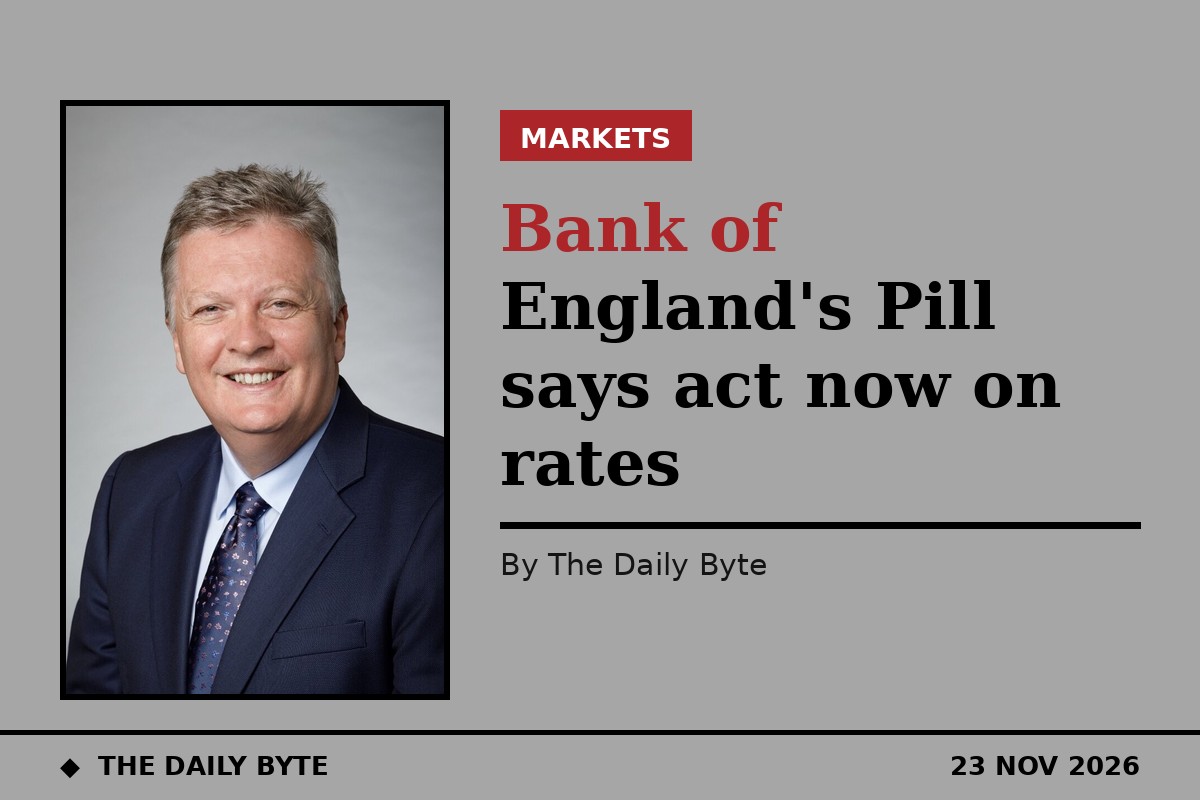
Bank of England chief economist Huw Pill said on Monday, 23 November 2026, that interest rates need to rise again now if the Bank is to keep inflation under control and hold on to the public's trust that prices will return to target. Speaking at a conference in Vienna, he warned that the Bank could not take its hard-won credibility for granted.
'To maintain that medium-term price stability, meet the inflation target on a lasting basis at longer-term horizons, I think we do need to take action now,' Pill said at an Austrian central bank conference on European economic integration, according to Reuters. He pointed out that inflation has been below the Bank's 2% target in only three of the last 62 months.
Markets already expect a December rise
Traders are already betting heavily on another increase. Money markets were pricing around an 84% chance of a 25-basis-point rise at the Bank's December meeting, with at least three such increases priced in by July 2027, according to FXStreet, citing Prime Terminal data. A separate Reuters market report put the chance of a December rise at about 83%.
The Bank raised its benchmark rate by 25 basis points to 4% earlier this month, its first increase of the year, after inflation climbed to 3.6% in October, a one-year high. The next decision is due on 17 December.
The November decision was not unanimous. The Monetary Policy Committee voted 8 to 1 to raise Bank Rate to 4%, according to the Bank's published minutes, with one member backing a larger half-point increase. Pill himself has argued for weeks that a single quarter-point rise would not be enough on its own.
Growth cools but prices stay high
Pill's warning came on the same day fresh surveys showed Britain's private sector growing more slowly. The S&P Global composite purchasing managers' index slipped to 52.3 in November from October's eight-month high of 52.9, landing just below economists' expectations, Reuters reported. A reading above 50 still signals growth.
Ashley Webb, senior UK economist at Capital Economics, said the fall 'suggests that the recent resilience of the economy is fading in Q4. But with price pressures remaining elevated, this is unlikely to prevent the Bank of England from raising interest rates for a second time in a row in December,' Reuters reported. Weaker foreign demand for services and softer housing-related demand were largely offset by spending linked to the build-out of artificial intelligence capacity.
The pound's muted response
Sterling barely moved on the news. The pound was last 0.1% firmer at $1.3096 after rising as high as $1.3144 earlier in the session, Reuters reported. It has fallen against the dollar for three straight weeks and is down by more than 2% so far this month. Against the euro it nudged 0.1% higher to 83.7 pence per euro.
The muted reaction reflects how much tightening traders have already priced in. With a December rise seen as near-certain, the pound needs stronger data to rally further, market commentary noted, and softer surveys can shift expectations towards fewer future increases, which usually pulls down short-dated gilt yields.
What to watch next
The next test comes on 17 December, when the Monetary Policy Committee announces its decision. Before then, investors will watch fresh inflation and jobs data, plus speeches from other Bank officials, for any sign the committee is split. Policymaker Megan Greene speaks on Tuesday.
If Pill's view carries the day, borrowers should expect another quarter-point rise before Christmas, with more to follow in 2027. The question for households and businesses is not whether rates rise again, but how far the Bank is prepared to go to bring inflation back to 2%.