Australia Watchdog Urges Religion Cut From Terror Law
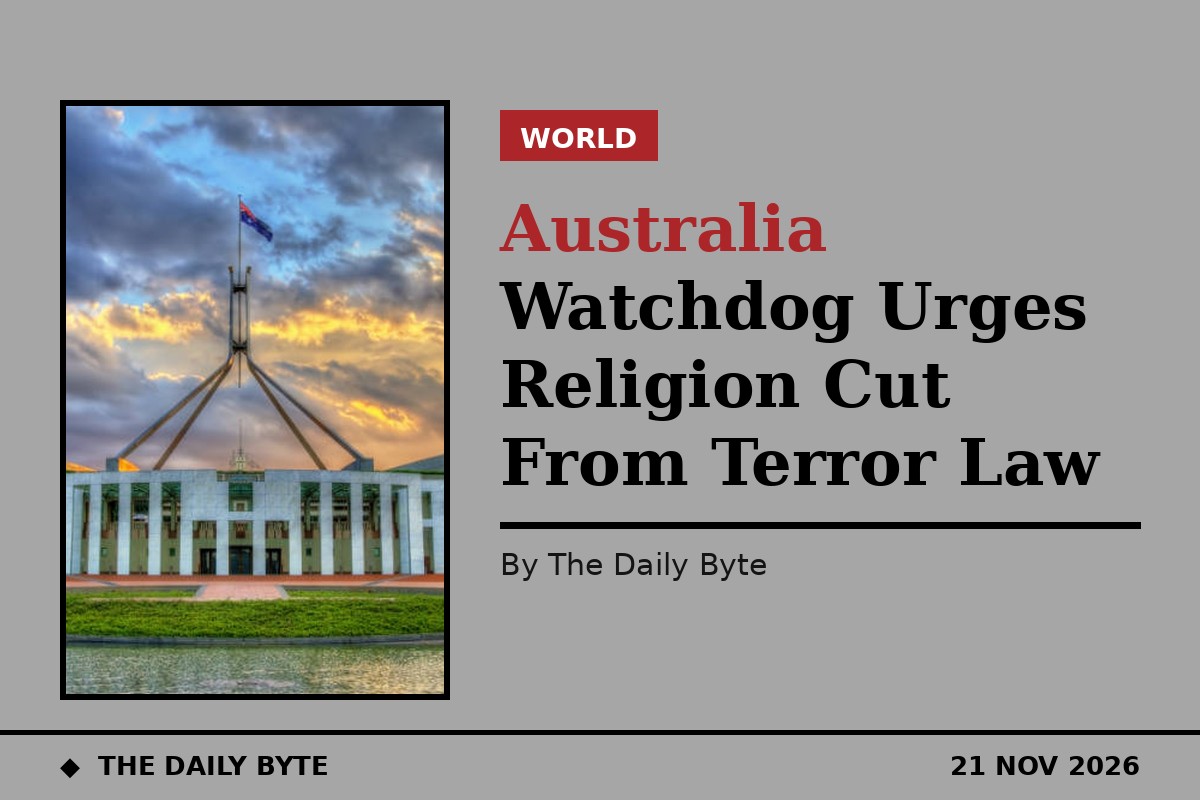
Australia's national security watchdog has urged the government to strip religion from the country's legal definition of terrorism, arguing the 24-year-old wording hands violent extremists a credibility they do not deserve and leaves ordinary believers under suspicion.
The Independent National Security Legislation Monitor, Jake Blight, made the call in a 400-page report on the definition of a terrorist act, which the Attorney-General formally presented to Parliament on 19 November. The report contains seven recommendations.
Under section 100.1 of the federal Criminal Code, prosecutors must prove an act was intended to cause serious harm in order to advance a political, religious or ideological cause. Blight wants the word religious removed from that list and folded into a broader, newly defined category of ideology.
What the watchdog wants changed
Under the proposal, ideology would be defined in law as a set of beliefs or ideas, which may or may not be coherent, about how the world or society is, or should be, understood. Motives linked to nationalism, politics, faith, philosophy or the superiority of one group over another would be named as examples within it.
"Requiring proof that an act was intended to advance a religious cause glorifies and gives false credibility to offenders and stigmatises religious communities," a summary of the report states. It adds that those claiming to act for a religious cause would still be able to be prosecuted effectively under the wider definition.
Blight told the Sydney Morning Herald that groups such as Islamic State wanted to be seen as religious warriors doing holy work. "I don't think we should give them that credibility," he said.
The conviction gap behind the call
The report found that since the current definition was introduced in 2002, after the September 11 attacks in the United States, prosecutions for violence driven by racist, nationalist and other ideologies have ended in conviction only about half the time, compared with 84 per cent for violent acts linked to Islamic State.
So-called other ideologies now account for around a third of the caseload of the Australian Security Intelligence Organisation and the Australian Federal Police, and at least five of the nine people charged with terrorism offences in the first seven months of this year, the report found.
He argued a single, defined test of ideology would make it easier to frame prosecutions and give juries, judges and police a common standard, including for offenders who mix beliefs from different traditions.
Government and agencies push back
Attorney-General Michelle Rowland said the government would consider the findings and provide a formal response. "The government is committed to ensuring the definition of terrorism is sufficiently broad to respond to current and future threats," she said.
But the security agencies that would apply any new definition have resisted the change. ASIO argued for keeping the current wording, warning that obscuring motivations could risk effective interventions, and noted that 13 of the 16 terrorist attacks Australia has experienced since 2014 were religiously motivated. The Australian Federal Police said the existing definition was clear, had been well tested in Australian courts over many years, and aligned with the definitions used by key international law enforcement partners. Home Affairs Minister Tony Burke said earlier this year he was comfortable with the current definition.
Community reaction split along similar lines. Eleven Muslim advocacy and community groups, including the Australian Muslim Advocacy Network, welcomed the recommendations and urged the government to amend the law. Aftab Malik, Australia's special envoy to combat Islamophobia, told the review that keeping religion as a terrorism motivation had created a climate of suspicion around Muslims. The Executive Council of Australian Jewry described the report as high quality but opposed removing religion as a motivating factor.
Other recommendations in the report
Beyond the definition itself, the monitor recommended that making a bomb threat should no longer be able to result in life imprisonment, and reported that around half of those currently under investigation for terrorism offences in Australia are children. On that point it recommended more work to understand what drives children towards radicalisation, to identify interventions that could help them, and to ensure they have appropriate legal protections.
The review also noted that a United Nations special rapporteur earlier in 2026 recommended defining terrorist acts by their political and ideological causes and leaving out religious motives, on the grounds that references to religion have discriminatory and stigmatising effects.
The report was released as debate over the definition intensified in Canberra. Its release coincided with police raids in Sydney on Friday in which a man was charged with terrorism offences. Any change to the law would require the government to act: recommendations of this kind do not change the Criminal Code on their own, and the government's formal response has not yet been set out.